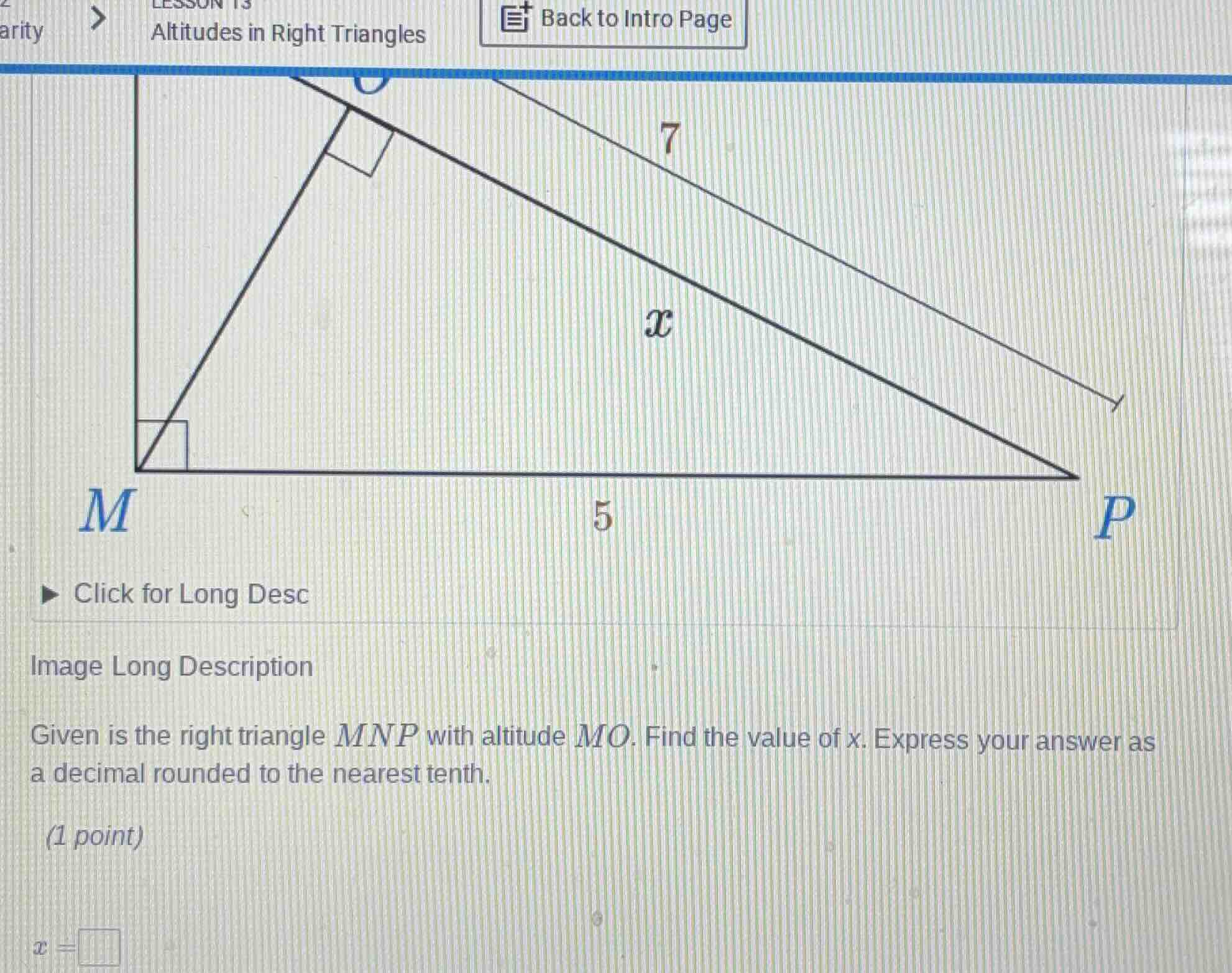
Step1: Recall the geometric mean theorem (altitude-on-hypotenuse theorem) for right triangles. In a right triangle, the length of a leg is the geometric mean of the length of the hypotenuse segment adjacent to that leg and the length of the entire hypotenuse. Wait, actually, more precisely, if we have a right triangle with an altitude drawn to the hypotenuse, then each leg is the geometric mean of the hypotenuse and the segment of the hypotenuse adjacent to that leg. Wait, let's clarify the triangle here. Triangle \( MNP \) is a right triangle with right angle at \( M \), and \( MO \) is the altitude to the hypotenuse \( NP \)? Wait, no, looking at the diagram, \( M \) is a right angle, \( MO \) is an altitude, so maybe the hypotenuse is \( NP \), and the legs are \( MP = 5 \) and \( MN \) (unknown), and the altitude is \( MO \), with the segment of the hypotenuse adjacent to \( P \) being 7? Wait, maybe I got the segments wrong. Let's re-express: In a right triangle, when an altitude is drawn from the right angle to the hypotenuse, it creates two smaller similar triangles, each similar to the original triangle and to each other. So, if we have right triangle \( MNP \) with right angle at \( M \), and altitude \( MO \) (where \( O \) is on \( NP \)), then \( \triangle MNP \sim \triangle PMO \sim \triangle MNO \). Therefore, the ratio of corresponding sides should be equal. So, the leg \( MP \) (length 5) is a leg of the original triangle, and the segment of the hypotenuse adjacent to \( P \) is 7? Wait, no, maybe the hypotenuse segments: Let's denote the hypotenuse \( NP \) as having segments \( NO \) and \( OP \), with \( OP = 7 \) and \( MP = 5 \), \( MO \) is the altitude, and we need to find \( x \) (which is \( MN \) or \( MP \)? Wait, the diagram shows \( MP = 5 \), \( OP = 7 \), and \( x \) is the length of \( MN \)? Wait, no, looking at the labels: \( M \) is at the right angle, \( P \) is the other end of the horizontal leg (length 5), and the slant leg from \( M \) to \( P \)'s opposite vertex? Wait, maybe the correct application is: In a right triangle, the square of a leg is equal to the product of the hypotenuse and the adjacent segment. Wait, let's use the geometric mean formula: If in right triangle \( ABC \), right-angled at \( C \), and altitude \( CD \) to hypotenuse \( AB \), then \( AC^2 = AD \times AB \), \( BC^2 = BD \times AB \), and \( CD^2 = AD \times BD \). So applying that here: Let's assume that \( M \) is the right angle, \( MP = 5 \) (one leg), \( x \) is the other leg ( \( MN \) ), and the hypotenuse segment adjacent to \( P \) is 7 (so \( OP = 7 \), and the entire hypotenuse \( NP = NO + OP \), but maybe we have \( MP^2 = OP \times NP \)? Wait, no, maybe I mixed up the segments. Wait, the problem is: Right triangle \( MNP \), right angle at \( M \), altitude \( MO \) (so \( O \) is on \( NP \)), \( MP = 5 \), \( OP = 7 \), find \( x \) (which is \( MN \) or \( MP \)? Wait, the diagram shows \( x \) as the length from \( M \) to \( P \)'s opposite vertex? Wait, no, looking at the diagram, \( x \) is the length of the leg from \( M \) to the vertex above, and \( MP = 5 \), \( OP = 7 \). Wait, maybe the correct formula is that the leg \( MP \) (length 5) is the geometric mean of \( OP \) (length 7) and \( NP \)? No, that doesn't make sense. Wait, let's re-express the triangle: Let’s denote the right triangle as \( \triangle MNP \) with \( \angle M = 90^\circ \), altitude \( MO \) to hypotenuse \( NP \), so \( O \) is on \( NP \). Then, by the geometric mean theorem, \( MP^2 = OP \times NP \)? No, wait, no: the leg is the geometric mean of the hypotenuse and the adjacent segment. Wait, actually, the correct formula is: In a right triangle, the square of a leg is equal to the product of the hypotenuse and the segment of the hypotenuse adjacent to that leg. So, if \( MP \) is a leg, and the segment of the hypotenuse adjacent to \( P \) is \( OP \), then \( MP^2 = OP \times NP \). But we don't know \( NP \). Wait, maybe the other leg: Let's say \( x \) is the other leg ( \( MN \) ), and the segment adjacent to \( N \) is, say, \( NO \), but we don't know that. Wait, maybe the problem is that \( MP = 5 \), \( OP = 7 \), and we need to find \( x \) (the length of \( MN \))? Wait, no, maybe \( x \) is the length of the hypotenuse segment? Wait, no, the problem says "Find the value of \( x \)". Let's look again: The diagram has \( M \) at the right angle, \( MP = 5 \) (horizontal leg), \( OP = 7 \) (segment of the hypotenuse), and \( x \) is the length of the other leg (vertical leg) or the hypotenuse? Wait, no, the geometric mean theorem: If we have a right triangle, and we draw an altitude from the right angle to the hypotenuse, then each leg is the geometric mean of the hypotenuse and the adjacent segment. Wait, maybe I got the segments reversed. Let's suppose that \( MP \) is a leg, and the hypotenuse segment adjacent to \( P \) is 7, so \( MP^2 = 7 \times (7 + y) \), where \( y \) is the other hypotenuse segment, but we also have the other leg \( 5 \), so \( 5^2 = y \times (7 + y) \)? No, that can't be. Wait, maybe the correct approach is: The two legs are \( 5 \) and \( x \), and the hypotenuse is divided into segments \( 7 \) and \( y \). Then, by the geometric mean theorem: \( 5^2 = y \times (7 + y) \) and \( x^2 = 7 \times (7 + y) \), and also \( x^2 + 5^2 = (7 + y)^2 \). But that seems complicated. Wait, maybe the diagram is such that \( MP = 5 \) (one leg), \( x \) is the other leg, and the altitude creates a segment of length 7 on the hypotenuse adjacent to the vertex opposite \( M \). Wait, no, let's use the formula correctly. The geometric mean theorem states that in a right triangle, the length of a leg is the geometric mean of the length of the hypotenuse and the length of the segment of the hypotenuse adjacent to that leg. So, if we have leg \( a \), hypotenuse \( c \), and adjacent segment \( d \), then \( a^2 = c \times d \). Wait, maybe in this problem, the leg is \( 5 \), the adjacent segment is \( 7 \), and we need to find the hypotenuse? No, that would be \( 5^2 = 7 \times c \), so \( c = 25/7 \approx 3.57 \), which doesn't make sense. Wait, maybe I have the segments reversed. Let's assume that \( x \) is the leg, and the adjacent segment is \( 5 \), and the other segment is \( 7 \). Then \( x^2 = 5 \times (5 + 7) = 5 \times 12 = 60 \), so \( x = \sqrt{60} \approx 7.7 \). Wait, that makes sense. Wait, no, let's re-express: If the right triangle has legs \( 5 \) and \( x \), and the hypotenuse is divided into segments \( 5 \) and \( 7 \)? No, the diagram shows \( MP = 5 \) (horizontal), \( OP = 7 \) (slant segment), and \( x \) is the other leg. Wait, maybe the correct formula is that the leg \( x \) is the geometric mean of the hypotenuse segment \( 7 \) and the entire hypotenuse, but no. Wait, let's look at the problem again: "Given is the right triangle \( MNP \) with altitude \( MO \). Find the value of \( x \)." So, \( MNP \) is right-angled, \( MO \) is altitude, \( MP = 5 \), \( OP = 7 \), find \( x \). So, applying the geometric mean theorem: In right triangle \( MNP \), right-angled at \( M \), altitude \( MO \) to hypotenuse \( NP \), so \( \triangle MPO \sim \triangle NPM \). Therefore, the ratio of corresponding sides: \( \frac{MP}{NP} = \frac{OP}{MP} \). Wait, \( MP = 5 \), \( OP = 7 \), \( NP = NO + OP \), but we don't know \( NO \). Wait, no, maybe \( \triangle MPO \sim \triangle MNP \), so \( \frac{MP}{MN} = \frac{OP}{MP} \)? No, that's not right. Wait, similarity: \( \triangle MPO \sim \triangle NMP \), so corresponding sides: \( MP \) corresponds to \( NM \), \( OP \) corresponds to \( MP \), and \( MO \) corresponds to \( NP \). Wait, no, let's label the triangle: Right angle at \( M \), so vertices \( M \) (right angle), \( N \) (top), \( P \) (right). Altitude \( MO \) from \( M \) to hypotenuse \( NP \), so \( O \) is on \( NP \). Then, \( \triangle MNP \sim \triangle PMO \sim \triangle MNO \). Therefore, \( \frac{MP}{NP} = \frac{OP}{MP} \), so \( MP^2 = OP \times NP \). Wait, \( MP = 5 \), \( OP = 7 \), so \( 5^2 = 7 \times NP \), so \( NP = 25/7 \approx 3.57 \), which is less than \( OP = 7 \), which is impossible. So I must have the segments reversed. Ah! Maybe \( MP = 5 \) is not the leg but the hypotenuse segment? No, the diagram shows \( MP \) as a horizontal leg with length 5. Wait, maybe the altitude is drawn to the leg? No, the problem says "altitudes in right triangles", so altitude to the hypotenuse. Wait, maybe the correct segments are: The leg is \( x \), the other leg is \( 5 \), and the hypotenuse is divided into segments \( 7 \) and \( y \). Then, by the geometric mean theorem: \( x^2 = 7 \times (7 + y) \) and \( 5^2 = y \times (7 + y) \). Then, dividing the two equations: \( \frac{x^2}{25} = \frac{7}{y} \), so \( x^2 y = 175 \). Also, from \( 5^2 = y(7 + y) \), we have \( y^2 + 7y - 25 = 0 \). Solving this quadratic: \( y = \frac{-7 \pm \sqrt{49 + 100}}{2} = \frac{-7 \pm \sqrt{149}}{2} \). Taking the positive root: \( y = \frac{-7 + \sqrt{149}}{2} \approx \frac{-7 + 12.20655}{2} \approx 2.603 \). Then, \( x^2 = 7 \times (7 + 2.603) \approx 7 \times 9.603 \approx 67.221 \), so \( x \approx \sqrt{67.221} \approx 8.2 \). Wait, but that doesn't seem right. Wait, maybe I made a mistake in the segment labels. Let's try another approach. The problem is likely using the geometric mean where one leg is \( 5 \), the hypotenuse segment adjacent to that leg is \( 7 \), so the other leg \( x \) is calculated as \( x = \sqrt{5 \times (5 + 7)} \)? No, that's not the formula. Wait, no, the correct formula is that each leg is the geometric mean of the hypotenuse and the adjacent segment. So if the hypotenuse is \( c \), and the segment adjacent to leg \( a \) is \( d \), then \( a^2 = c \times d \). So if we have leg \( 5 \), adjacent segment \( d \), and leg \( x \), adjacent segment \( 7 \), then \( 5^2 = d \times c \), \( x^2 = 7 \times c \), and \( c = d + 7 \). Then, substituting \( c = d + 7 \) into \( 5^2 = d(d + 7) \), we get \( 25 = d^2 + 7d \), so \( d^2 + 7d - 25 = 0 \), which is the same quadratic as before. Then, \( x^2 = 7(d + 7) = 7d + 49 \). From \( 25 = d^2 + 7d \), we have \( 7d = 25 - d^2 \), so \( x^2 = 25 - d^2 + 49 = 74 - d^2 \). But we also have \( x^2 + 5^2 = c^2 = (d + 7)^2 \), so \( 74 - d^2 + 25 = d^2 + 14d + 49 \), so \( 99 - d^2 = d^2 + 14d + 49 \), so \( 2d^2 + 14d - 50 = 0 \), \( d^2 + 7d - 25 = 0 \), which is the same equation. So solving \( d^2 + 7d - 25 = 0 \), \( d = \frac{-7 + \sqrt{49 + 100}}{2} = \frac{-7 + \sqrt{149}}{2} \approx 2.603 \). Then, \( x^2 = 7(2.603 + 7) \approx 7 \times 9.603 \approx 67.221 \), so \( x \approx \sqrt{67.221} \approx 8.2 \). Wait, but maybe the diagram is simpler: Maybe the two legs are \( 5 \) and \( x \), and the hypotenuse is \( 7 + 5 \)? No, that doesn't make sense. Wait, maybe the problem is that the altitude is \( 5 \), but no, the diagram shows \( MP = 5 \). Wait, let's check the problem again: "Given is the right triangle \( MNP \) with altitude \( MO \). Find the value of \( x \). Express your answer as a decimal rounded to the nearest tenth." The diagram has \( MP = 5 \), \( OP = 7 \), and \( x \) is the length of \( MN \) (the other leg). So using the geometric mean theorem: In right triangle \( MNP \), right-angled at \( M \), altitude \( MO \) to hypotenuse \( NP \), so \( \triangle MNP \sim \triangle PMO \). Therefore, \( \frac{MP}{NP} = \frac{OP}{MP} \), so \( MP^2 = OP \times NP \). Wait, \( MP = 5 \), \( OP = 7 \), so \( 5^2 = 7 \times NP \), so \( NP = 25/7 \approx 3.57 \), which is less than \( OP = 7 \), which is impossible. So I must have mislabeled the segments. Ah! Maybe \( MP = 5 \) is the hypotenuse segment, not the leg. Wait, that makes more sense. So the hypotenuse is divided into segments \( 5 \) and \( 7 \), and we need to find the leg \( x \). Then, by the geometric mean theorem, the leg \( x \) is the geometric mean of the two hypotenuse segments? No, the leg is the geometric mean of the hypotenuse and the adjacent segment. Wait, if the hypotenuse segments are \( 5 \) and \( 7 \), then the entire hypotenuse is \( 5 + 7 = 12 \). Then, the leg \( x \) would be \( \sqrt{5 \times 12} = \sqrt{60} \approx 7.7 \), and the other leg would be \( \sqrt{7 \times 12} = \sqrt{84} \approx 9.2 \). But that doesn't match the diagram. Wait, maybe the correct segments are: The leg is \( 5 \), the hypotenuse segment adjacent to that leg is \( 7 \), so the other