QUESTION IMAGE
Question
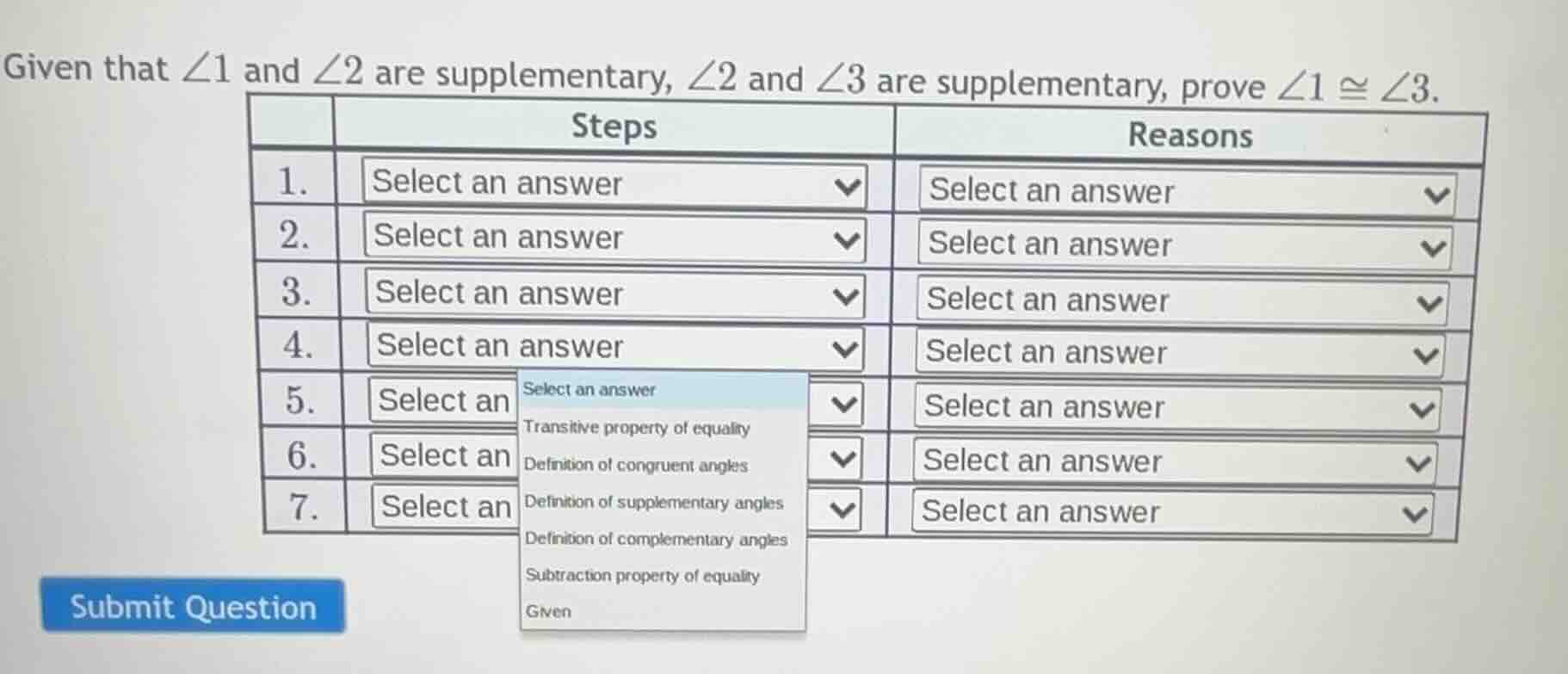
given that $\angle 1$ and $\angle 2$ are supplementary, $\angle 2$ and $\angle 3$ are supplementary, prove $\angle 1 \cong \angle 3$.
Step1: State given information
$\angle 1$ and $\angle 2$ are supplementary; $\angle 2$ and $\angle 3$ are supplementary
Step2: Apply supplementary angle definition
$m\angle 1 + m\angle 2 = 180^\circ$; $m\angle 2 + m\angle 3 = 180^\circ$
Step3: Set expressions equal (transitive property)
$m\angle 1 + m\angle 2 = m\angle 2 + m\angle 3$
Step4: Subtract $m\angle 2$ (subtraction property)
$m\angle 1 + m\angle 2 - m\angle 2 = m\angle 2 + m\angle 3 - m\angle 2$
Step5: Simplify both sides
$m\angle 1 = m\angle 3$
Step6: Apply congruent angle definition
$\angle 1 \cong \angle 3$
Filled table (matching steps to reasons):
| # | Steps | Reasons |
|---|---|---|
| 2 | $m\angle 1 + m\angle 2 = 180^\circ$; $m\angle 2 + m\angle 3 = 180^\circ$ | Definition of supplementary angles |
| 3 | $m\angle 1 + m\angle 2 = m\angle 2 + m\angle 3$ | Transitive property of equality |
| 4 | $m\angle 1 + m\angle 2 - m\angle 2 = m\angle 2 + m\angle 3 - m\angle 2$ | Subtraction property of equality |
| 5 | $m\angle 1 = m\angle 3$ | Simplification |
| 6 | $\angle 1 \cong \angle 3$ | Definition of congruent angles |

Snap & solve any problem in the app
Get step-by-step solutions on Sovi AI
Photo-based solutions with guided steps
Explore more problems and detailed explanations
$\boldsymbol{\angle 1 \cong \angle 3}$ is proven using the transitive and subtraction properties of equality, along with definitions of supplementary and congruent angles.