QUESTION IMAGE
Question
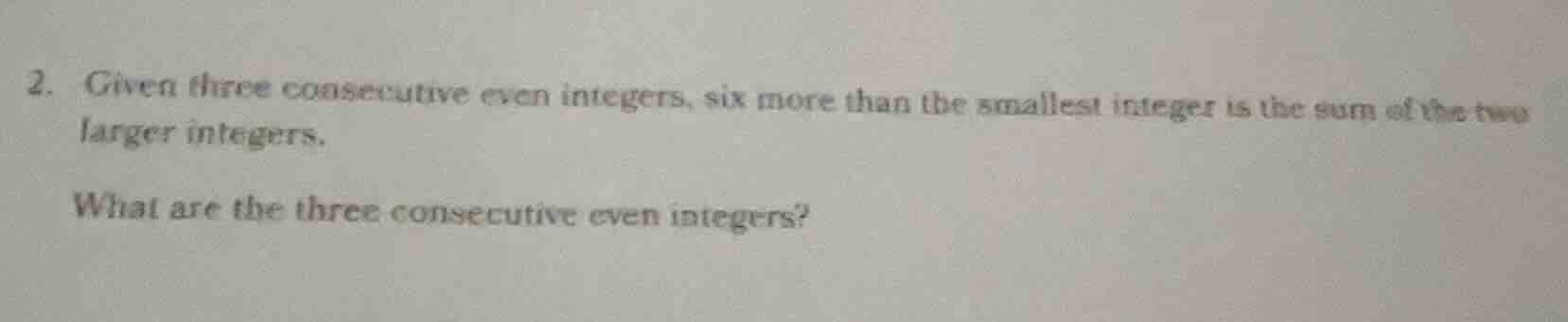
- given three consecutive even integers, six more than the smallest integer is the sum of the two larger integers. what are the three consecutive even integers?
Step1: Define the variables
Let the smallest consecutive even integer be \( x \). Then the next two consecutive even integers will be \( x + 2 \) and \( x + 4 \) (since consecutive even integers differ by 2).
Step2: Translate the problem into an equation
The problem states that six more than the smallest integer is the sum of the two larger integers. So, we can write the equation as:
\( x + 6=(x + 2)+(x + 4) \)
Step3: Simplify and solve the equation
First, simplify the right - hand side of the equation:
\( (x + 2)+(x + 4)=x+x + 2+4=2x+6 \)
So our equation becomes \( x + 6=2x + 6 \)
Subtract \( x \) from both sides:
\( x+6 - x=2x + 6-x \)
\( 6=x + 6 \)
Subtract 6 from both sides:
\( 6-6=x+6 - 6 \)
\( 0=x \)
Wait, this gives \( x = 0 \), but let's check if this makes sense. If \( x=0 \), the three integers are 0, 2, 4. But let's re - examine the equation. Maybe we made a mistake in setting up the equation.
Wait, the problem says "six more than the smallest integer is the sum of the two larger integers". Let's re - set up the equation.
The sum of the two larger integers is \( (x + 2)+(x + 4)=2x + 6 \)
Six more than the smallest integer is \( x+6 \)
So the equation is \( x + 6=(x + 2)+(x + 4) \)
But when we solve \( x+6=2x + 6 \), we get \( x=0 \). But if we check: six more than 0 is 6, and the sum of 2 and 4 is 6. So it works. But maybe we misinterpret the problem. Wait, maybe the problem is "six more than the smallest integer is equal to the sum of the two larger integers". Let's check with \( x=-8 \):
Wait, maybe we made a mistake in the sign. Let's re - consider. Suppose the three consecutive even integers are \( x\), \(x + 2\), \(x+4\). The sum of the two larger is \( (x + 2)+(x + 4)=2x+6 \). Six more than the smallest is \( x + 6 \). So \( x+6=2x + 6 \), which gives \( x = 0 \). But let's check another way. Suppose the three integers are \( - 8\), \( - 6\), \( - 4\). Six more than - 8 is \( - 8+6=-2\). The sum of - 6 and - 4 is \( - 10\). No. Wait, if \( x = 0 \), six more than 0 is 6, sum of 2 and 4 is 6. It works. But maybe the problem has a typo or we misread. Wait, maybe the problem is "six less than the smallest integer is the sum of the two larger integers"? No, the problem says "six more". Wait, let's check again.
Wait, if \( x=-8 \), then six more than - 8 is \( - 2\), sum of - 6 and - 4 is \( - 10\). Not equal. If \( x=-4 \), six more than - 4 is 2, sum of - 2 and 0 is - 2. Not equal. If \( x=-2 \), six more than - 2 is 4, sum of 0 and 2 is 2. Not equal. If \( x = 0 \), it works. If \( x = 2 \), six more than 2 is 8, sum of 4 and 6 is 10. Not equal. Wait, maybe the problem is "six more than the smallest integer is equal to the sum of the two larger integers". In that case, \( x = 0 \), the integers are 0, 2, 4. But let's check the equation again.
Wait, \( x+6=(x + 2)+(x + 4)\)
\( x+6=2x + 6\)
Subtract \( x \) from both sides: \( 6=x + 6\)
Subtract 6 from both sides: \( x = 0 \)
So the three consecutive even integers are 0, 2, 4. But let's confirm:
Smallest integer: 0, six more than 0 is 6.
Two larger integers: 2 and 4, their sum is \( 2 + 4=6 \). So it works.

Snap & solve any problem in the app
Get step-by-step solutions on Sovi AI
Photo-based solutions with guided steps
Explore more problems and detailed explanations
The three consecutive even integers are \( 0 \), \( 2 \), and \( 4 \).