QUESTION IMAGE
Question
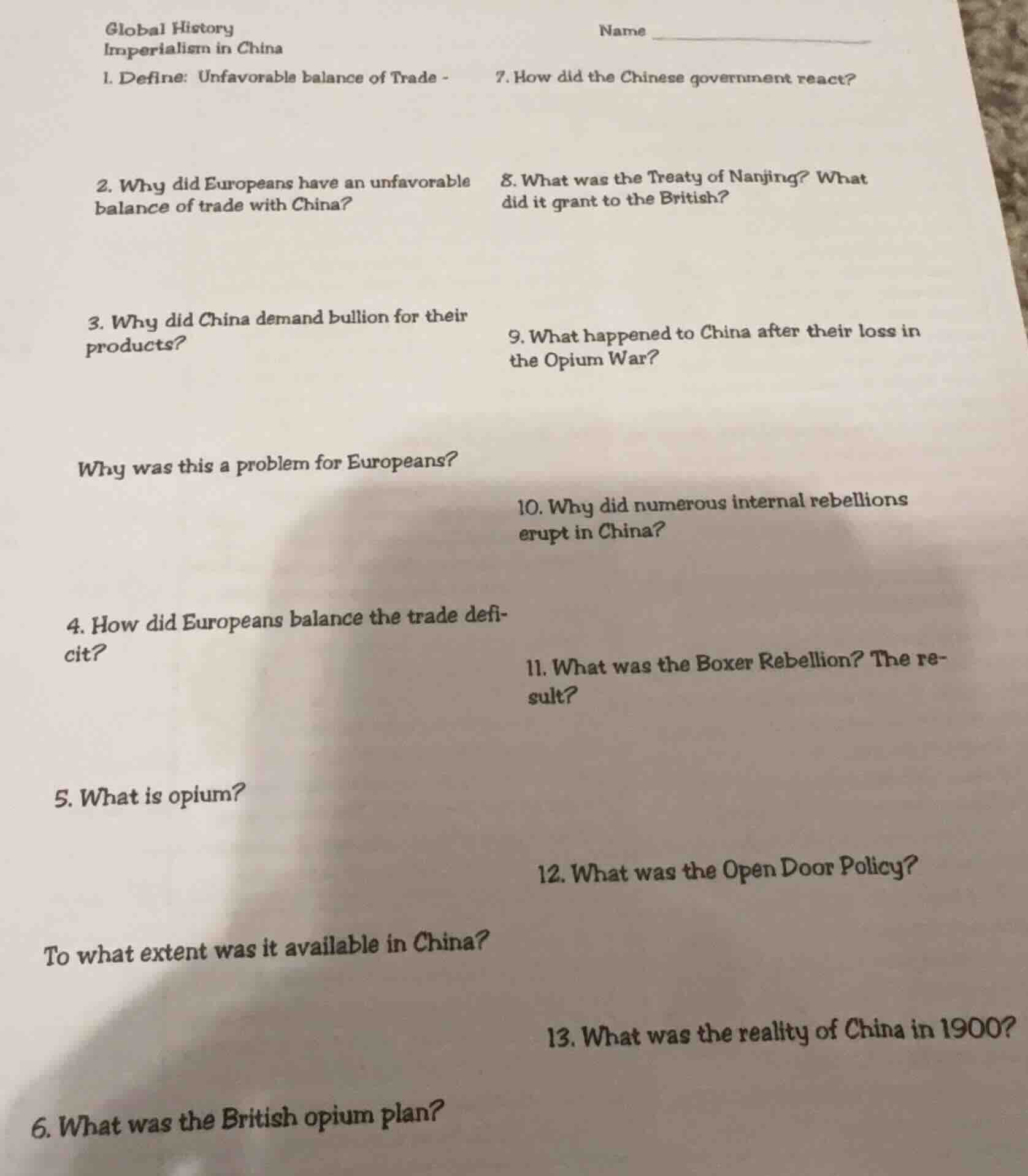
global history
imperialism in china
- define: unfavorable balance of trade -
- why did europeans have an unfavorable balance of trade with china?
- why did china demand bullion for their products?
why was this a problem for europeans?
- how did europeans balance the trade deficit?
- what is opium?
to what extent was it available in china?
- what was the british opium plan?
- how did the chinese government react?
- what was the treaty of nanjing? what did it grant to the british?
- what happened to china after their loss in the opium war?
- why did numerous internal rebellions erupt in china?
- what was the boxer rebellion? the result?
- what was the open door policy?
- what was the reality of china in 1900?
Question 1: Define Unfavorable balance of Trade
An unfavorable balance of trade (trade deficit) occurs when a country's imports of goods and services exceed its exports. In monetary terms, the value of imports ($M$) is greater than the value of exports ($X$), so the trade balance $TB = X - M$ is negative. For example, if a country exports $100$ billion worth of goods and imports $150$ billion, it has a trade deficit of $50$ billion. This can happen due to various factors like higher domestic demand for foreign goods, lack of competitiveness in domestic products, or exchange rate issues.
Europeans wanted Chinese goods like tea, silk, porcelain, and spices. China had a self - sufficient economy and little demand for European manufactured goods. So, Europe imported more from China (high - value Chinese products) than it exported to China (low - demand European goods), leading to an unfavorable balance (trade deficit) for Europe.
- Why China demanded bullion: China had a self - sufficient economy and did not need European goods. Bullion (precious metals like gold and silver) was a widely accepted form of value storage and medium of exchange. By demanding bullion, China could accumulate wealth in a form that was stable and not dependent on foreign goods.
- Problem for Europeans: Europe's supply of bullion (gold and silver) was limited. As they imported more from China (and paid in bullion), their reserves of precious metals were depleting. This led to a shortage of bullion, which was also used as a medium of exchange and for domestic monetary purposes in Europe, causing economic stress.

Snap & solve any problem in the app
Get step-by-step solutions on Sovi AI
Photo-based solutions with guided steps
Explore more problems and detailed explanations
An unfavorable balance of trade (trade deficit) is a situation where a country's total imports of goods and services are of greater value than its total exports, i.e., the value of imports > the value of exports, resulting in a negative trade balance.