QUESTION IMAGE
Question
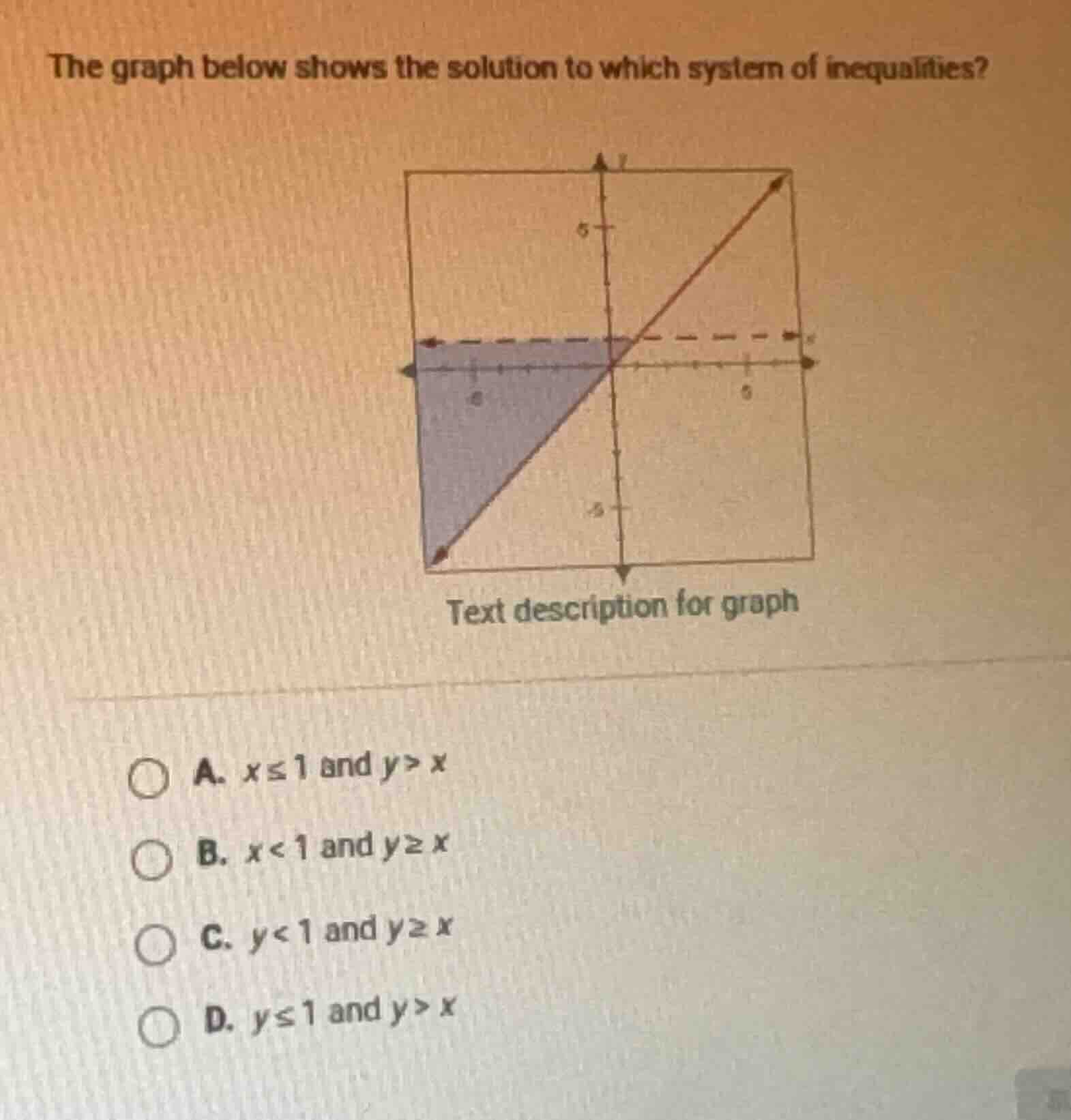
the graph below shows the solution to which system of inequalities?
text description for graph
a. ( xleq1 ) and ( y > x )
b. ( x < 1 ) and ( ygeq x )
c. ( y < 1 ) and ( ygeq x )
d. ( yleq1 ) and ( y > x )
Step1: Analyze the horizontal line
The dashed horizontal line is \( y = 1 \), and the shaded region is below or equal? Wait, no, looking at the graph, the dashed line is \( y = 1 \) (since it's dashed, the inequality is strict or not? Wait, the shaded region is below \( y = 1 \)? Wait, no, the graph's text description: the shaded area is below the dashed line \( y = 1 \) and to the left of... Wait, no, let's check the options. Wait, the other line is \( y = x \), with a solid or dashed line? The line \( y = x \) is solid? Wait, no, in the options, let's check each part.
First, the horizontal boundary: the dashed line is \( y = 1 \), so the inequality for \( y \): if the shaded region is below \( y = 1 \), and the line is dashed, so \( y < 1 \)? Wait, no, looking at option D: \( y \leq 1 \) (but line is dashed, so maybe \( y < 1 \)? Wait, no, maybe I misread. Wait, the options:
Option D: \( y \leq 1 \) and \( y > x \)
Wait, let's check the two inequalities:
- The horizontal line: dashed, so if it's \( y = 1 \), and the shaded region is below (since the top is dashed, so \( y < 1 \) or \( y \leq 1 \)? Wait, maybe the line is \( y = 1 \), dashed, so \( y < 1 \)? No, option D has \( y \leq 1 \), but line is dashed. Wait, maybe the line is \( y = 1 \), dashed, so \( y < 1 \) is not an option. Wait, option C: \( y < 1 \) and \( y \geq x \); option D: \( y \leq 1 \) and \( y > x \)
Wait, the line \( y = x \): is it solid or dashed? In the graph, the line \( y = x \) is solid? Wait, no, in the graph, the line \( y = x \) is part of the boundary. Wait, the shaded region is above or below \( y = x \)?
Looking at the graph: the shaded area is to the left of \( y = x \)? No, wait, the line \( y = x \) goes through the origin, and the shaded region is below \( y = 1 \) and above \( y = x \)? Wait, no, let's think again.
Wait, the two inequalities: one is a horizontal line (y-related), one is the line \( y = x \) (slope 1).
First, the horizontal line: dashed, so the inequality is \( y < 1 \) or \( y \leq 1 \). But in the options, option D has \( y \leq 1 \) (but line is dashed, so maybe it's a typo, or maybe the line is solid? Wait, the graph's dashed line is \( y = 1 \), so the inequality for \( y \) is \( y < 1 \) (dashed) or \( y \leq 1 \) (solid). But the options:
Option C: \( y < 1 \) and \( y \geq x \)
Option D: \( y \leq 1 \) and \( y > x \)
Wait, the line \( y = x \): if the shaded region is above \( y = x \), then \( y > x \); if below, \( y < x \). Wait, in the graph, the shaded area is above \( y = x \)? No, wait, the line \( y = x \) goes from bottom left to top right. The shaded region is to the left of \( y = x \)? No, maybe I got it wrong.
Wait, let's check each option:
Option A: \( x \leq 1 \) (vertical line \( x = 1 \), solid) and \( y > x \). But the vertical line in the graph: is it \( x = 1 \)? No, the graph's vertical boundary: the shaded region is to the left of \( x = 1 \)? No, the options have \( x \leq 1 \) (A), \( x < 1 \) (B), \( y < 1 \) (C), \( y \leq 1 \) (D).
Wait, the horizontal line is \( y = 1 \), dashed, so \( y < 1 \) (C) or \( y \leq 1 \) (D). The line \( y = x \): if the shaded region is above \( y = x \), then \( y > x \) (D) or \( y \geq x \) (C).
Now, check the vertical boundary: is there a vertical line? No, the options have x or y. Wait, the graph's shaded region: let's see the intersection. The shaded area is below \( y = 1 \) (dashed line) and above \( y = x \) (solid line? No, the line \( y = x \) in the graph: is it solid or dashed? In the graph, the line \( y = x \) is part of the…

Snap & solve any problem in the app
Get step-by-step solutions on Sovi AI
Photo-based solutions with guided steps
Explore more problems and detailed explanations
D. \( y \leq 1 \) and \( y > x \)