QUESTION IMAGE
Question
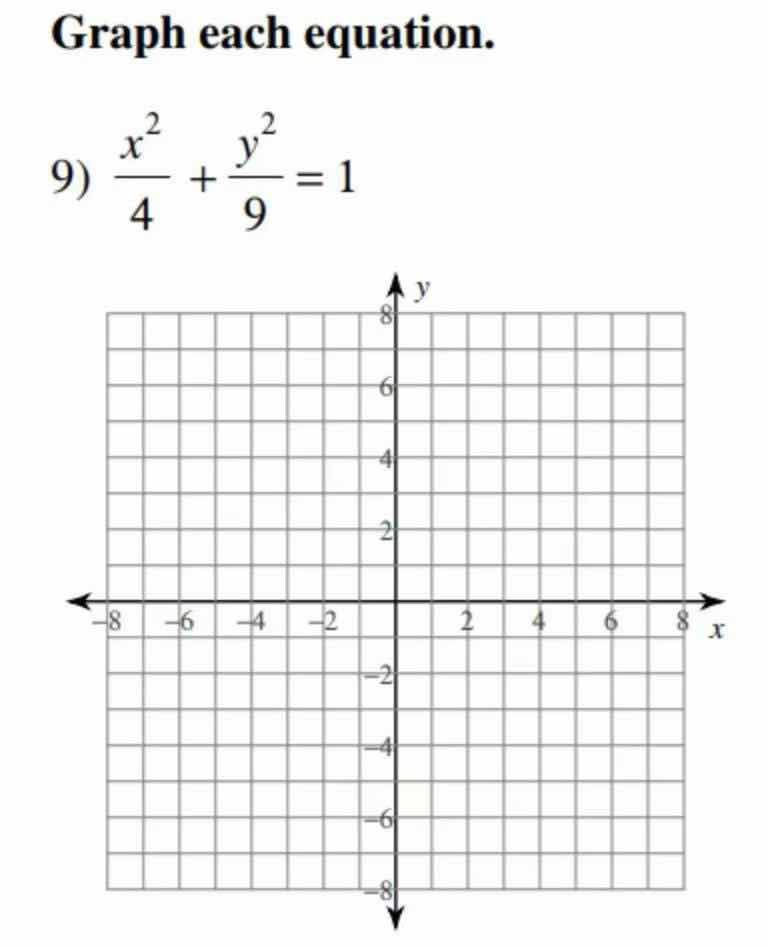
graph each equation.
- \\(\dfrac{x^2}{4} + \dfrac{y^2}{9} = 1\\)
Step1: Identify the ellipse type
The equation is \(\frac{x^2}{4}+\frac{y^2}{9} = 1\), which is an ellipse in standard form \(\frac{x^2}{b^2}+\frac{y^2}{a^2}=1\) (since \(a^2 = 9\), \(b^2=4\), so \(a = 3\), \(b = 2\), and major axis is vertical).
Step2: Find the vertices and co - vertices
- For the \(y\) - axis (major axis) vertices: When \(x = 0\), \(\frac{y^2}{9}=1\Rightarrow y=\pm3\). So the points are \((0,3)\) and \((0, - 3)\).
- For the \(x\) - axis (minor axis) co - vertices: When \(y = 0\), \(\frac{x^2}{4}=1\Rightarrow x=\pm2\). So the points are \((2,0)\) and \((- 2,0)\).
Step3: Plot the points and draw the ellipse
Plot the points \((0,3)\), \((0, - 3)\), \((2,0)\), \((-2,0)\) on the coordinate plane. Then, sketch a smooth curve connecting these points to form the ellipse. The ellipse will be centered at the origin \((0,0)\), with a vertical major axis of length \(2a = 6\) (from \(y=-3\) to \(y = 3\)) and a horizontal minor axis of length \(2b=4\) (from \(x=-2\) to \(x = 2\)).
(Note: Since the problem is about graphing, the final answer is the graph of the ellipse with vertices \((0,\pm3)\) and co - vertices \((\pm2,0)\) centered at the origin. But in text - based form, we can describe the key points and the shape.)

Snap & solve any problem in the app
Get step-by-step solutions on Sovi AI
Photo-based solutions with guided steps
Explore more problems and detailed explanations
The graph is an ellipse centered at the origin \((0,0)\) with vertices at \((0, 3)\), \((0, - 3)\) and co - vertices at \((2, 0)\), \((-2, 0)\). To draw it, plot these four points and sketch a smooth, closed curve passing through them, with the major axis along the \(y\) - axis (length 6) and minor axis along the \(x\) - axis (length 4).