QUESTION IMAGE
Question
graph the equation shown below by transforming the given graph of the parent function.
$y = x^3 + 5$
Step1: Identify the parent function
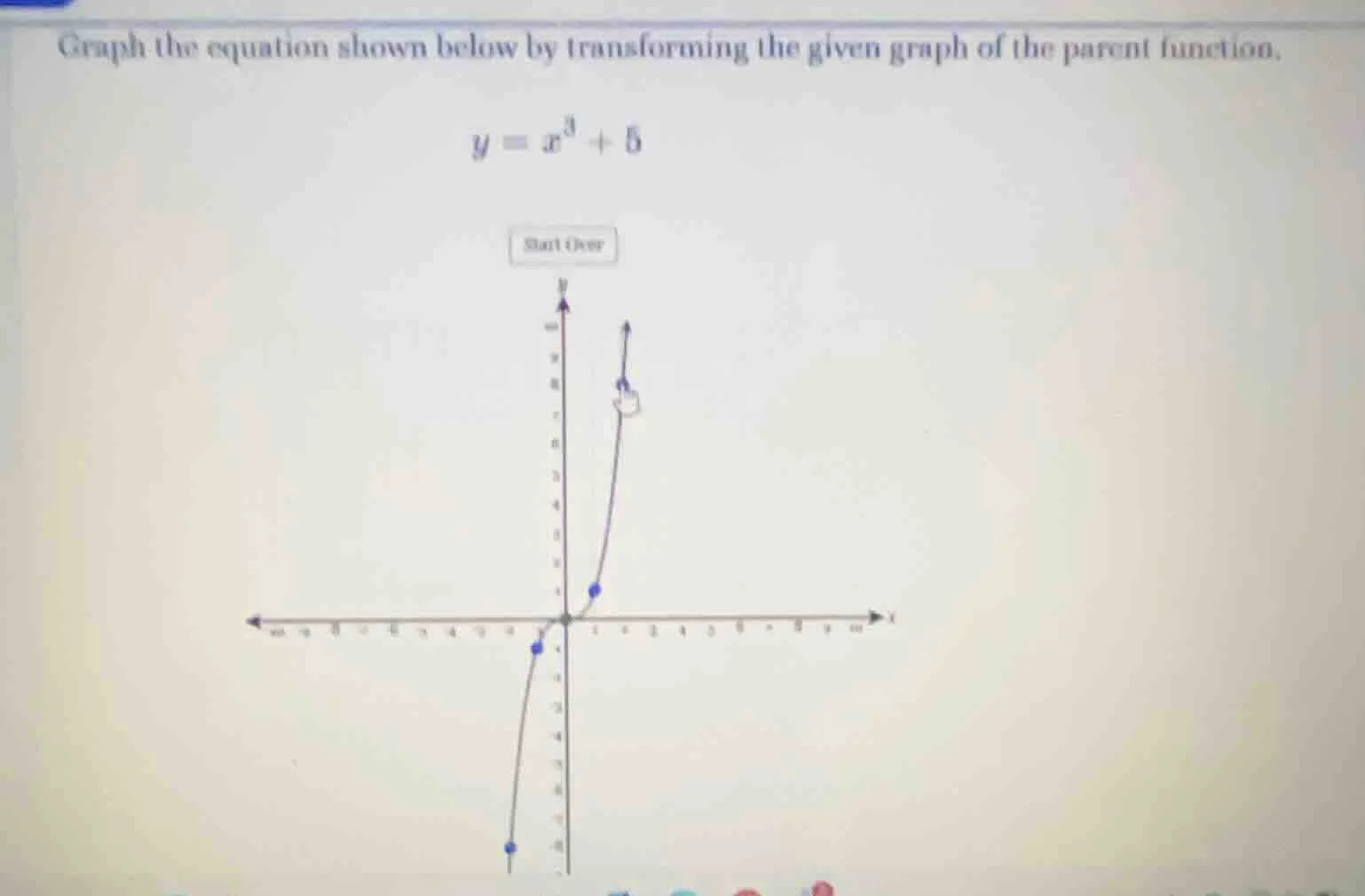
The parent function here is \( y = x^3 \), which is a cubic function. Its graph passes through the origin \((0,0)\), and has a characteristic S - shaped curve.
Step2: Analyze the transformation
The given function is \( y=x^{3}+5 \). For a function of the form \( y = f(x)+k \), when \( k>0 \), the graph of \( y = f(x) \) is shifted vertically upward by \( k \) units. Here, \( f(x)=x^{3} \) and \( k = 5 \). So, we take the graph of \( y=x^{3} \) (the parent function) and shift every point on the graph of \( y=x^{3} \) upward by 5 units.
For example, the point \((0,0)\) on the parent function \( y = x^{3} \) will be shifted to \((0,0 + 5)=(0,5)\) on the graph of \( y=x^{3}+5 \). The point \((1,1)\) on \( y=x^{3} \) will be shifted to \((1,1 + 5)=(1,6)\), and the point \((- 1,-1)\) will be shifted to \((-1,-1 + 5)=(-1,4)\) etc.
To graph \( y=x^{3}+5 \), we can use the key points of the parent function \( y = x^{3}\) (like \((-2,-8)\), \((-1,-1)\), \((0,0)\), \((1,1)\), \((2,8)\)) and shift each of them up by 5 units. So the new key points will be \((-2,-8 + 5)=(-2,-3)\), \((-1,-1+5)=(-1,4)\), \((0,0 + 5)=(0,5)\), \((1,1 + 5)=(1,6)\), \((2,8 + 5)=(2,13)\). Then we can plot these new points and draw the curve through them, which will be the graph of \( y=x^{3}+5 \), obtained by vertically shifting the graph of \( y = x^{3}\) up by 5 units.
(Note: Since the problem is about graphing by transformation, the main idea is to apply the vertical shift transformation to the parent cubic function's graph. If we were to describe the graphing process, these are the key steps.)

Snap & solve any problem in the app
Get step-by-step solutions on Sovi AI
Photo-based solutions with guided steps
Explore more problems and detailed explanations
To graph \( y=x^{3}+5 \), shift the graph of the parent function \( y = x^{3} \) vertically upward by 5 units. Key points of \( y = x^{3} \) (e.g., \((-2,-8)\), \((-1,-1)\), \((0,0)\), \((1,1)\), \((2,8)\)) are shifted to \((-2,-3)\), \((-1,4)\), \((0,5)\), \((1,6)\), \((2,13)\) respectively, and the curve is drawn through these new points.