QUESTION IMAGE
Question
8
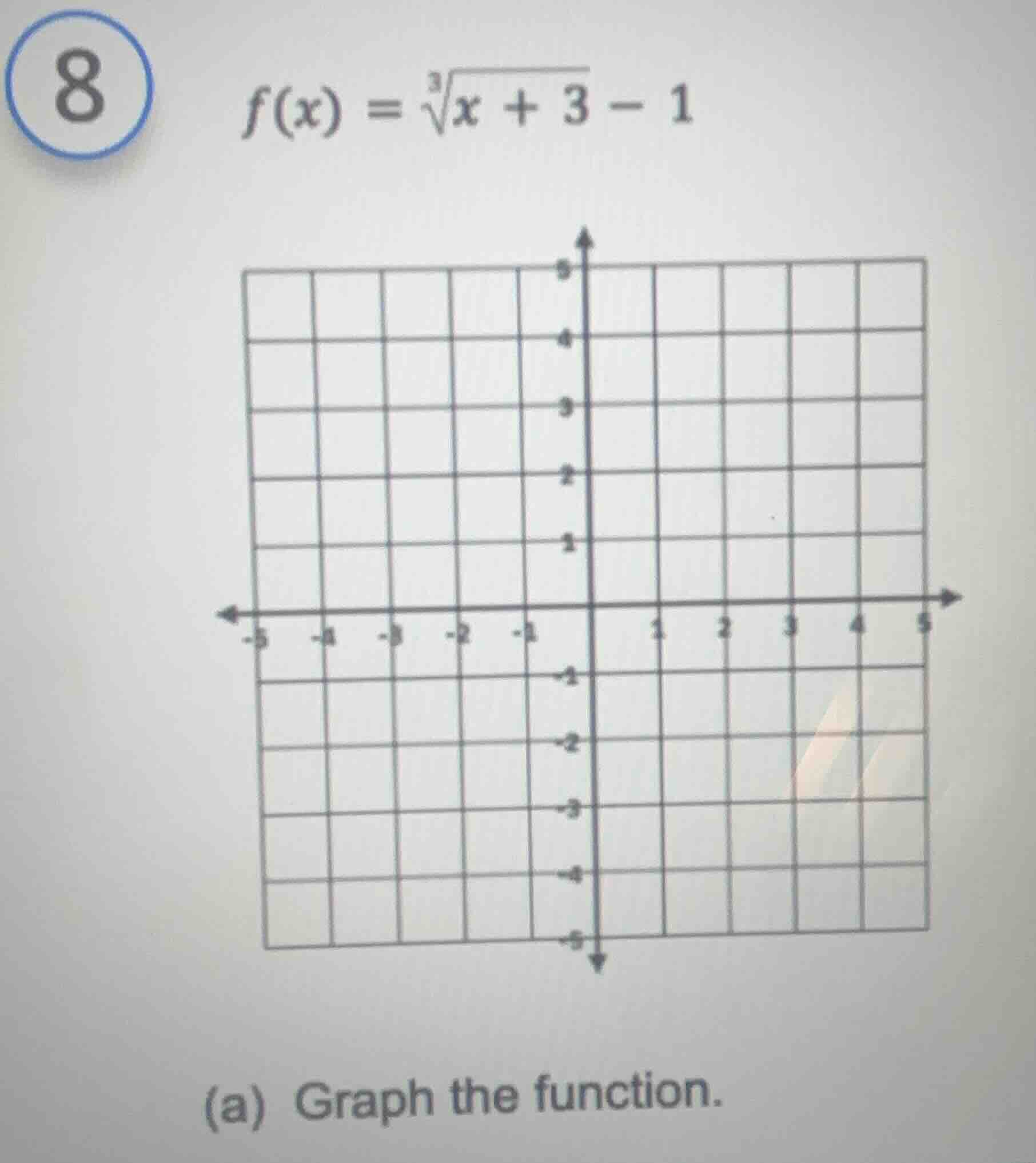
$f(x) = \sqrt3{x + 3} - 1$
(a) graph the function.
Step1: Identify the parent function
The parent function of a cube root function is \( y = \sqrt[3]{x} \). Its graph passes through the origin \((0,0)\), is symmetric about the origin, and has a point - slope - like shape with a horizontal and vertical asymptote? No, the cube root function has a domain of all real numbers and a range of all real numbers. It is an increasing function.
Step2: Analyze the transformations
For the function \( f(x)=\sqrt[3]{x + 3}-1 \), we use the transformation rules for functions:
- The transformation \( y=\sqrt[3]{x - h}\) represents a horizontal shift of the parent function \( y = \sqrt[3]{x}\). If \( h>0 \), it is a shift to the right; if \( h < 0 \), it is a shift to the left. In our case, \( y=\sqrt[3]{x+3}=\sqrt[3]{x-(- 3)}\), so there is a horizontal shift of 3 units to the left.
- The transformation \( y = g(x)-k\) represents a vertical shift of the function \( y = g(x)\). If \( k>0 \), it is a shift downwards; if \( k < 0 \), it is a shift upwards. In our case, \( f(x)=\sqrt[3]{x + 3}-1\), so there is a vertical shift of 1 unit downwards.
Step3: Find key points of the parent function and apply transformations
- For the parent function \( y=\sqrt[3]{x}\), some key points are:
- When \( x = 0 \), \( y=\sqrt[3]{0}=0\), so the point is \((0,0)\).
- When \( x = 1 \), \( y=\sqrt[3]{1}=1\), so the point is \((1,1)\).
- When \( x=- 1 \), \( y=\sqrt[3]{-1}=-1\), so the point is \((-1,-1)\).
- When \( x = 8 \), \( y=\sqrt[3]{8}=2\), so the point is \((8,2)\).
- When \( x=-8 \), \( y=\sqrt[3]{-8}=-2\), so the point is \((-8,-2)\).
- Apply the horizontal shift \( x
ightarrow x - 3\) (since we have \( x+3\), so to get the new \( x\) - value from the parent function's \( x\) - value, we solve \( x_{new}+3=x_{parent}\), or \( x_{new}=x_{parent}-3\)) and vertical shift \( y
ightarrow y - 1\) (since \( f(x)=g(x)-1\), where \( g(x)=\sqrt[3]{x + 3}\)):
- For the point \((0,0)\) of the parent function:
- Horizontal shift: \( x=0 - 3=-3\)
- Vertical shift: \( y = 0-1=-1\). So the new point is \((-3,-1)\).
- For the point \((1,1)\) of the parent function:
- Horizontal shift: \( x = 1-3=-2\)
- Vertical shift: \( y=1 - 1 = 0\). So the new point is \((-2,0)\).
- For the point \((-1,-1)\) of the parent function:
- Horizontal shift: \( x=-1-3=-4\)
- Vertical shift: \( y=-1 - 1=-2\). So the new point is \((-4,-2)\).
- For the point \((8,2)\) of the parent function:
- Horizontal shift: \( x = 8-3 = 5\)
- Vertical shift: \( y=2-1 = 1\). So the new point is \((5,1)\).
- For the point \((-8,-2)\) of the parent function:
- Horizontal shift: \( x=-8 - 3=-11\) (but our graph has \( x\) - values from - 5 to 5, so we can focus on the points within the visible range of the given grid)
Step4: Plot the points and draw the graph
- Plot the points we found: \((-3,-1)\), \((-2,0)\), \((-4,-2)\), \((5,1)\) (and other points if needed).
- The graph of \( f(x)=\sqrt[3]{x + 3}-1\) should have the same general shape as the cube root function, but shifted 3 units to the left and 1 unit down. It is an increasing function, passing through the plotted points.
To graph it:
- Start by marking the point \((-3,-1)\) (the "center" of the cube - root - like graph after shifts).
- Then, use the fact that the cube root function is smooth and increasing. For example, when \( x=-3\), \( f(-3)=\sqrt[3]{-3 + 3}-1=\sqrt[3]{0}-1=-1\). When \( x=-2\), \( f(-2)=\sqrt[3]{-2 + 3}-1=\sqrt[3]{1}-1=1 - 1=0\). When \( x = 5\), \( f(5)=\sqrt[…

Snap & solve any problem in the app
Get step-by-step solutions on Sovi AI
Photo-based solutions with guided steps
Explore more problems and detailed explanations
To graph \( f(x)=\sqrt[3]{x + 3}-1\):
- Recognize it is a transformed cube - root function. The parent function \( y = \sqrt[3]{x}\) is shifted 3 units left (due to \( x+3\)) and 1 unit down (due to \(-1\)).
- Plot key points:
- \((-3,-1)\) (since \( f(-3)=\sqrt[3]{-3 + 3}-1=-1\))
- \((-2,0)\) (since \( f(-2)=\sqrt[3]{-2 + 3}-1=0\))
- \((-4,-2)\) (since \( f(-4)=\sqrt[3]{-4 + 3}-1=-2\))
- \((5,1)\) (since \( f(5)=\sqrt[3]{5 + 3}-1=1\))
- Draw a smooth, increasing curve through these points, matching the general shape of the cube - root function.