QUESTION IMAGE
Question
graph the inequality.
y > 4x + 5
Step1: Analyze the inequality type
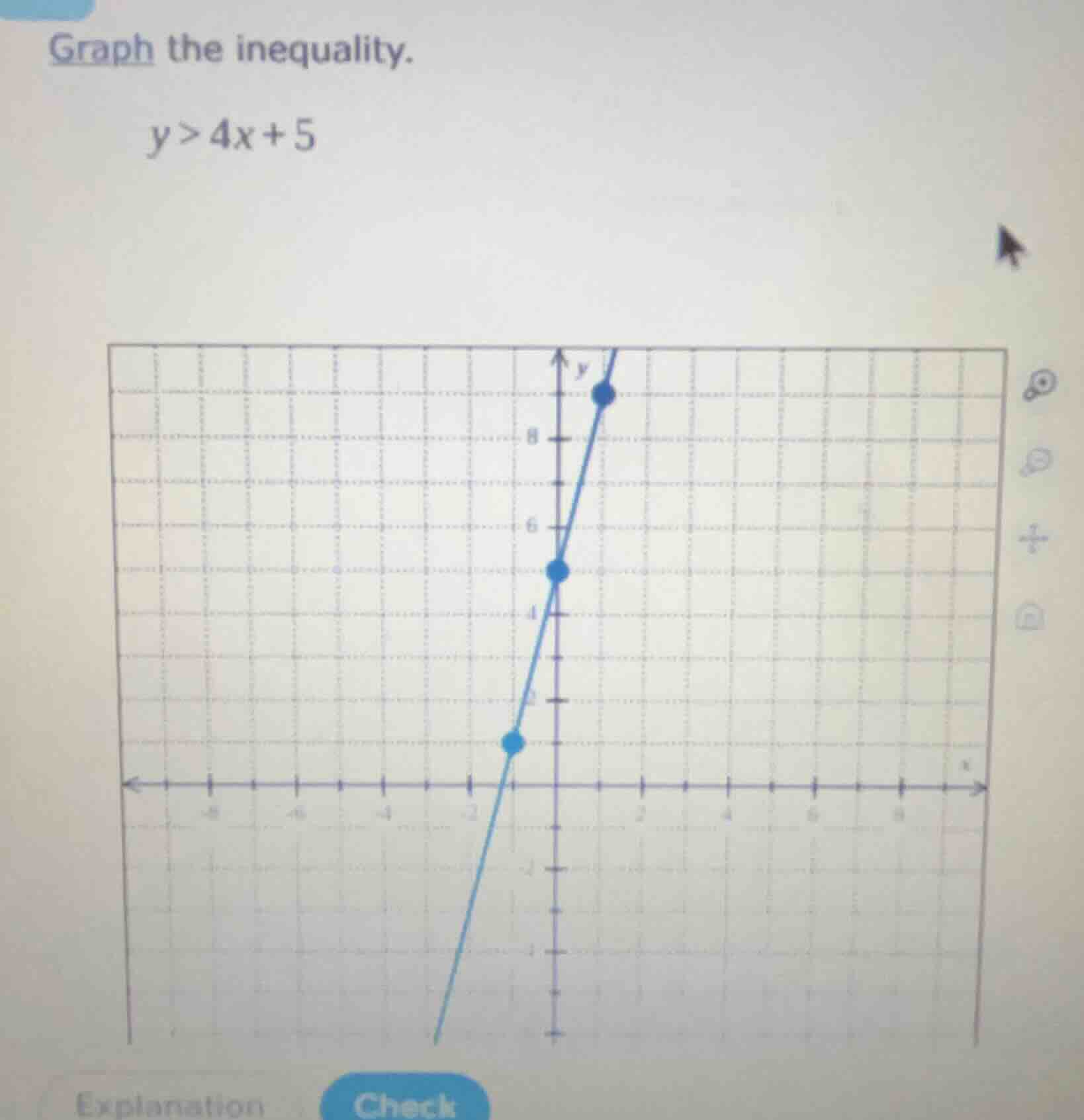
The inequality is \( y > 4x + 5 \), which is a linear inequality. First, we consider the boundary line. The equation of the boundary line is \( y = 4x + 5 \), which is in slope - intercept form \( y=mx + b \) where \( m = 4 \) (slope) and \( b = 5 \) (y - intercept).
Step2: Determine the line type (dashed or solid)
Since the inequality is \( y>4x + 5 \) (not \( y\geq4x + 5 \)), the boundary line should be a dashed line. This is because the points on the line \( y = 4x+5 \) do not satisfy the inequality \( y>4x + 5 \).
Step3: Determine the region to shade
To determine which side of the line to shade, we can use a test point. A common test point is the origin \((0,0)\) (if the line does not pass through it). Substitute \( x = 0 \) and \( y = 0 \) into the inequality: \( 0>4(0)+5\), which simplifies to \( 0 > 5 \). This is false. So we shade the region that does not contain the origin. Since the slope of the line \( y = 4x + 5 \) is positive (\( m = 4 \)), the line goes up from left to right. And since the test point \((0,0)\) does not satisfy the inequality, we shade the region above the dashed line \( y = 4x+5 \).
(Note: In the given graph, if the line is solid, it should be changed to dashed. Then shade the area above the dashed line \( y = 4x + 5 \))

Snap & solve any problem in the app
Get step-by-step solutions on Sovi AI
Photo-based solutions with guided steps
Explore more problems and detailed explanations
To graph \( y>4x + 5 \):
- Draw a dashed line for \( y = 4x+5 \) (because the inequality is strict, \( y>4x + 5 \), not \( y\geq4x + 5 \)). The line has a slope of 4 and a y - intercept of 5.
- Shade the region above the dashed line \( y = 4x + 5 \) (since the test point \((0,0)\) does not satisfy \( y>4x + 5 \), we shade the side opposite to the origin with respect to the line \( y = 4x + 5 \)).