QUESTION IMAGE
Question
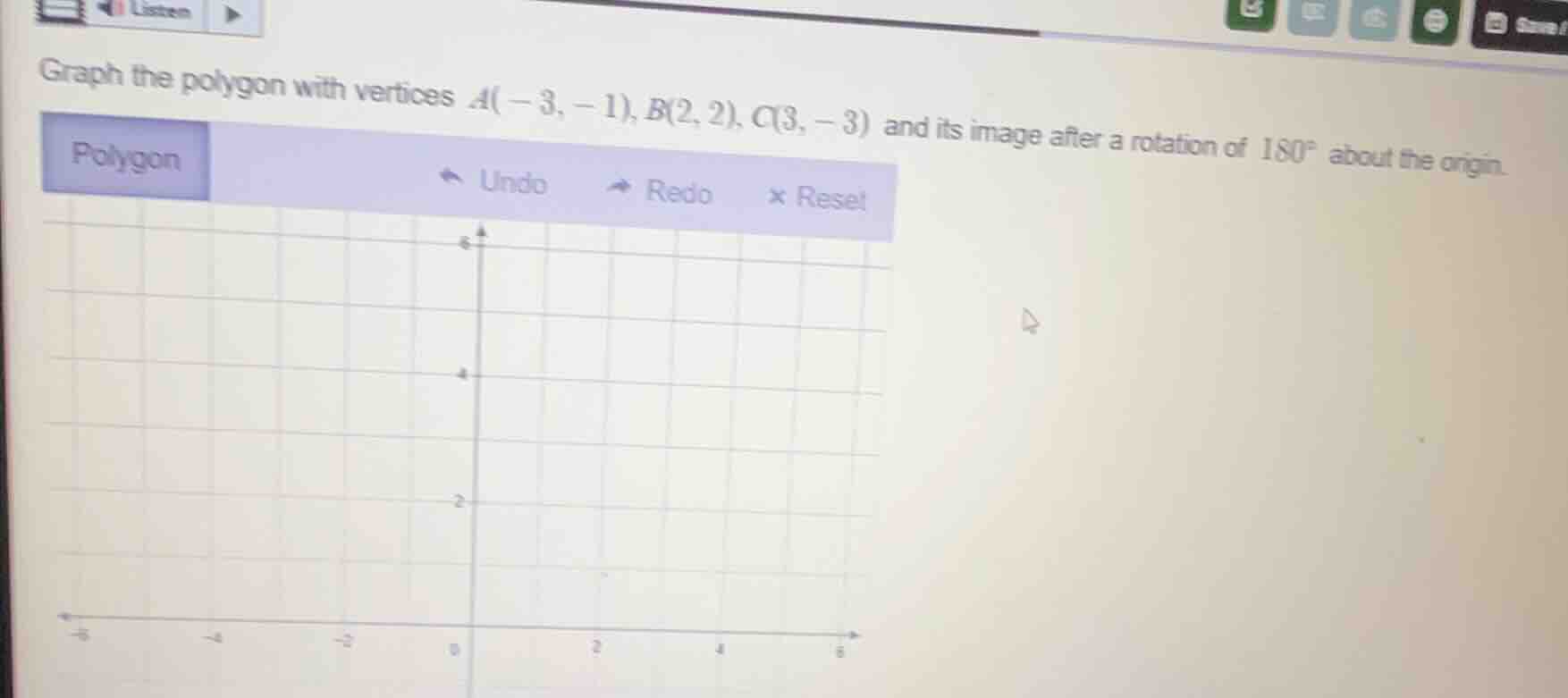
graph the polygon with vertices a(-3, -1), b(2, 2), c(3, -3) and its image after a rotation of 180° about the origin.
Step1: Recall 180° rotation rule
The rule for rotating a point \((x,y)\) 180° about the origin is \((x,y)\to(-x,-y)\).
Step2: Apply rule to point A
For \(A(-3,-1)\), substitute \(x = -3\), \(y = -1\) into the rule: \((-(-3),-(-1))=(3,1)\). So \(A'\) is \((3,1)\).
Step3: Apply rule to point B
For \(B(2,2)\), substitute \(x = 2\), \(y = 2\) into the rule: \((-2,-2)\). So \(B'\) is \((-2,-2)\).
Step4: Apply rule to point C
For \(C(3,-3)\), substitute \(x = 3\), \(y = -3\) into the rule: \((-3,3)\). So \(C'\) is \((-3,3)\).
To graph:
- Plot original points \(A(-3,-1)\), \(B(2,2)\), \(C(3,-3)\) and connect them to form the polygon.
- Plot image points \(A'(3,1)\), \(B'(-2,-2)\), \(C'(-3,3)\) and connect them to form the rotated polygon.

Snap & solve any problem in the app
Get step-by-step solutions on Sovi AI
Photo-based solutions with guided steps
Explore more problems and detailed explanations
Original vertices: \(A(-3,-1)\), \(B(2,2)\), \(C(3,-3)\); Rotated vertices: \(A'(3,1)\), \(B'(-2,-2)\), \(C'(-3,3)\). Graph by plotting these points and connecting them.