QUESTION IMAGE
Question
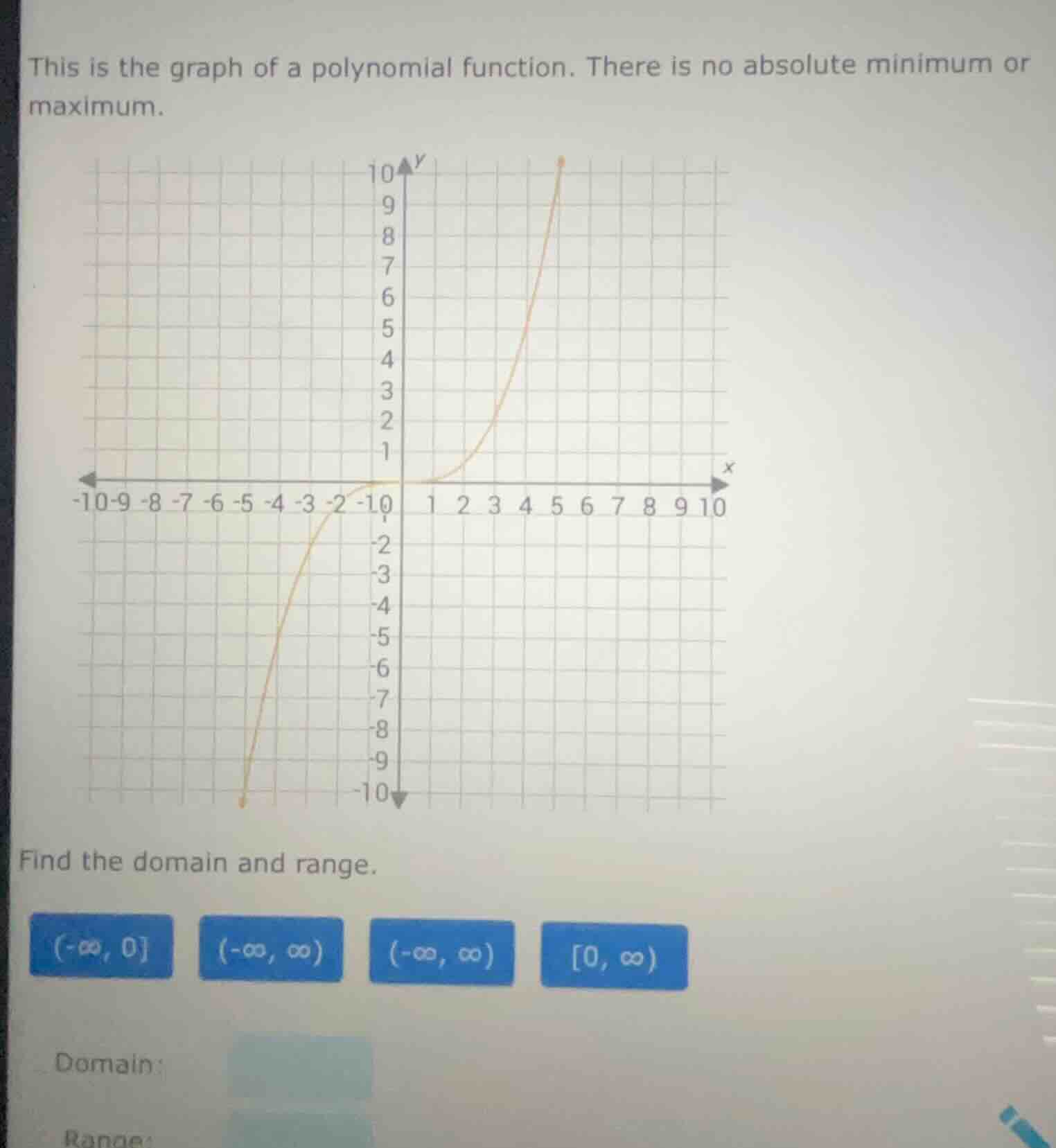
this is the graph of a polynomial function. there is no absolute minimum or maximum. find the domain and range. (-∞, 0 (-∞, ∞) (-∞, ∞) 0, ∞) domain: range:
Step1: Determine the domain
The domain of a function is the set of all x - values for which the function is defined. Looking at the graph, the polynomial function has endpoints? No, wait, the graph extends from the left (negative x - values) to the right (positive x - values) with some endpoints? Wait, no, the left end is at x=-5 (the point there) and the right end is at x = 5? Wait, no, looking at the graph, the leftmost point is at x=-5 (the dot) and the rightmost point is at x = 5 (the dot). Wait, no, actually, the graph is a polynomial function, but the graph as drawn has a left endpoint at x=-5 and right endpoint at x = 5? Wait, no, maybe I misread. Wait, the x - axis goes from - 10 to 10, and the graph has a left endpoint at x=-5 (the bottom left dot) and right endpoint at x = 5 (the top right dot). Wait, no, the domain is the set of all x - values covered by the graph. Wait, the left end is at x=-5 (the point) and the right end is at x = 5 (the point). Wait, no, actually, looking at the x - coordinates, the graph starts at x=-5 (the leftmost point) and ends at x = 5 (the rightmost point)? Wait, no, the x - axis labels: from - 10 to 10. The left dot is at x=-5 (since the grid lines: each grid is 1 unit). Wait, the leftmost point is at x=-5 (the bottom left) and the rightmost point is at x = 5 (the top right). Wait, but the graph of a polynomial function: if it's a polynomial, the domain is usually all real numbers, but here the graph has endpoints. Wait, maybe the graph is a piecewise? No, the problem says it's a polynomial function, but the graph has two endpoints: left at x=-5 and right at x = 5? Wait, no, looking at the x - axis, the left dot is at x=-5 (the x - coordinate is - 5) and the right dot is at x = 5 (x - coordinate 5). Wait, but the domain is the set of x - values from the leftmost x to the rightmost x. Wait, the leftmost x is - 5 and the rightmost x is 5? No, wait, the x - axis: the left dot is at x=-5 (because the grid lines: from - 10, - 9,...,-5, - 4,...0,1,...5,6... So the left dot is at x=-5 (the x - coordinate) and the right dot is at x = 5 (x - coordinate). Wait, but the options for domain: one of the options is (-∞, ∞)? No, the options given are (-∞, 0], (-∞, ∞), (-∞, ∞), [0, ∞). Wait, maybe I made a mistake. Wait, the graph: looking at the x - values, the graph is defined from x=-5 to x = 5? No, the left end is at x=-5 (the bottom left) and the right end is at x = 5 (the top right). Wait, no, the x - coordinate of the leftmost point: let's count the grid lines. From x=-10 to x = 10, each grid is 1 unit. The left dot is at x=-5 (because it's 5 units to the right of - 10? No, - 10, - 9, - 8, - 7, - 6, - 5: so the left dot is at x=-5. The right dot is at x = 5 (5 units to the right of 0). Wait, but the domain of a function is all x - values for which the function exists. If the graph has endpoints at x=-5 and x = 5, then the domain is [-5,5]? But the options don't have that. Wait, the options given are (-∞, 0], (-∞, ∞), (-∞, ∞), [0, ∞). Wait, maybe the graph is actually a polynomial with domain all real numbers, but the drawing has endpoints. Wait, no, the problem says "There is no absolute minimum or maximum", which for a polynomial, if it's of odd degree, it has no absolute min or max. But the graph here has endpoints. Wait, maybe the graph is a cubic or something, but the options for domain: one of the options is (-∞, ∞). Wait, maybe the left and right dots are just the ends of the graph shown, but the domain is all real numbers? No, the options include (-∞, ∞) twice. Wait, maybe the domain is (-∞, ∞)…

Snap & solve any problem in the app
Get step-by-step solutions on Sovi AI
Photo-based solutions with guided steps
Explore more problems and detailed explanations
Domain: \((-\infty, \infty)\)
Range: \((-\infty, \infty)\)