QUESTION IMAGE
Question
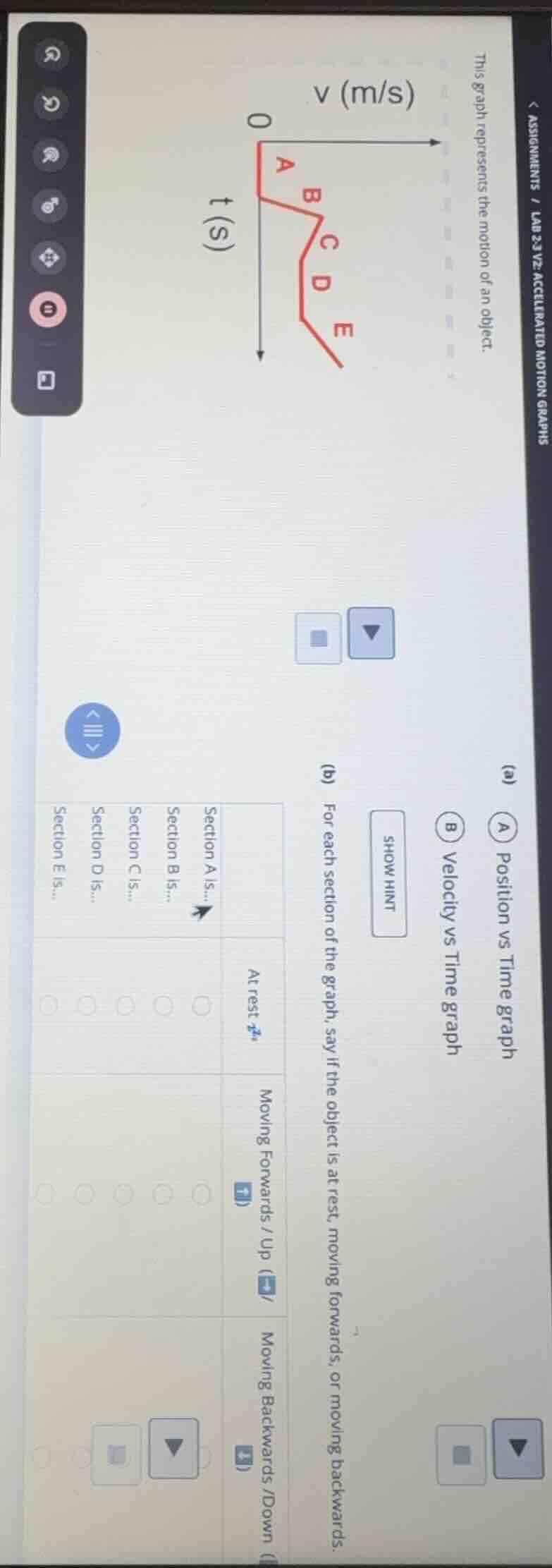
this graph represents the motion of an object.
(a)
a position vs time graph
b velocity vs time graph
(b) for each section of the graph, say if the object is at rest, moving forwards, or moving backwards.
section a is...
at rest
moving forwards / up
moving backwards / down
section b is...
section c is...
section d is...
section e is...
To solve this, we analyze the velocity - time graph:
Section A
Step 1: Analyze velocity in Section A
In a velocity - time graph, if the velocity \(v = 0\) (the graph is along the time axis, \(v = 0\) m/s), the object is at rest. For Section A, the velocity is \(0\) m/s (since it's along the \(t\) - axis at \(v = 0\)). So Section A is "At rest".
Section B
Step 1: Analyze the direction of velocity in Section B
In a velocity - time graph, if the velocity is negative (assuming the positive direction is, for example, forward and negative is backward), the object is moving backward. In Section B, the velocity has a negative value (the graph is below the \(v = 0\) line and has a negative slope but the key is the sign of velocity). So the object is moving backwards (or down, depending on the coordinate system).
Section C
Step 1: Analyze the direction of velocity in Section C
The velocity in Section C is still negative (the graph is below the \(v=0\) line). So the object is moving backwards (or down). Also, the slope of the velocity - time graph gives acceleration. The slope in Section C is such that the magnitude of velocity is changing, but the direction (negative velocity) means it's moving backwards.
Section D
Step 1: Analyze the velocity in Section D
In Section D, the velocity is constant (the graph is a horizontal line) and negative. A constant negative velocity means the object is moving backwards (or down) with a constant speed.
Section E
Step 1: Analyze the velocity in Section E
The velocity in Section E has a negative value and the slope of the velocity - time graph (which represents acceleration) is negative (the line is sloping downwards in the negative velocity direction). The velocity is negative, so the object is moving backwards (or down) and its speed is increasing (since the magnitude of velocity is increasing as time increases, as the slope is negative and velocity is negative, \(v=v_0+at\), if \(a\) is negative and \(v_0\) is negative, the magnitude of \(v\) increases). But the key for the motion direction: since velocity is negative, it's moving backwards (or down).

Snap & solve any problem in the app
Get step-by-step solutions on Sovi AI
Photo-based solutions with guided steps
Explore more problems and detailed explanations
s for each section:
- Section A: At rest
- Section B: Moving Backwards/Down
- Section C: Moving Backwards/Down
- Section D: Moving Backwards/Down (with constant velocity)
- Section E: Moving Backwards/Down (with increasing speed)