QUESTION IMAGE
Question
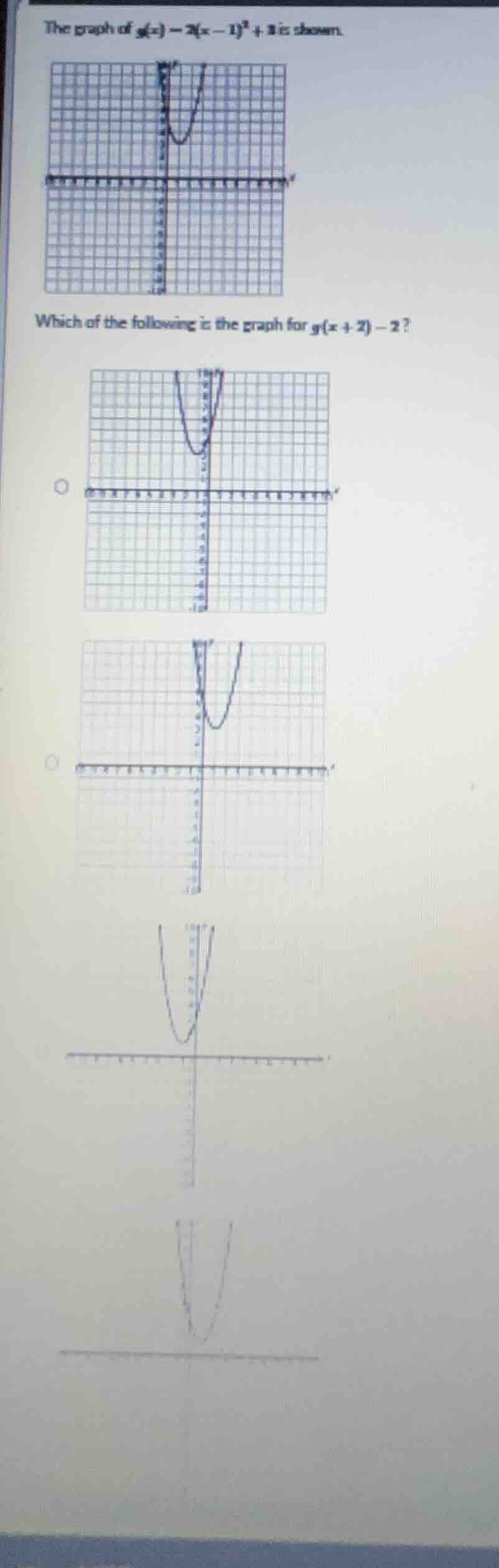
the graph of $g(x)=2(x - 1)^2+3$ is shown.
which of the following is the graph for $g(x + 2)-2$?
Step1: Analyze the original function's vertex
The original function is \( g(x) = 2(x - 1)^2 + 3 \), which is in vertex form \( y = a(x - h)^2 + k \), where the vertex is \((h, k)=(1, 3)\).
Step2: Apply horizontal shift
For the transformation \( g(x + 2) \), we use the rule: replacing \( x \) with \( x + 2 \) in a function shifts the graph horizontally. The horizontal shift formula is: if we have \( y = f(x + c) \), the graph of \( f(x) \) shifts left by \( c \) units (when \( c>0 \)). Here, \( c = 2 \), so the vertex of \( g(x) \) at \((1, 3)\) will shift left by 2 units. The new \( x \)-coordinate of the vertex is \( 1-2=-1 \), and the \( y \)-coordinate remains 3 for now. So the vertex after horizontal shift is \((-1, 3)\).
Step3: Apply vertical shift
Now, we apply the transformation \( g(x + 2)-2 \). The rule for vertical shift: if we have \( y = f(x)-d \), the graph of \( f(x) \) shifts down by \( d \) units (when \( d>0 \)). Here, \( d = 2 \), so we subtract 2 from the \( y \)-coordinate of the vertex we got from the horizontal shift. The new \( y \)-coordinate is \( 3 - 2=1 \). So the vertex of the transformed function \( g(x + 2)-2 \) is \((-1, 1)\).
Step4: Analyze the shape and other features
The coefficient of the squared term is still 2, so the parabola opens upwards with the same width as the original function \( g(x) \). Now we look for the graph with vertex at \((-1, 1)\) and opening upwards.

Snap & solve any problem in the app
Get step-by-step solutions on Sovi AI
Photo-based solutions with guided steps
Explore more problems and detailed explanations
The graph with vertex at \((-1, 1)\) (you need to identify the correct option from the given graphs based on the vertex \((-1, 1)\) and the same parabola shape as \( g(x) \) since the coefficient of the squared term is unchanged).