QUESTION IMAGE
Question
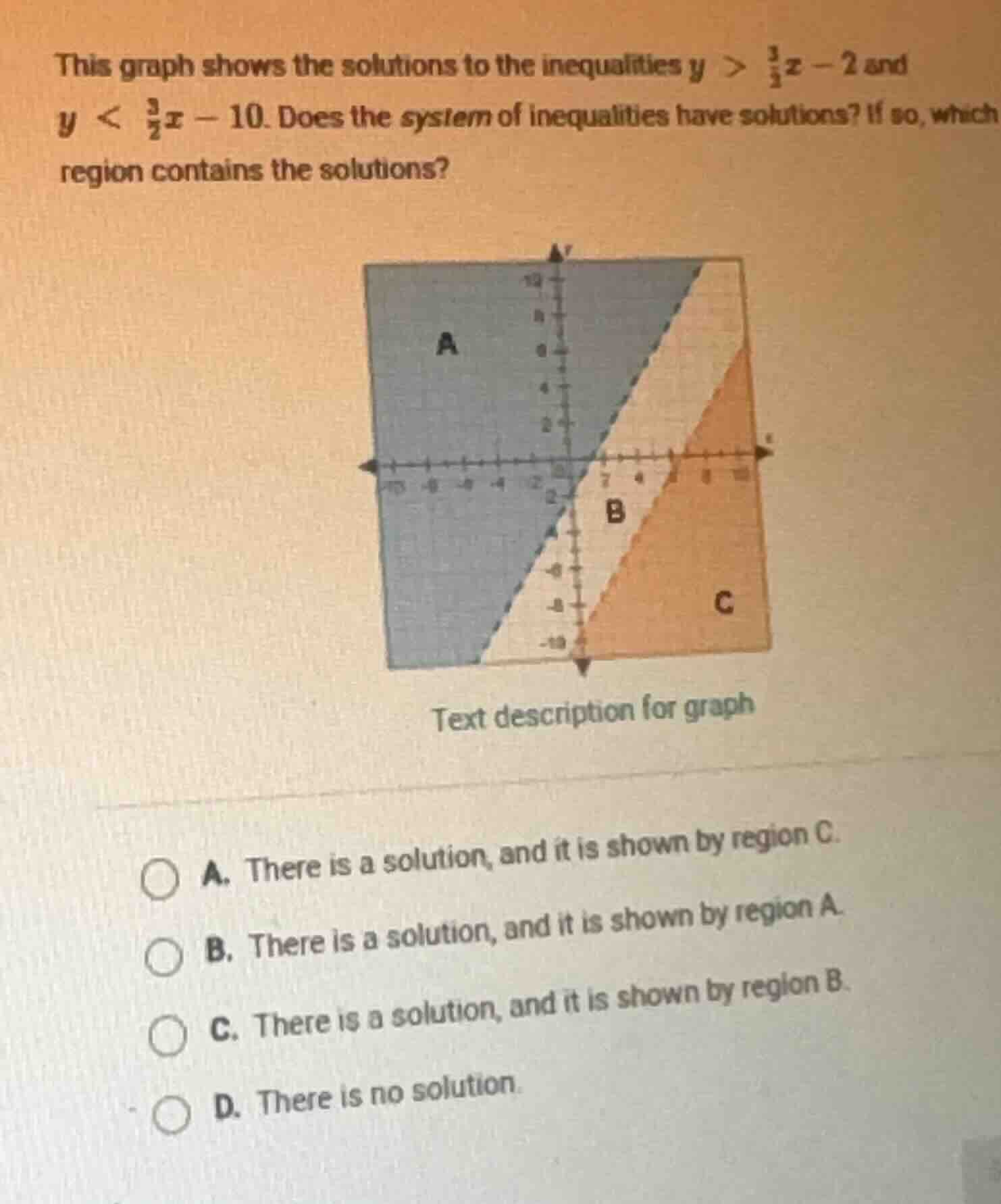
this graph shows the solutions to the inequalities $y > \frac{3}{2}x - 2$ and $y < \frac{3}{2}x - 10$. does the system of inequalities have solutions? if so, which region contains the solutions? text description for graph a. there is a solution, and it is shown by region c. b. there is a solution, and it is shown by region a. c. there is a solution, and it is shown by region b. d. there is no solution.
Step1: Analyze the slopes and intercepts
The two inequalities are \( y > \frac{3}{2}x - 2 \) and \( y < \frac{3}{2}x - 10 \). Both lines have the same slope (\( \frac{3}{2} \)), so they are parallel. The y - intercept of the first line is - 2 and the y - intercept of the second line is - 10. Since the lines are parallel and the region above \( y=\frac{3}{2}x - 2 \) (for \( y > \frac{3}{2}x - 2 \)) and the region below \( y=\frac{3}{2}x - 10 \) (for \( y < \frac{3}{2}x - 10 \)) do not overlap (because \( \frac{3}{2}x-2>\frac{3}{2}x - 10 \) for all x, so there is no x - value for which a y - value can be both greater than \( \frac{3}{2}x - 2 \) and less than \( \frac{3}{2}x - 10 \)).
Step2: Determine the solution of the system
A system of inequalities has a solution if there is at least one point that satisfies all the inequalities in the system. Since the two regions defined by the inequalities do not overlap (because the lines are parallel and the "upper" region of the first line is always above the "lower" region of the second line), there is no point that can satisfy both inequalities simultaneously.

Snap & solve any problem in the app
Get step-by-step solutions on Sovi AI
Photo-based solutions with guided steps
Explore more problems and detailed explanations
D. There is no solution.