QUESTION IMAGE
Question
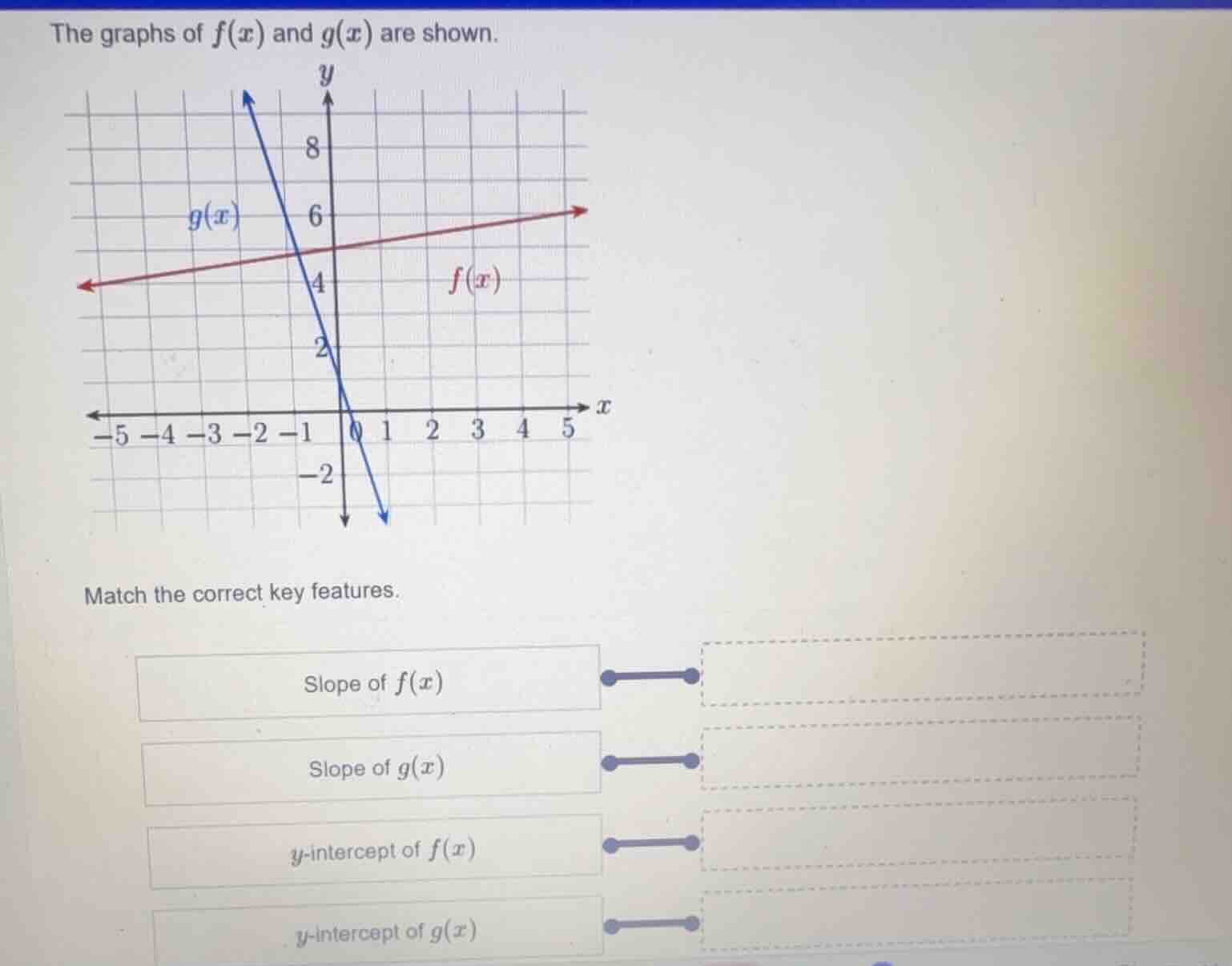
the graphs of $f(x)$ and $g(x)$ are shown.
match the correct key features.
slope of $f(x)$
slope of $g(x)$
$y$-intercept of $f(x)$
$y$-intercept of $g(x)$
Step1: Find two points on \( f(x) \)
From the graph, \( f(x) \) passes through \( (0, 5) \) and \( (4, 6) \). The slope formula is \( m = \frac{y_2 - y_1}{x_2 - x_1} \). So, \( m_{f} = \frac{6 - 5}{4 - 0} = \frac{1}{4} = 0.25 \). The \( y \)-intercept is the \( y \)-value when \( x = 0 \), so for \( f(x) \), \( y \)-intercept is \( 5 \).
Step2: Find two points on \( g(x) \)
\( g(x) \) passes through \( (0, 1) \) and \( (-1, 7) \) (or \( (1, -5) \), let's use \( (0, 1) \) and \( (1, -5) \)). Slope \( m_{g} = \frac{-5 - 1}{1 - 0} = -6 \). The \( y \)-intercept of \( g(x) \) is the \( y \)-value when \( x = 0 \), so it's \( 1 \)? Wait, no, looking at the graph, \( g(x) \) crosses \( y \)-axis at \( (0,1) \)? Wait, no, the blue line \( g(x) \) passes through \( (0,1) \)? Wait, the graph: when \( x = 0 \), \( g(x) \) is at \( y = 1 \)? Wait, no, let's re - check. The blue line \( g(x) \): when \( x = 0 \), \( y = 1 \)? Wait, no, the grid: at \( x = 0 \), the blue line is at \( y = 1 \)? Wait, maybe I made a mistake. Let's take two clear points on \( g(x) \). Let's take \( (0,1) \) and \( (1, -5) \): change in \( y \) is \( -5 - 1=-6 \), change in \( x \) is \( 1 - 0 = 1 \), so slope is \( -6 \). For \( f(x) \), two points: \( (0,5) \) and \( (4,6) \), slope is \( \frac{6 - 5}{4 - 0}=\frac{1}{4}=0.25 \). \( y \)-intercept of \( f(x) \) is \( 5 \) (when \( x = 0 \), \( y = 5 \)), \( y \)-intercept of \( g(x) \) is \( 1 \) (when \( x = 0 \), \( y = 1 \))? Wait, no, looking at the graph again, the red line \( f(x) \) crosses \( y \)-axis at \( y = 5 \) (since at \( x = 0 \), it's at \( y = 5 \)). The blue line \( g(x) \) crosses \( y \)-axis at \( y = 1 \)? Wait, no, maybe I misread. Let's take \( g(x) \): when \( x=-1 \), \( y = 7 \); when \( x = 0 \), \( y = 1 \); when \( x = 1 \), \( y=-5 \). So the slope is \( \frac{1 - 7}{0 - (-1)}=\frac{-6}{1}=-6 \). The \( y \)-intercept is \( 1 \) (at \( x = 0 \), \( y = 1 \)). For \( f(x) \): when \( x = 0 \), \( y = 5 \); when \( x = 4 \), \( y = 6 \). So slope is \( \frac{6 - 5}{4 - 0}=\frac{1}{4}=0.25 \), \( y \)-intercept is \( 5 \).
Wait, maybe the correct points: Let's re - examine the graph. The red line \( f(x) \): passes through \( (0,5) \) and \( (4,6) \), so slope \( m_f=\frac{6 - 5}{4 - 0}=\frac{1}{4} \), \( y \)-intercept \( b_f = 5 \). The blue line \( g(x) \): passes through \( (0,1) \) and \( (1, - 5) \), slope \( m_g=\frac{-5 - 1}{1 - 0}=-6 \), \( y \)-intercept \( b_g = 1 \).
So:
- Slope of \( f(x) \): \( \frac{1}{4} \) (or \( 0.25 \))
- Slope of \( g(x) \): \( - 6 \)
- \( y \)-intercept of \( f(x) \): \( 5 \)
- \( y \)-intercept of \( g(x) \): \( 1 \)
(Assuming the right - hand side has options like \( \frac{1}{4} \), \( -6 \), \( 5 \), \( 1 \) for matching)

Snap & solve any problem in the app
Get step-by-step solutions on Sovi AI
Photo-based solutions with guided steps
Explore more problems and detailed explanations
- Slope of \( f(x) \): \( \frac{1}{4} \)
- Slope of \( g(x) \): \( -6 \)
- \( y \)-intercept of \( f(x) \): \( 5 \)
- \( y \)-intercept of \( g(x) \): \( 1 \)
(If the options are given, we match them accordingly. For example, if the options for slope of \( f(x) \) is \( \frac{1}{4} \), slope of \( g(x) \) is \( -6 \), \( y \)-intercept of \( f(x) \) is \( 5 \), \( y \)-intercept of \( g(x) \) is \( 1 \), we connect them.)