QUESTION IMAGE
Question
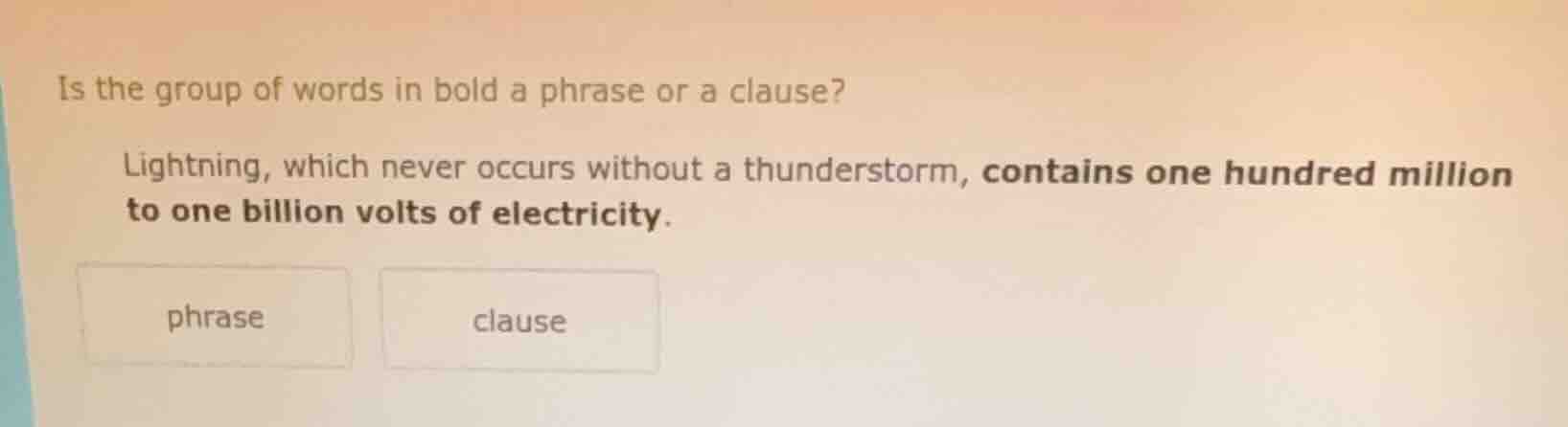
is the group of words in bold a phrase or a clause? lightning, which never occurs without a thunderstorm, contains one hundred million to one billion volts of electricity. phrase clause
A clause must have a subject and a predicate (verb + related elements), while a phrase lacks a subject - predicate structure. The bolded group “contains one hundred million to one billion volts of electricity” has the subject (implied as “Lightning”) and the predicate “contains...electricity” with a verb “contains” and its object. Wait, no—actually, the bolded part: let's re - examine. Wait, the bolded text is “contains one hundred million to one billion volts of electricity”. Wait, no, the bolded part: the structure here—wait, no, a clause has a subject and a verb. Wait, the bolded group: “contains one hundred million to one billion volts of electricity”—here, “contains” is the verb, and the subject (Lightning) is outside the bolded part? Wait, no, maybe I made a mistake. Wait, no—actually, a phrase is a group of words without a subject - verb combination, and a clause has a subject and a verb. Wait, the bolded group: “contains one hundred million to one billion volts of electricity”—does it have a subject? The subject of the main clause is “Lightning”, and the bolded part is the predicate of the main clause? Wait, no, the bolded part is a clause? Wait, no—wait, the bolded text: “contains one hundred million to one billion volts of electricity”—this has a verb “contains” and an object. But does it have a subject? The subject is “Lightning” (not in the bolded part), but in terms of the structure, a clause requires a subject and a verb. Wait, maybe I messed up. Wait, no—let's recall: a phrase is a group of words that functions as a single unit in a sentence, lacking a subject - verb pair. A clause has a subject and a verb. The bolded part: “contains one hundred million to one billion volts of electricity”—the word “contains” is a verb, and the subject (Lightning) is the subject of this verb. So this group has a subject (implied from the main clause) and a verb, so it's a clause? Wait, no, maybe not. Wait, no—wait, the bolded text is “contains one hundred million to one billion volts of electricity”. Let's break it down: “contains” (verb) + “one hundred million to one billion volts of electricity” (object). But a clause needs a subject and a verb. The subject here is “Lightning”, which is part of the main sentence, not the bolded part. Wait, maybe the bolded part is a clause because it has a verb (“contains”) and it can stand as a clause (even though the subject is outside, but in the context of the sentence, it's a clause). Wait, no—actually, the correct approach: a phrase is a group of words without a subject - verb combination. The bolded group: “contains one hundred million to one billion volts of electricity”—has a verb “contains”, so it's a clause (because a clause has a verb, and the subject is present in the sentence, even if not in the bolded part? Wait, no, maybe I'm wrong. Wait, let's check the definitions again. A clause is a group of words that includes a subject and a verb. A phrase is a group of words that does not include a subject - verb pair. The bolded text: “contains one hundred million to one billion volts of electricity”—“contains” is a verb, so this group has a verb. The subject is “Lightning” (from the main sentence), so this is a clause? Wait, no, maybe the bolded part is a clause. Wait, but let's see: the bolded part is “contains one hundred million to one billion volts of electricity”. So the structure is verb + object. But a clause needs a subject and a verb. So if the subject is “Lightning” (which is the subject of the main clause), then this bolded part is the predicate of the main clause, which is a claus…

Snap & solve any problem in the app
Get step-by-step solutions on Sovi AI
Photo-based solutions with guided steps
Explore more problems and detailed explanations
clause