QUESTION IMAGE
Question
guided practice
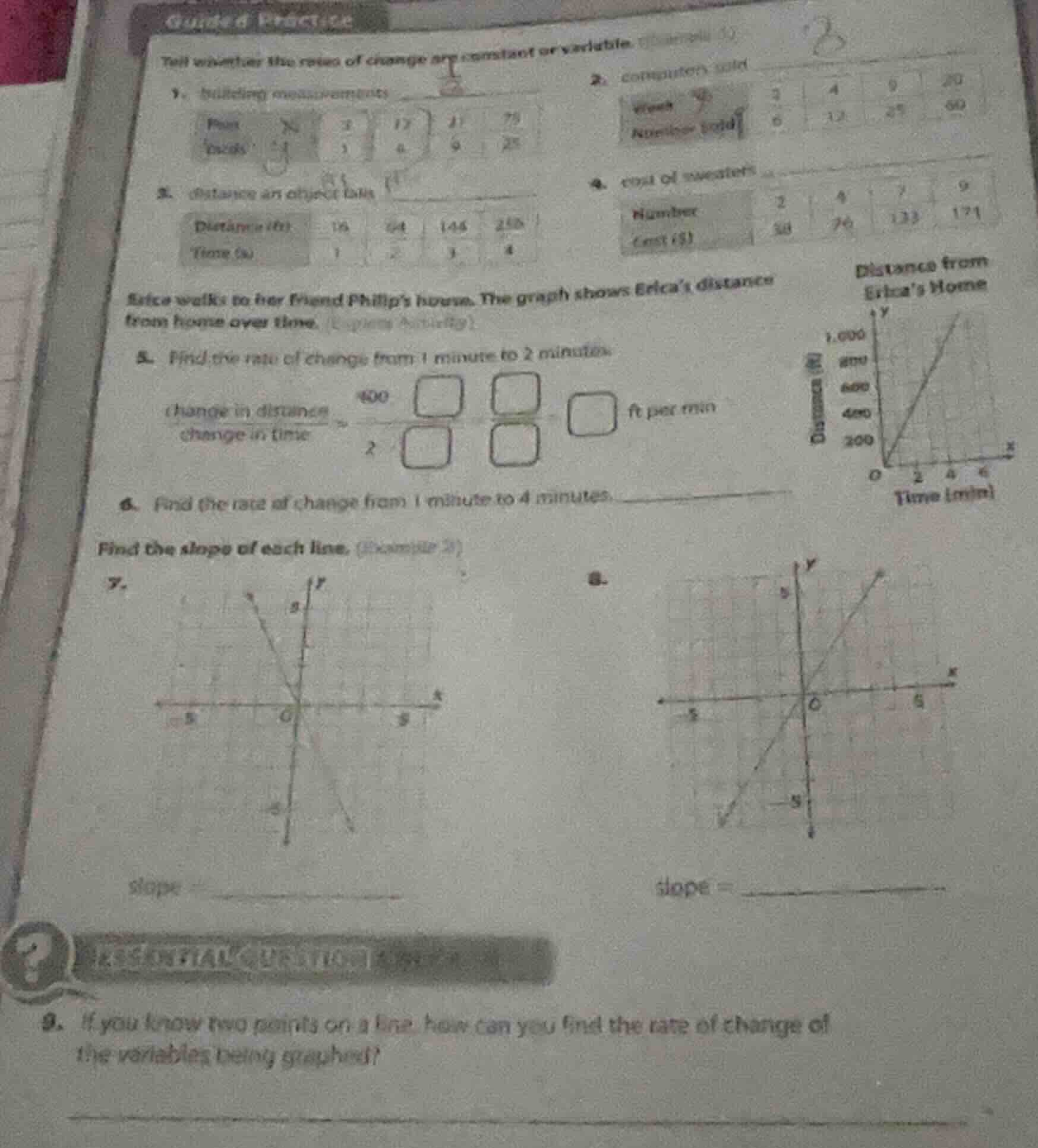
tell whether the rate of change are constant or variable. (example 1)
- building measurements
- computers sold
- distance an object falls
- cost of sweaters
erica walks to her friend philip’s house. the graph shows erica’s distance from home over time. (example 2)
- find the rate of change from 1 minute to 2 minutes.
\\(\frac{\text{change in distance}}{\text{change in time}} = \frac{400 - \square}{2 - \square} = \frac{\square}{\square} = \square\\) ft per min
- find the rate of change from 1 minute to 4 minutes. _________
find the slope of each line. (example 3)
7.
slope = _________
8.
slope = _________
- if you know two points on a line, how can you find the rate of change of the variables being graphed?
Problem 5:
Step1: Identify change in distance and time
From the graph, at \( t = 1 \) minute, distance \( d_1 = 400 \) ft? Wait, no, the formula is \(\frac{\text{change in distance}}{\text{change in time}}\). Wait, the numerator is \( 400 - 0 \)? Wait, no, the given is from 1 minute to 2 minutes. Wait, the graph: at \( x = 2 \) (time), \( y = 400 \)? Wait, the formula is \(\frac{\text{change in distance}}{\text{change in time}}=\frac{400 - 200}{2 - 1}\)? Wait, no, the problem has \(\frac{400 - \square}{2 - \square}\). Wait, maybe at \( t = 1 \), distance is 200, at \( t = 2 \), distance is 400. So change in distance is \( 400 - 200 = 200 \)? Wait, no, the problem's formula is \(\frac{400 - \square}{2 - \square}\). Wait, maybe the first value at \( t = 1 \) is 200, \( t = 2 \) is 400. So:
Step1: Subtract initial distance from final distance
Change in distance: \( 400 - 200 = 200 \) (Wait, no, the numerator is \( 400 - \square \), denominator \( 2 - \square \). Let's see, time changes from 1 to 2, so change in time is \( 2 - 1 = 1 \). Distance at 1 min: 200, at 2 min: 400. So \(\frac{400 - 200}{2 - 1}=\frac{200}{1}=200\)? Wait, no, the problem's formula is \(\frac{400 - \square}{2 - \square}\). Wait, maybe the blanks are: numerator \( 400 - 200 \), denominator \( 2 - 1 \). So:
Step1: Fill in the blanks for distance change
Change in distance: \( 400 - 200 \) (assuming at \( t = 1 \), distance is 200)
Step2: Fill in the blanks for time change
Change in time: \( 2 - 1 \)
Step3: Calculate the ratio
\(\frac{400 - 200}{2 - 1}=\frac{200}{1}=200\) ft per min. Wait, but the problem's formula is \(\frac{400 - \square}{2 - \square}\), so maybe:
\(\frac{400 - 200}{2 - 1}=\frac{200}{1}=200\). So the blanks are 200, 1, 200, 1, and the result is 200. Wait, maybe the correct values are:
Numerator: \( 400 - 200 = 200 \)
Denominator: \( 2 - 1 = 1 \)
So \(\frac{400 - 200}{2 - 1}=\frac{200}{1}=200\) ft per min.
Step1: Find distance at 1 min and 4 min
From the graph, at \( t = 1 \), distance is 200; at \( t = 4 \), distance is 800 (since the line is linear, slope 200, so at \( t = 4 \), \( d = 200 \times 4 = 800 \))
Step2: Calculate change in distance and time
Change in distance: \( 800 - 200 = 600 \)
Change in time: \( 4 - 1 = 3 \)
Step3: Find the ratio
Rate of change: \(\frac{600}{3}=200\) ft per min.
Step1: Identify two points on the line
The line passes through (0, 0) and (1, -3) (or (-1, 3)). Let's take (0, 0) and (1, -3).
Step2: Use slope formula \( m=\frac{y_2 - y_1}{x_2 - x_1} \)
\( m=\frac{-3 - 0}{1 - 0}=\frac{-3}{1}=-3 \)

Snap & solve any problem in the app
Get step-by-step solutions on Sovi AI
Photo-based solutions with guided steps
Explore more problems and detailed explanations
The blanks are (from top to bottom, left to right): 200, 1, 200, 1, and the final answer is 200.