QUESTION IMAGE
Question
guiding question 2: why did the us change its mind and enter world war i?
term | definition/notes
supporting the allies? |
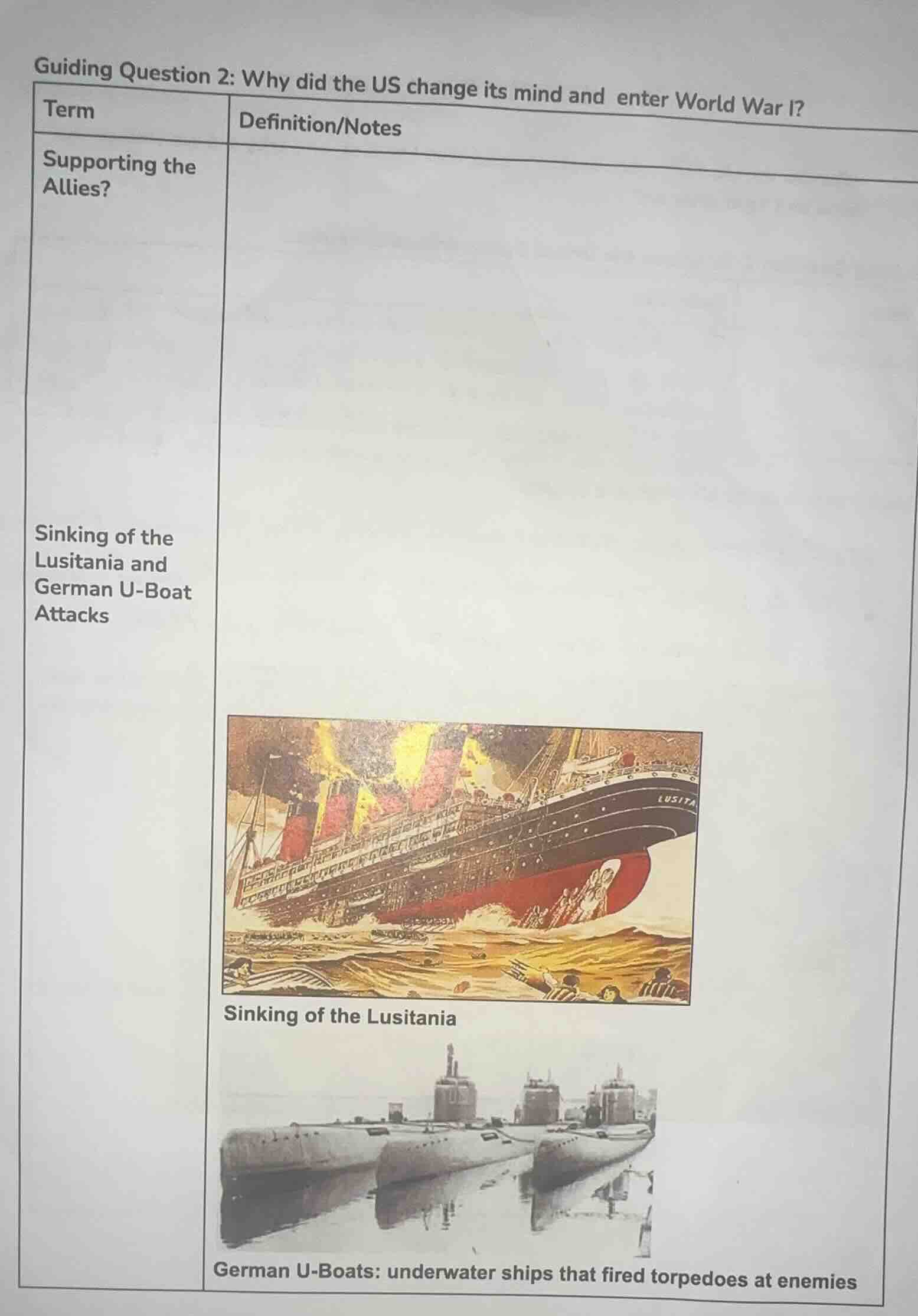
sinking of the lusitania and german u - boat attacks |
image of sinking of the lusitania
sinking of the lusitania
image of german u - boats
german u - boats: underwater ships that fired torpedoes at enemies
To answer the questions about the terms in the context of US entry into WWI, we analyze each term:
1. “Supporting the Allies?”
The US had economic ties with the Allies (e.g., loans, trade). If the Allies lost, the US risked losing investments. Also, cultural ties (many Americans had European, especially Allied - leaning, heritage) and a sense of shared values with democratic - leaning Allies influenced support. This support grew as tensions with Central Powers (like Germany) rose, pushing the US closer to joining the war.
2. “Sinking of the Lusitania and German U - Boat Attacks”
- Lusitania Sinking: In 1915, a German U - boat sank the British passenger liner Lusitania, killing 1,198 people, including 128 Americans. This outraged the US public and turned opinion against Germany.
- German U - Boat Attacks: Germany’s unrestricted submarine warfare (attacking any ships, including neutral US vessels) violated international law and US neutrality. It threatened US lives and commerce, making US entry into the war more likely as it directly challenged US interests.
For the table:
| Term | Definition/Notes |
|---|---|
| Sinking of the Lusitania and German U - Boat Attacks | - Lusitania: 1915, German U - boat sank the liner, killing 128 Americans, outraging the US. <br> - German U - Boats: Submarines that fired torpedoes. Germany’s unrestricted submarine warfare targeted US ships, violating neutrality and threatening US lives/commerce, a key reason for US entry into WWI. |

Snap & solve any problem in the app
Get step-by-step solutions on Sovi AI
Photo-based solutions with guided steps
Explore more problems and detailed explanations
To answer the questions about the terms in the context of US entry into WWI, we analyze each term:
1. “Supporting the Allies?”
The US had economic ties with the Allies (e.g., loans, trade). If the Allies lost, the US risked losing investments. Also, cultural ties (many Americans had European, especially Allied - leaning, heritage) and a sense of shared values with democratic - leaning Allies influenced support. This support grew as tensions with Central Powers (like Germany) rose, pushing the US closer to joining the war.
2. “Sinking of the Lusitania and German U - Boat Attacks”
- Lusitania Sinking: In 1915, a German U - boat sank the British passenger liner Lusitania, killing 1,198 people, including 128 Americans. This outraged the US public and turned opinion against Germany.
- German U - Boat Attacks: Germany’s unrestricted submarine warfare (attacking any ships, including neutral US vessels) violated international law and US neutrality. It threatened US lives and commerce, making US entry into the war more likely as it directly challenged US interests.
For the table:
| Term | Definition/Notes |
|---|---|
| Sinking of the Lusitania and German U - Boat Attacks | - Lusitania: 1915, German U - boat sank the liner, killing 128 Americans, outraging the US. <br> - German U - Boats: Submarines that fired torpedoes. Germany’s unrestricted submarine warfare targeted US ships, violating neutrality and threatening US lives/commerce, a key reason for US entry into WWI. |