QUESTION IMAGE
Question
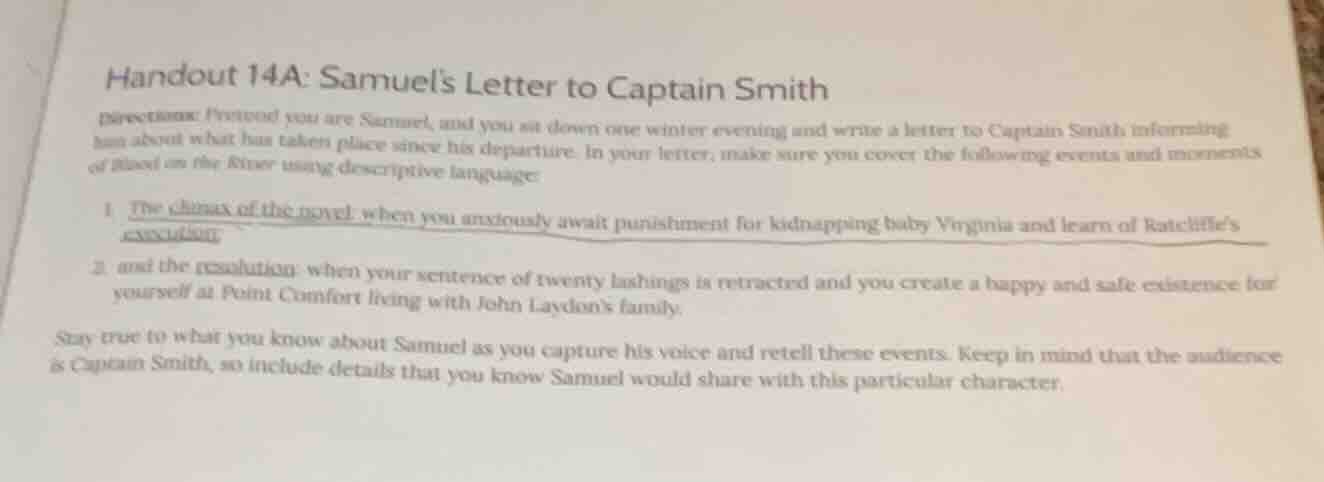
handout 14a: samuels letter to captain smithdirections: pretend you are samuel, and you sit down one winter evening and write a letter to captain smith informing him about what has taken place since his departure. in your letter, make sure you cover the following events and moments of based on the novel using descriptive language:1. the climax of the novel: when you anxiously await punishment for kidnapping baby virginia and learn of ratcliffes execution;2. and the resolution: when your sentence of twenty lashings is retracted and you create a happy and safe existence for yourself at point comfort living with john laydons family.stay true to what you know about samuel as you capture his voice and retell these events. keep in mind that the audience is captain smith, so include details that you know samuel would share with this particular character.
This is a creative writing task from a literary context, requiring adoption of Samuel's voice to write a personal letter to Captain Smith. The letter must vividly recount the climax (awaiting punishment for kidnapping baby Virginia, learning of Ratcliffe's execution) and resolution (sentence retraction, building a safe life with John Laydon's family at Point Comfort), with details Samuel would share with this specific recipient.

Snap & solve any problem in the app
Get step-by-step solutions on Sovi AI
Photo-based solutions with guided steps
Explore more problems and detailed explanations
Samuel's Letter to Captain Smith
Winter Evening, Point Comfort
Dear Captain Smith,
The fire sputters low here by the James, and I write with hands still calloused from the work of felling trees, but my heart is lighter than it has been in months—though I must first tell you of the darkest days that came after you sailed away.
When we found baby Virginia gone, the settlement turned on me like a pack of starved hounds. I was dragged before the council, my hands tied so tight the blood pooled at my wrists, and told I’d hang for stealing her. I sat in the cold, damp cell each night, listening to the wind howl through the palisade, sure I’d never see the sun rise again. Then a guard slipped me a scrap of bread and whispered it: Ratcliffe was dead, hanged for his lies and greed, his body left for the crows by the river. I didn’t cheer—my own neck still felt the noose’s phantom touch—but I knew the tide might turn.
And turn it did. Young John Laydon, who’d once shared a crust of bread with me when we first landed, spoke up for me. He told the council I’d never hurt a child, that I’d been half-mad with grief over my own sister’s death back in England. Miraculously, they listened. The sentence of twenty lashings was torn up, and I was set free.
Now I live with John’s family at Point Comfort. We have a small cabin with a thatched roof that keeps out the rain, and a garden where we grow corn and squash. Last week, I taught John’s little brother to carve a wooden rabbit, and he laughed so loud the geese took flight from the river. I still wake some nights, sweating, thinking I’m back in that cell—but then I hear the crickets outside, or John’s mother singing by the fire, and I know I’m safe.
I wish you were here to see it. You always said we could build something better than the fear and bloodshed. We’re starting to, here at Point Comfort.
Stay safe on the seas, Captain.
Your friend,
Samuel