QUESTION IMAGE
Question
hands-on activity
modeling periodic trends
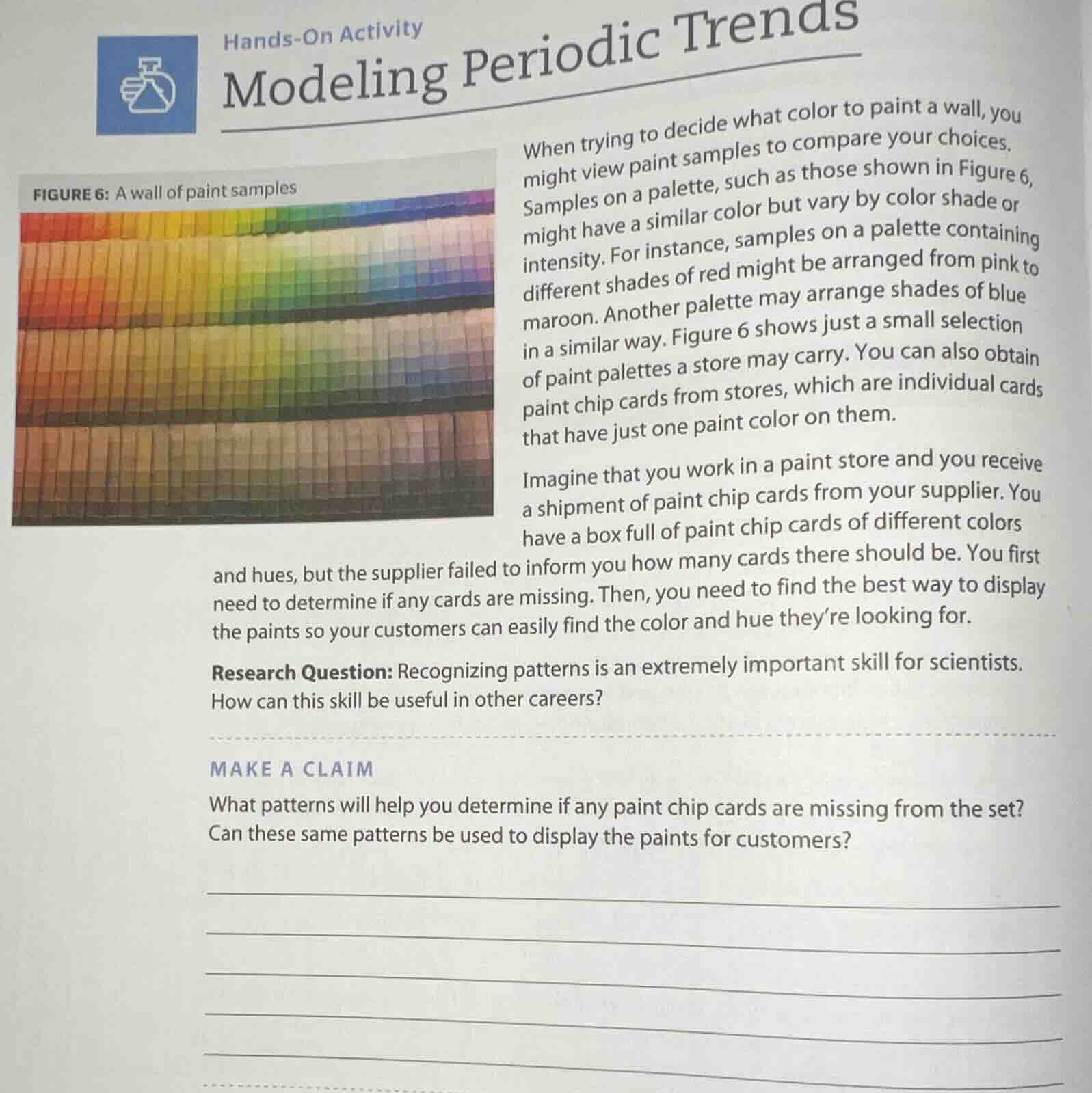
figure 6: a wall of paint samples
when trying to decide what color to paint a wall, you might view paint samples to compare your choices. samples on a palette, such as those shown in figure 6, might have a similar color but vary by color shade or intensity. for instance, samples on a palette containing different shades of red might be arranged from pink to maroon. another palette may arrange shades of blue in a similar way. figure 6 shows just a small selection of paint palettes a store may carry. you can also obtain paint chip cards from stores, which are individual cards that have just one paint color on them.
imagine that you work in a paint store and you receive a shipment of paint chip cards from your supplier. you have a box full of paint chip cards of different colors and hues, but the supplier failed to inform you how many cards there should be. you first need to determine if any cards are missing. then, you need to find the best way to display the paints so your customers can easily find the color and hue they’re looking for.
research question: recognizing patterns is an extremely important skill for scientists. how can this skill be useful in other careers?
make a claim
what patterns will help you determine if any paint chip cards are missing from the set? can these same patterns be used to display the paints for customers?
To determine missing paint chip cards, patterns like color gradients (arranging from lighter to darker or across the color spectrum) and sequential color families (e.g., all red - related shades in order) can be used. These patterns help identify gaps (missing cards) as a continuous sequence would have no breaks. For display, the same color - based patterns (gradients, color - family groupings) work because customers can easily navigate by color intensity or family, matching how they choose paint (e.g., from light to dark blue). So, color - related patterns (gradient, color - family order) help detect missing cards and are suitable for display.

Snap & solve any problem in the app
Get step-by-step solutions on Sovi AI
Photo-based solutions with guided steps
Explore more problems and detailed explanations
Patterns such as arranging paint chip cards by color gradients (from lighter to darker shades of a color) and by color - family sequences (e.g., all red - hued cards in order from pink to maroon) can help determine if any cards are missing (by identifying gaps in the continuous sequence of colors). These same patterns can be used to display the paints for customers, as customers can easily find colors by following the gradient or color - family order (e.g., to find a specific shade of blue, they can look through the blue - family cards arranged from light to dark blue).