QUESTION IMAGE
Question
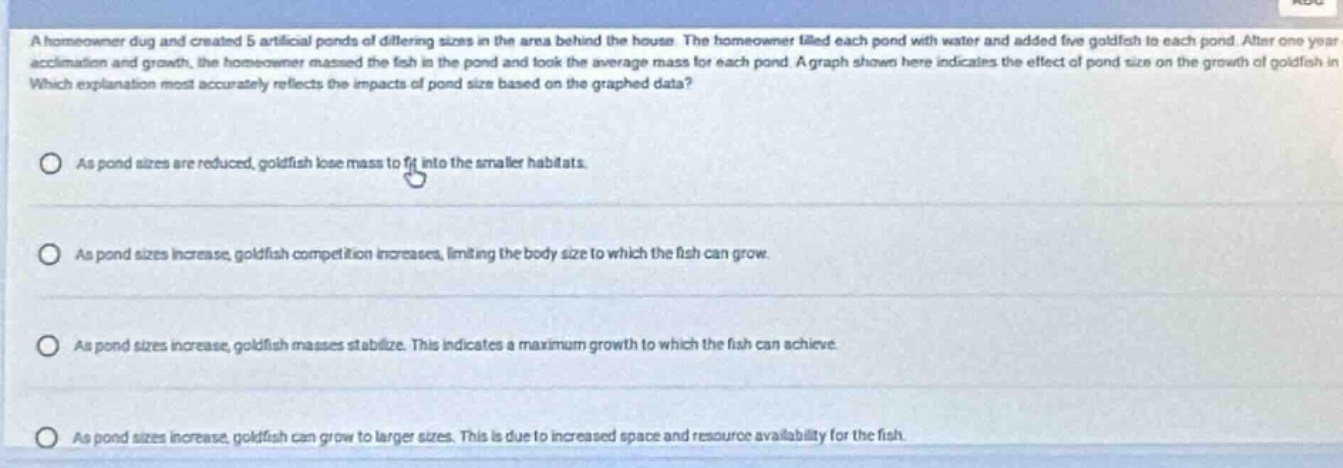
a homeowner dug and created 5 artificial ponds of differing sizes in the area behind the house. the homeowner filled each pond with water and added five goldfish to each pond. after one year acclimation and growth, the homeowner massed the fish in the pond and took the average mass for each pond. a graph shown here indicates the effect of pond size on the growth of goldfish in which explanation most accurately reflects the impacts of pond size based on the graphed data?
- as pond sizes are reduced, goldfish lose mass to fit into the smaller habitats.
- as pond sizes increase, goldfish competition increases, limiting the body size to which the fish can grow.
- as pond sizes increase, goldfish masses stabilize. this indicates a maximum growth to which the fish can achieve.
- as pond sizes increase, goldfish can grow to larger sizes. this is due to increased space and resource availability for the fish.
- Analyze Option 1: There's no biological basis for fish losing mass to "fit" habitats; this is not a valid ecological explanation.
- Analyze Option 2: Larger ponds usually mean less competition (more space/resources), so competition wouldn't increase with pond size. This is incorrect.
- Analyze Option 3: If masses stabilize with larger ponds, it would imply a limit, but the typical ecological relationship with pond size (space/resources) suggests growth with more resources, not stabilization as the primary effect.
- Analyze Option 4: Larger ponds provide more space and resources (food, oxygen, etc.), allowing goldfish to grow larger. This aligns with ecological principles (more resources reduce competition and support growth).

Snap & solve any problem in the app
Get step-by-step solutions on Sovi AI
Photo-based solutions with guided steps
Explore more problems and detailed explanations
D. As pond sizes increase, goldfish can grow to larger sizes. This is due to increased space and resource availability for the fish.