QUESTION IMAGE
Question
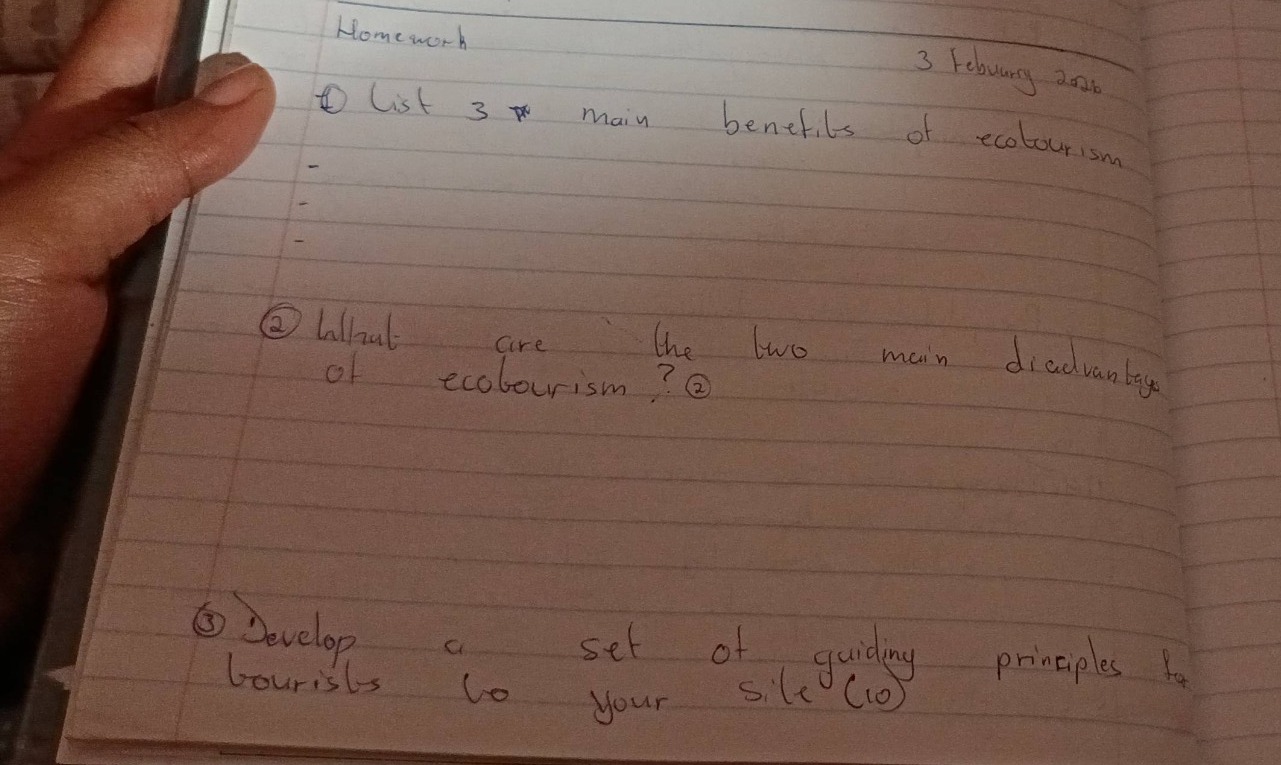
homework 3 february 2026
1 list 3 main benefits of ecotourism
-
-
-
2 what are the two main disadvantages of ecotourism?
3 develop a set of guiding principles for tourists to your site (10)
Response
Sub - question 1: List 3 main benefits of ecotourism
Brief Explanations
Ecotourism focuses on responsible travel to natural areas.
- Economic Benefit: It generates income for local communities. This income can be used for infrastructure development, healthcare, and education. For example, in many ecotourism destinations, local people get jobs in hotels, tour guiding, or handicraft sales related to ecotourism activities.
- Conservation Benefit: It promotes the conservation of natural habitats and wildlife. The revenue from ecotourism can be used to fund conservation projects. Also, when areas are used for ecotourism, there is an economic incentive to protect the environment rather than exploit it (e.g., deforestation for other industries).
- Cultural Benefit: It helps in preserving local cultures. Tourists get to experience local traditions, and this interaction also makes the local community more aware of the value of their own culture, leading to efforts to preserve it (like traditional festivals, handicrafts, and ways of life).
Brief Explanations
- Environmental Degradation: An increase in the number of tourists can lead to environmental damage. For instance, increased foot traffic can damage fragile ecosystems, overuse of natural resources (like water) in ecotourism facilities, and pollution from waste generated by tourists (e.g., plastic waste in natural areas).
- Cultural Erosion: The influx of tourists can lead to the commercialization of local cultures. Local traditions may be modified or lost as they are adapted to meet tourist expectations. Also, the values of the local community may be influenced by the more consumer - oriented values of tourists, leading to a loss of traditional cultural identity.
Brief Explanations
- Respect for the Environment:
- Do not litter. Carry all waste back with you or dispose of it in designated bins.
- Stay on marked trails to avoid damaging fragile vegetation and habitats.
- Do not disturb wildlife. Keep a safe distance and do not feed animals (feeding can disrupt their natural behavior and diet).
- Respect for Local Culture:
- Dress appropriately when visiting cultural sites or interacting with local communities (follow local dress codes if any).
- Ask for permission before taking photos of local people or their cultural practices.
- Respect local customs and traditions (e.g., religious practices, social norms).
- Sustainable Consumption:
- Use local products and services to support the local economy.
- Conserve resources like water and energy in accommodation facilities (e.g., turn off lights when not in use, use water sparingly).

Snap & solve any problem in the app
Get step-by-step solutions on Sovi AI
Photo-based solutions with guided steps
Explore more problems and detailed explanations
- Economic: Generates income for local communities (e.g., jobs in tourism - related services).
- Conservation: Promotes protection of natural habitats and wildlife (e.g., funding for conservation projects).
- Cultural: Preserves local cultures (e.g., promotion of traditional practices and heritage).