QUESTION IMAGE
Question
how do consumers get oxygen to cells? movement of o₂ for cell respiration in organisms of the pacific northwest
recall from the exercise, \macromolecules: what are the building blocks of life?\ that all life depends on the properties and reactions of four classes of organic (carbon - based) compounds—carbohydrates, lipids, proteins, and nucleic acids. in africa, we found that the main source of food for energy for plants was glucose, for elephants was carbohydrates, and for lions it was protein. for some organisms, chemical digestion breaks down food into smaller molecules that can be transported across the membranes of the small intestines cells and finally into cells of the body for cellular respiration.
during cellular respiration, the energy released from chemical bonds is captured into the cells specific energy molecule, adenosine triphosphate (atp). atp has the ability to provide energy for work in the cell. oxygen is needed for stages of cell respiration to occur.
in the following exercise, you will consider how consumers of the pacific northwest obtain the oxygen necessary for cellular respiration from the environment. this oxygen must travel from the environment through the organism to the cell and finally to the mitochondria.
part 1: respiration and gas exchange in sea urchins
- the oxygen obtained by an urchin is dissolved in water. the urchin obtains oxygen through diffusion only. instead of the respiratory system used by many organisms, the urchin has a water vascular system. a water vascular system is a network of canals ending in the tubed feet of a sea urchin. there is also the ring canal which surrounds the mouth. the ring canal and tubed feet are part of the madreporite (m) which is an opening used to filter water into the water vascular system. the stone canal is a tube that connects the madreporite to the ring canal. in addition, the urchin has 5 pairs of external gills around its mouth.
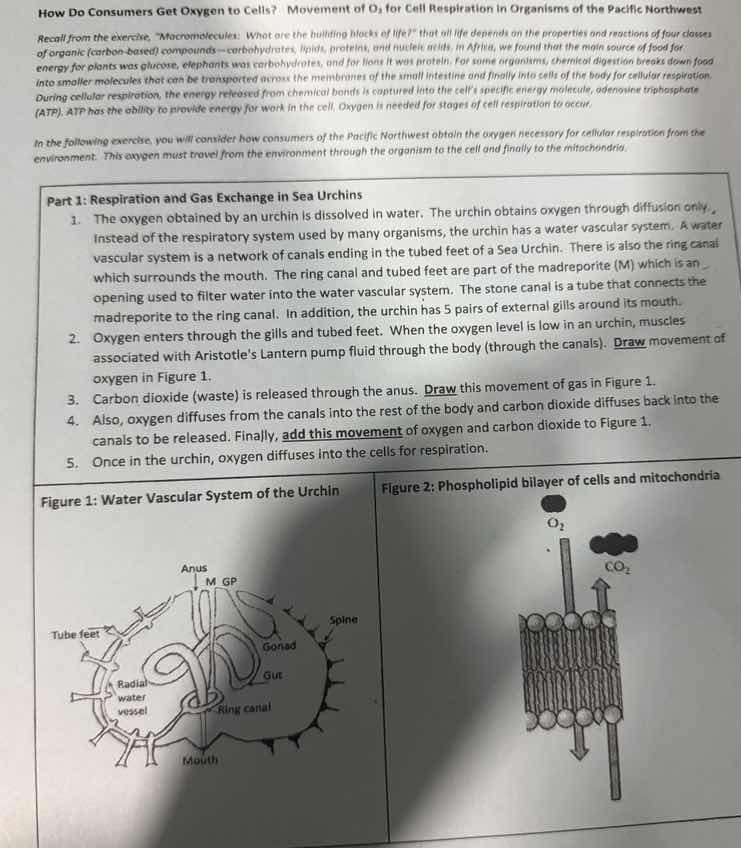
- oxygen enters through the gills and tubed feet. when the oxygen level is low in an urchin, muscles associated with aristotles lantern pump fluid through the body (through the canals). draw movement of oxygen in figure 1.
- carbon dioxide (waste) is released through the anus. draw this movement of gas in figure 1.
- also, oxygen diffuses from the canals into the rest of the body and carbon dioxide diffuses back into the canals to be released. finally, add this movement of oxygen and carbon dioxide to figure 1.
- once in the urchin, oxygen diffuses into the cells for respiration.
figure 1: water vascular system of the urchin
figure 2: phospholipid bilayer of cells and mitochondria
figure 1 shows a diagram of the water vascular system of the urchin with labels: anus, m, gp, tube feet, radial water vessel, ring canal, mouth, gonad, gut, spine
figure 2 shows a diagram of the phospholipid bilayer of cells and mitochondria with o₂ and co₂ movement arrows
This exercise tracks the path of oxygen for cellular respiration in sea urchins, plus carbon dioxide waste removal:
- Oxygen intake path: Starts as dissolved water oxygen → enters madreporite (M) → stone canal → ring canal → radial water vessels → tube feet/gills. Low oxygen triggers Aristotle's Lantern muscles to pump fluid through canals.
- Carbon dioxide removal path: Produced in cells → diffuses into water vascular canals → travels back through radial/ring canals → exits via anus.
- Final cellular step: Oxygen diffuses from canals into body cells, then into mitochondria for respiration.

Snap & solve any problem in the app
Get step-by-step solutions on Sovi AI
Photo-based solutions with guided steps
Explore more problems and detailed explanations
Oxygen Movement (Figure 1):
- Draw an arrow pointing into the Madreporite (M) (label "Dissolved O₂ from water").
- Draw arrows from Madreporite → Stone Canal → Ring Canal → Radial Water Vessels → Tube Feet + External Gills.
- Draw arrows from Radial Water Vessels toward body cells, then label an arrow from cells to mitochondria (Figure 2) pointing into the organelle (label "O₂ for respiration").
- Add a small arrow near Aristotle's Lantern (near mouth/gut) pointing into the ring canal, labeled "Pumped fluid (low O₂)".
Carbon Dioxide Movement (Figure 1):
- Draw arrows from body cells → Radial Water Vessels → Ring Canal → Anus.
- Draw an arrow pointing out of the Anus (label "CO₂ waste out").
- In Figure 2, draw an arrow pointing out of the cell membrane, labeled "CO₂ waste from cells".