QUESTION IMAGE
Question
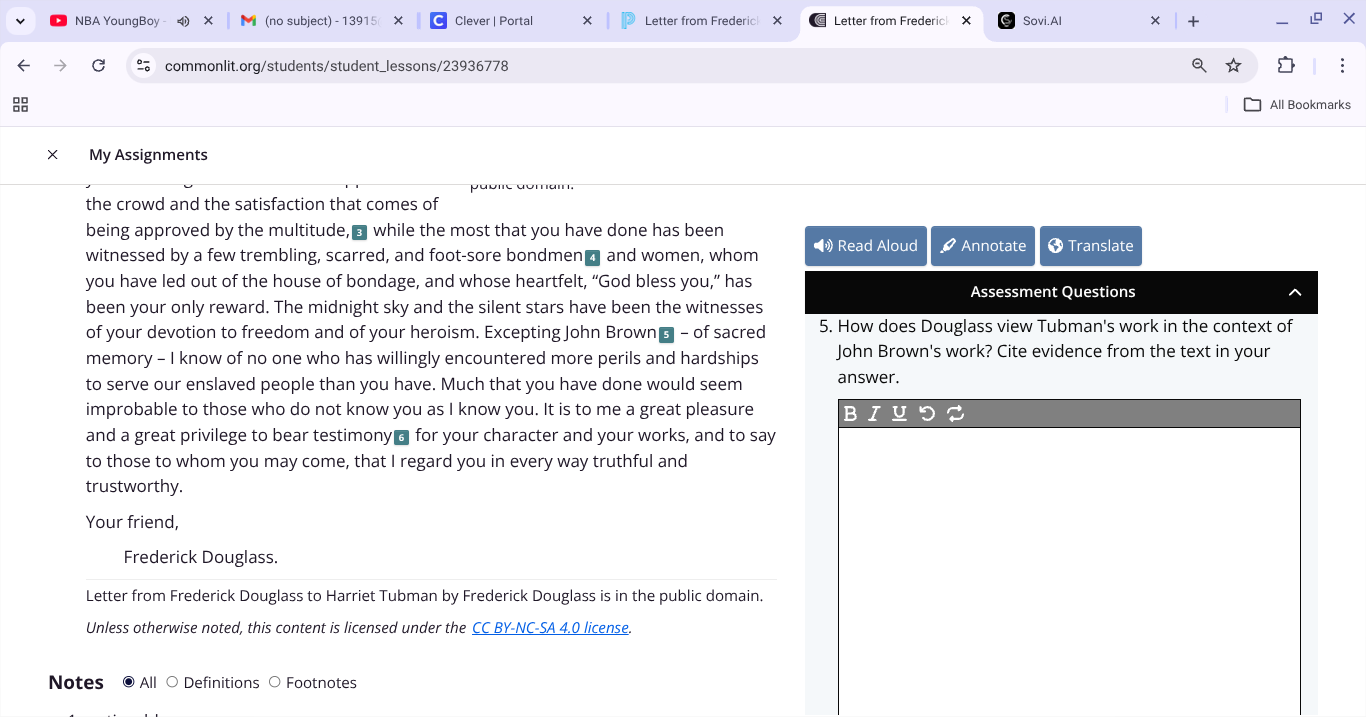
- how does douglass view tubmans work in the context of john browns work? cite evidence from the text in your answer.
To answer, we analyze the text: Douglass says Tubman’s work (leading enslaved people to freedom) involved “more perils and hardships” than John Brown’s, excepting Brown. Evidence: “Excepting John Brown – of sacred memory – I know of no one who has willingly encountered more perils and hardships to serve our enslaved people than you have.” Also, Tubman’s reward was “heartfelt, ‘God bless you’” (modest, personal), while Brown’s legacy is “sacred memory” (more public acclaim, but Tubman’s risks were greater per Douglass). Douglass views Tubman’s work as exceptionally courageous, with more direct peril in liberating enslaved people, even compared to Brown.

Snap & solve any problem in the app
Get step-by-step solutions on Sovi AI
Photo-based solutions with guided steps
Explore more problems and detailed explanations
Douglass views Tubman’s work as involving more “perils and hardships” in serving enslaved people than John Brown’s work, excepting Brown. Evidence from the text: “Excepting John Brown – of sacred memory – I know of no one who has willingly encountered more perils and hardships to serve our enslaved people than you have.” Additionally, Tubman’s efforts (leading “trembling, scarred, and foot - sore bondmen and women” out of bondage) were witnessed by few, with her only reward being their “God bless you,” while her “devotion to freedom and... heroism” was witnessed by “the midnight sky and the silent stars.” This shows Douglass believes Tubman’s work was uniquely courageous, with greater personal risk and more intimate, unheralded acts of liberation, even when compared to Brown (whose legacy is “sacred memory” but, per Douglass, did not face as many perils as Tubman in freeing enslaved people).