QUESTION IMAGE
Question
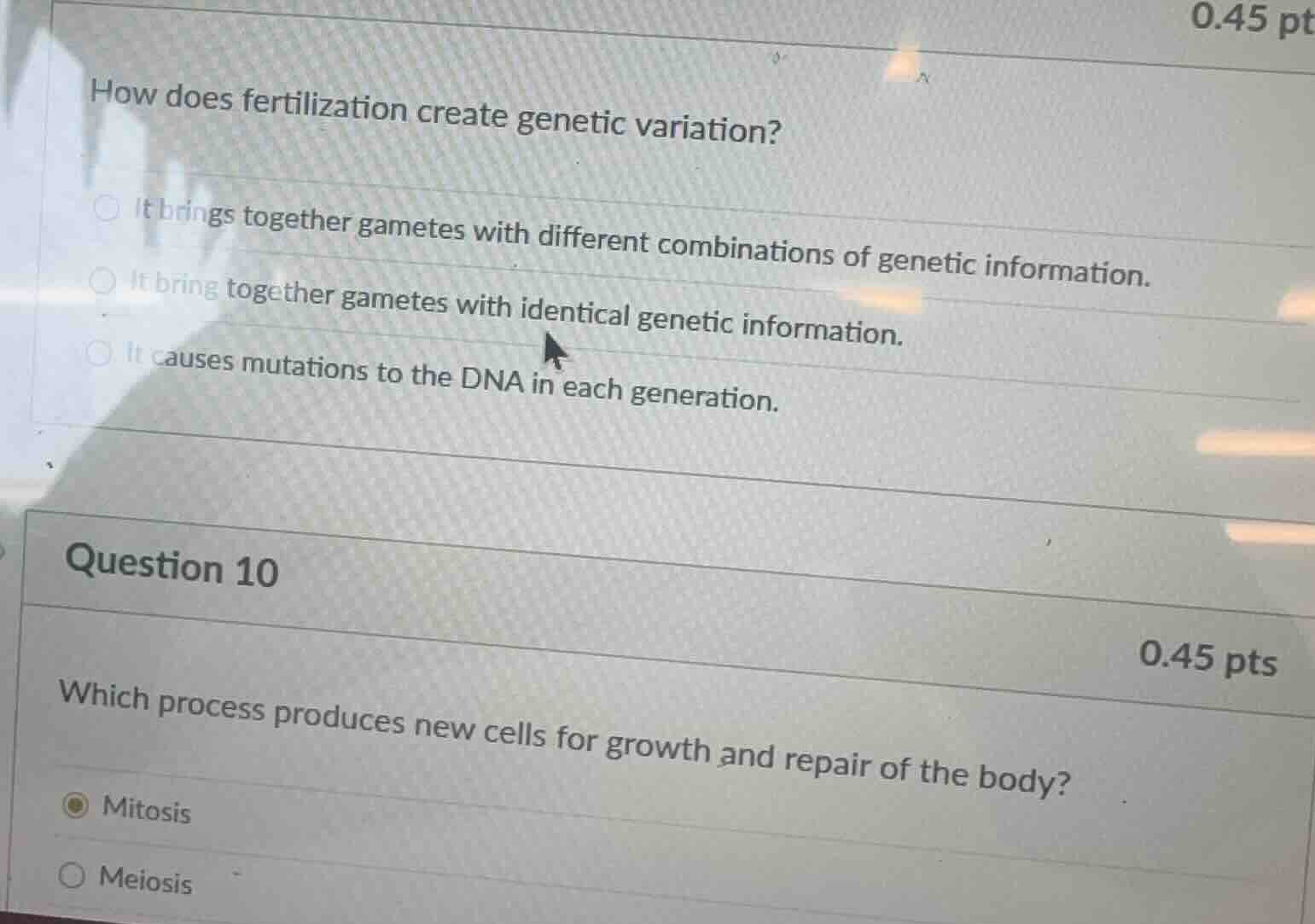
how does fertilization create genetic variation?
it brings together gametes with different combinations of genetic information.
it bring together gametes with identical genetic information.
it causes mutations to the dna in each generation.
question 10
which process produces new cells for growth and repair of the body?
mitosis
meiosis
Response
First Question (How does fertilization create genetic variation?):
Brief Explanations
- Analyze Option 1: Fertilization involves a sperm (a gamete) and an egg (a gamete) fusing. Gametes are produced via meiosis, which shuffles genetic information, so each gamete has a unique combination. Bringing two such gametes together combines their different genetic info, leading to variation.
- Analyze Option 2: Gametes from different parents (or even the same parent in some cases, but generally) don't have identical genetic info. So this is incorrect.
- Analyze Option 3: Fertilization itself doesn't cause mutations. Mutations are changes in DNA sequence due to other factors (like radiation, errors in replication), not fertilization. So this is incorrect.
Brief Explanations
- Mitosis: Mitosis is the process of cell division that produces two identical daughter cells. It's responsible for growth (e.g., increasing the number of cells in a tissue) and repair (replacing damaged or dead cells) in the body.
- Meiosis: Meiosis is the process that produces gametes (sperm and egg cells) with half the number of chromosomes. It's involved in sexual reproduction, not growth/repair of the body.

Snap & solve any problem in the app
Get step-by-step solutions on Sovi AI
Photo-based solutions with guided steps
Explore more problems and detailed explanations
A. It brings together gametes with different combinations of genetic information.