QUESTION IMAGE
Question
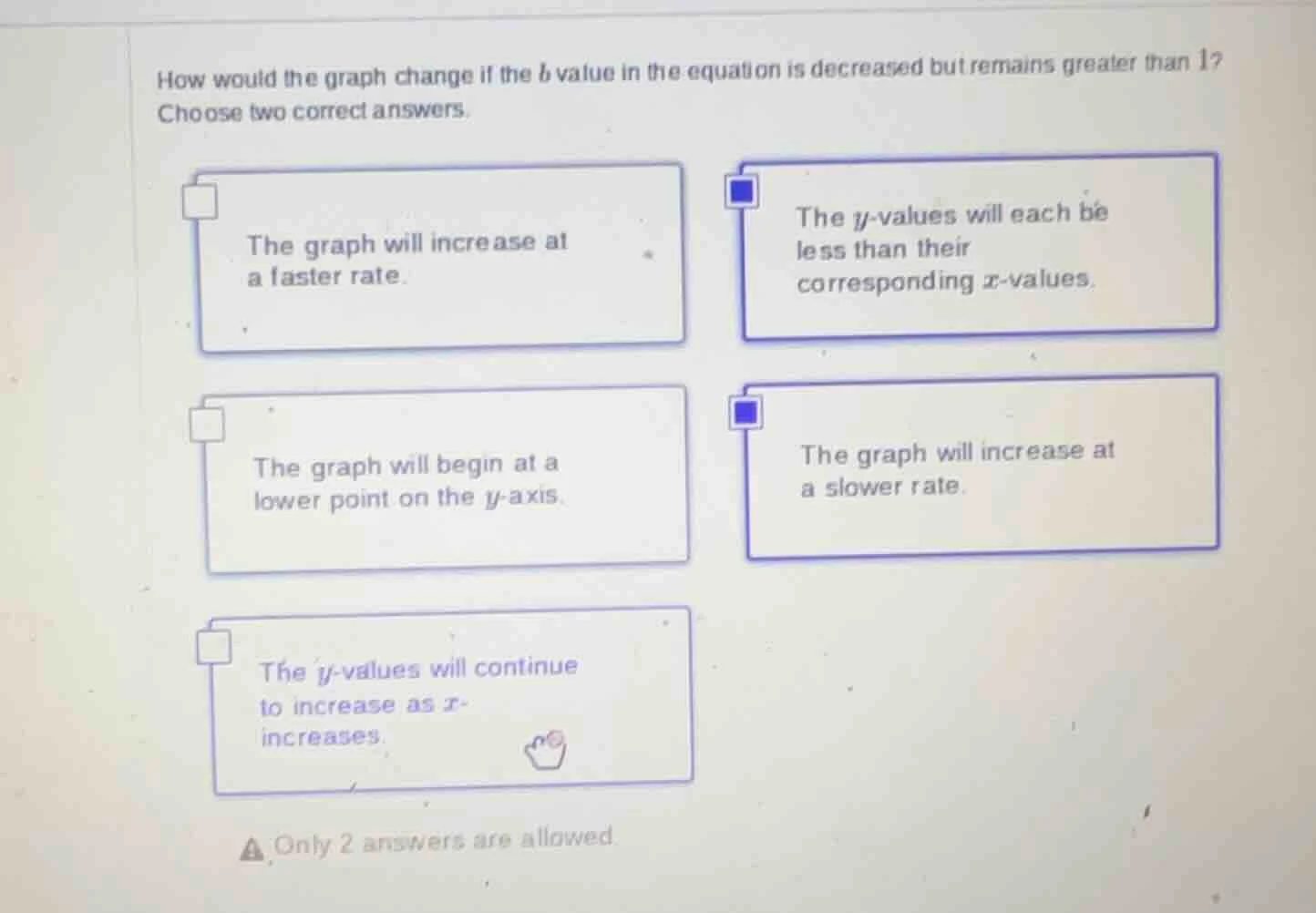
how would the graph change if the $b$ value in the equation is decreased but remains greater than 1?
choose two correct answers.
the graph will increase at a faster rate.
the $y$-values will each be less than their corresponding $x$-values.
the graph will begin at a lower point on the $y$-axis.
the graph will increase at a slower rate.
the $y$-values will continue to increase as $x$-increases.
only 2 answers are allowed
This refers to exponential functions of the form $y = ab^x$ where $b>1$ (exponential growth). When $b$ is decreased but stays above 1:
- The growth rate slows because a smaller base means each multiplicative step is smaller.
- Since $b>1$, $y$ still increases as $x$ increases, just more slowly.
- The y-intercept (when $x=0$, $y=a$) does not depend on $b$, so it does not change.
- $y$-values are not necessarily less than $x$-values; this depends on $a$ and the specific $x$ value.

Snap & solve any problem in the app
Get step-by-step solutions on Sovi AI
Photo-based solutions with guided steps
Explore more problems and detailed explanations
D. The graph will increase at a slower rate.
E. The $y$-values will continue to increase as $x$-increases.