QUESTION IMAGE
Question
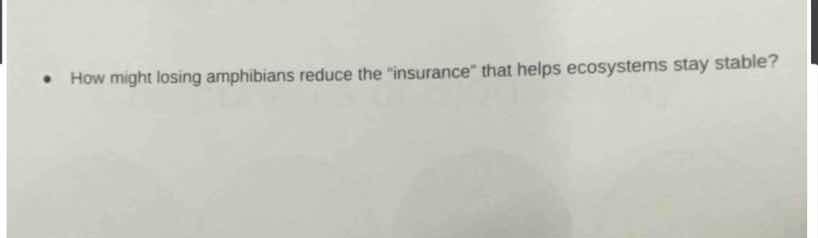
how might losing amphibians reduce the \insurance\ that helps ecosystems stay stable?
Amphibians play multiple ecological roles (e.g., predator, prey, nutrient cycler). Ecosystem "insurance" refers to functional redundancy (multiple species performing similar functions). Losing amphibians reduces this redundancy: if other species (with similar roles, like insect - eating or nutrient - cycling) decline, there's no backup. Also, amphibians are sensitive to environmental changes (e.g., pollution, climate change), so their loss signals ecosystem stress. Their absence disrupts food webs (e.g., if they eat insects, insect populations may boom, harming plants) and nutrient cycles (e.g., tadpoles help cycle nutrients in aquatic systems). With fewer amphibians, the ecosystem has fewer species to buffer against disturbances, so its stability (ability to resist/ recover from change) decreases.

Snap & solve any problem in the app
Get step-by-step solutions on Sovi AI
Photo-based solutions with guided steps
Explore more problems and detailed explanations
Losing amphibians reduces ecosystem "insurance" (stability) by: 1. Reducing functional redundancy (fewer species with similar ecological roles, so no backup if other species decline). 2. Signaling ecosystem stress (amphibians are environmental sentinels; their loss indicates deteriorating conditions). 3. Disrupting food webs (e.g., insect populations may surge without amphibian predators, harming plants) and nutrient cycles (e.g., tadpoles’ role in aquatic nutrient cycling is lost). 4. Decreasing the ecosystem’s ability to resist/recover from disturbances (fewer species to buffer changes).