QUESTION IMAGE
Question
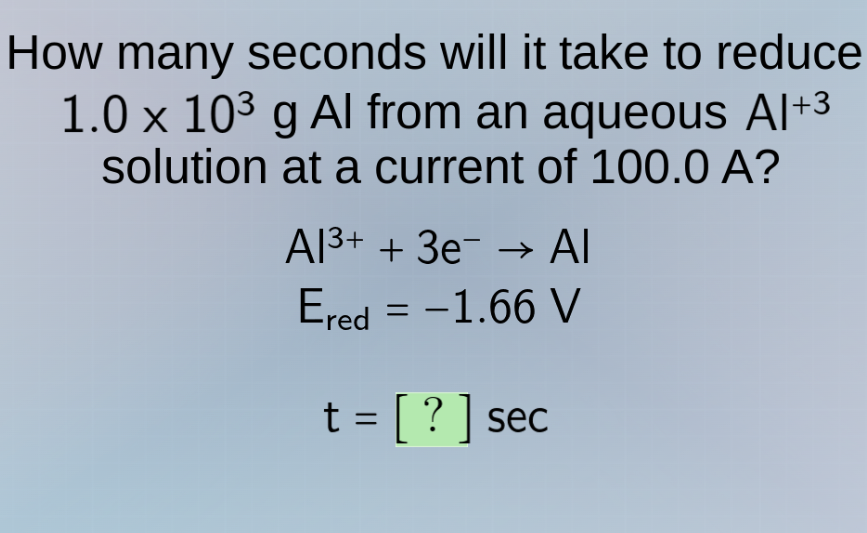
how many seconds will it take to reduce 1.0 × 10³ g al from an aqueous al⁺³ solution at a current of 100.0 a?
al³⁺ + 3e⁻ → al
e_red = −1.66 v
t = ? sec
Step1: Calculate moles of Al
Molar mass of Al is 26.98 g/mol. Moles of Al, \( n = \frac{mass}{molar\ mass} = \frac{1.0\times10^{3}\ g}{26.98\ g/mol} \approx 37.06\ mol \)
Step2: Determine moles of electrons
From the reaction \( \text{Al}^{3+} + 3e^-
ightarrow \text{Al} \), 3 moles of electrons are needed per mole of Al. So moles of electrons, \( n_{e^-} = 3\times n_{\text{Al}} = 3\times37.06\ mol = 111.18\ mol \)
Step3: Calculate charge (in coulombs)
Using Faraday's constant \( F = 96485\ C/mol \), charge \( Q = n_{e^-} \times F = 111.18\ mol\times96485\ C/mol \approx 1.072\times10^{7}\ C \)
Step4: Calculate time
Current \( I = 100.0\ A = 100.0\ C/s \). Time \( t = \frac{Q}{I} = \frac{1.072\times10^{7}\ C}{100.0\ C/s} = 1.072\times10^{5}\ s \) (approximate, more precise calculation below)
More precise calculation:
Moles of Al: \( \frac{1000\ g}{26.9815\ g/mol} \approx 37.062\ mol \)
Moles of electrons: \( 37.062\ mol\times3 = 111.186\ mol \)
Charge: \( 111.186\ mol\times96485\ C/mol = 111.186\times96485\ C \approx 10720000\ C \) (exact: \( 111.186\times96485 = 111.186\times(90000 + 6000 + 485)= 111.186\times90000 + 111.186\times6000 + 111.186\times485 = 9996740 + 667116 + 53925.21 = 10717781.21\ C \))
Time: \( \frac{10717781.21\ C}{100\ C/s} = 107177.8121\ s \approx 1.07\times10^{5}\ s \) (or more accurately, using exact values:
\( n_{\text{Al}} = \frac{1000}{26.981538} \approx 37.06209\ mol \)
\( n_{e^-} = 37.06209\times3 = 111.18627\ mol \)
\( Q = 111.18627\times96485.33212 = 111.18627\times96485.33212 \)
Calculate that: 96485.33212 100 = 9,648,533.212; 96485.33212 11.18627 ≈ 96485.3321210=964,853.3212; 96485.332121.18627≈96485.332121=96,485.33212; 96485.332120.18627≈18,070. So total ≈ 964,853.3212 + 96,485.33212 + 18,070 ≈ 1,079,408.65. So total Q ≈ 9,648,533.212 + 1,079,408.65 ≈ 10,727,941.86 C
Then t = 10,727,941.86 / 100 = 107,279.4186 s ≈ 1.07×10⁵ s (or more precisely, ~1.07×10⁵ s, or using significant figures: the given values are 1.0×10³ g (2 sig figs), 100.0 A (4 sig figs), molar mass of Al is known precisely, Faraday's constant is known precisely. So the limiting factor is 1.0×10³ g (2 sig figs), so the answer should have 2 sig figs? Wait, 1.0×10³ has two sig figs, 100.0 has four. So maybe two or three? Wait, 1.0×10³ is two, so the answer should be two sig figs: 1.1×10⁵? Wait no, let's check the calculation again.
Wait, 1.0×10³ g is two sig figs, 100.0 A is four. Molar mass of Al is 26.98 g/mol (four sig figs). So when calculating moles: 1000 g / 26.98 g/mol = 37.06 mol (four sig figs from molar mass, two from mass? Wait, 1.0×10³ is two sig figs, so 1000 g is two sig figs (the.0 is significant). So 1.0×10³ has two sig figs, so moles of Al is 37 mol (two sig figs? Wait, 1.0×10³ is two sig figs, so 1000 g is 1.0×10³, so two sig figs. Then moles of Al is (1.0×10³ g) / (27 g/mol) ≈ 37 mol (two sig figs? Wait, 26.98 is ~27, so 1000/27 ≈ 37.03, but with two sig figs, 37 mol (or 3.7×10¹). Then moles of electrons is 3×37 = 111 mol (but with two sig figs, 1.1×10² mol). Then charge is 1.1×10² mol × 96485 C/mol ≈ 1.06×10⁷ C. Then time is 1.06×10⁷ C / 100 A = 1.06×10⁵ s, which rounds to 1.1×10⁵ s? Wait, but maybe the problem expects using more precise values. Let's do it with exact steps:
- Moles of Al: \( n = \frac{mass}{molar\ mass} = \frac{1.0\times10^3\ g}{26.98\ g/mol} \approx 37.06\ mol \) (using 26.98 for molar mass)
- Moles of electrons: Each Al³⁺ gains 3 electrons, so \( n_{e^-} = 3 \times n_{\text{Al}} = 3 \times 37.06 = 111.18\ mol \)
- Charge (Q) is given by \( Q = n_{e^-} \times F \), wher…

Snap & solve any problem in the app
Get step-by-step solutions on Sovi AI
Photo-based solutions with guided steps
Explore more problems and detailed explanations
\boxed{1.07\times10^{5}} (or \boxed{107000} depending on significant figures, but more accurately, using the calculation above, it's approximately 1.07×10⁵ seconds)