QUESTION IMAGE
Question
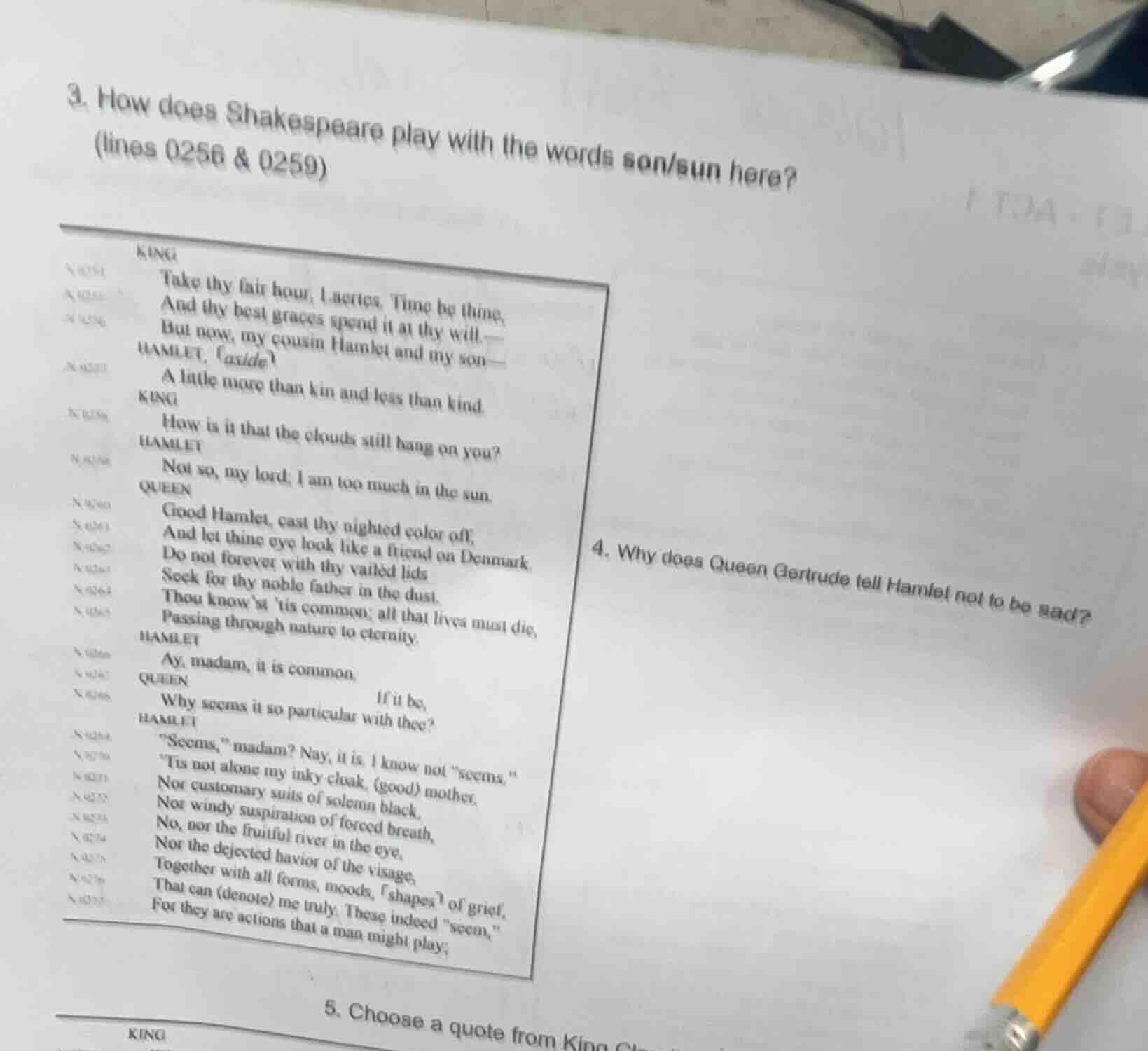
- how does shakespeare play with the words son/sun here?(lines 0256 & 0259)kingtake thy fair hour, laertes. time be thine,and thy best graces spend it at thy will.—but now, my cousin hamlet and my son—hamlet, asidea little more than kin and less than kind.kinghow is it that the clouds still hang on you?hamletnot so, my lord; i am too much in the sun.queengood hamlet, cast thy nighted color off,and let thine eye look like a friend on denmark.do not forever with thy vailed lidsseek for thy noble father in the dust.thou knowst tis common; all that lives must die,passing through nature to eternity.hamletay, madam, it is common.queenif it be,why seems it so particular with thee?hamlet\seems,\ madam? nay, it is. i know not \seems.\tis not alone my inky cloak, (good) mother,nor customary suits of solemn black,nor windy suspiration of forced breath,no, nor the fruitful river in the eye,nor the dejected behavior of the visage,together with all forms, moods, shapes of grief,that can (denote) me truly. these indeed \seem,\for they are actions that a man might play;4. why does queen gertrude tell hamlet not to be sad?5. choose a quote from king
For Question 3:
Shakespeare uses homophony (words with identical pronunciation but different meanings/spellings) between son and sun.
- King Claudius refers to Hamlet as his "son" (line 0256), positioning himself as Hamlet's new father.
- Hamlet's reply "I am too much in the sun" (line 0259) is a double entendre: it literally means he is overexposed to sunlight, but figuratively mocks Claudius' forced, unwanted paternal claim—he feels smothered by being called Claudius' "son."
For Question 4:
Queen Gertrude tells Hamlet not to be sad for three key reasons:
- She frames his grief as excessive, saying death is a universal, natural part of life ("all that lives must die, Passing through nature to eternity").
- She wants to maintain the stability of the Danish court; open, prolonged grief disrupts the new order established by her marriage to Claudius.
- She likely feels her own hasty marriage to Claudius is justified by this "common" view of death, and wants Hamlet to accept it to avoid drawing attention to the awkwardness of their new family dynamic.

Snap & solve any problem in the app
Get step-by-step solutions on Sovi AI
Photo-based solutions with guided steps
Explore more problems and detailed explanations
Question 3:
Shakespeare uses the homophones son and sun for wordplay: Claudius calls Hamlet his "son" to assert a paternal bond, while Hamlet's reply "too much in the sun" mocks this unwanted role (he feels smothered by the forced father-son title) while pretending to reference literal sunlight.
Question 4:
Queen Gertrude tells Hamlet not to be sad because she argues death is a universal, natural occurrence, wants to uphold court stability after Claudius' rise to power, and wishes Hamlet to accept her hasty marriage to Claudius by moving past his grief.