QUESTION IMAGE
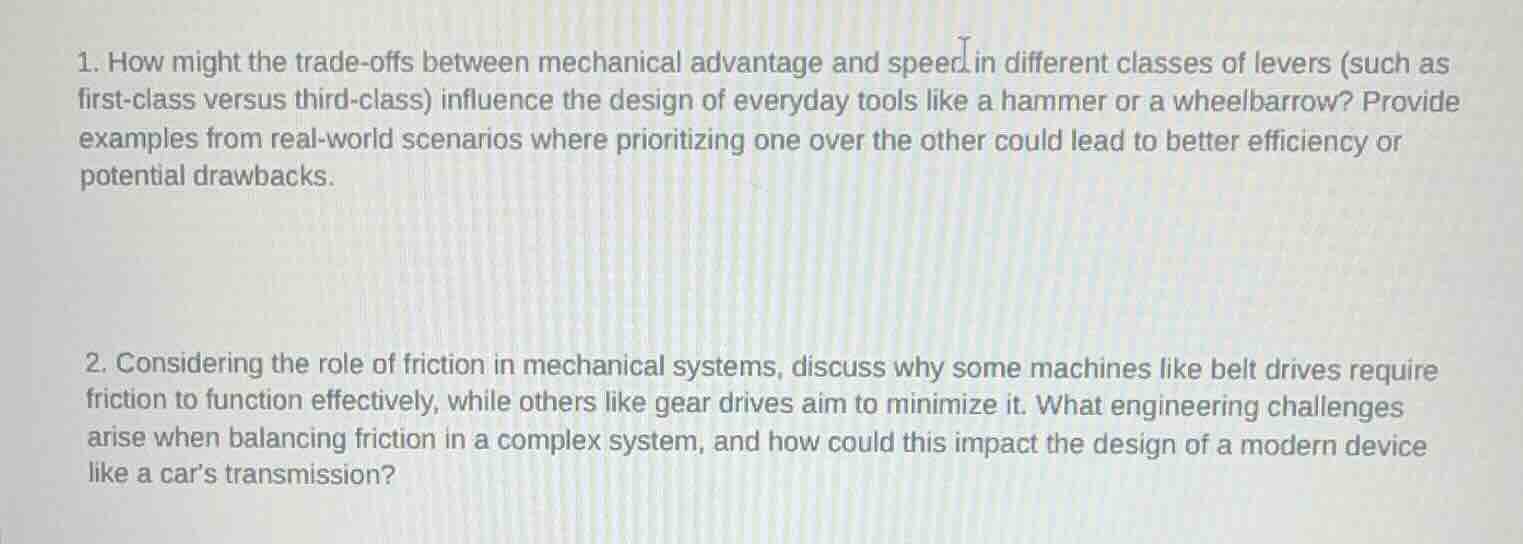
Question
- how might the trade - offs between mechanical advantage and speed in different classes of levers (such as first - class versus third - class) influence the design of everyday tools like a hammer or a wheelbarrow? provide examples from real - world scenarios where prioritizing one over the other could lead to better efficiency or potential drawbacks.
- considering the role of friction in mechanical systems, discuss why some machines like belt drives require friction to function effectively, while others like gear drives aim to minimize it. what engineering challenges arise when balancing friction in a complex system, and how could this impact the design of a modern device like a car’s transmission?
Brief Explanations
For Question 1:
- Lever Class Trade-Off Basics: Mechanical advantage (MA) = $\frac{\text{effort arm length}}{\text{load arm length}}$. A higher MA means less force is needed but the effort moves a longer distance (lower speed); lower MA means more force is needed but the effort moves a shorter distance (higher speed/quick motion).
- First-Class Lever (Wheelbarrow): A wheelbarrow is a second-class lever (load between fulcrum and effort), which prioritizes mechanical advantage. The long handles (effort arm) and short wheel-to-load distance (load arm) create a high MA, allowing users to lift heavy loads with small force. The trade-off is that the user must move the handles a long distance to lift the load a short distance. If it were designed for speed (shorter effort arm), it would require far more force to lift heavy materials, making it inefficient for its intended use.
- Third-Class Lever (Hammer): A hammer (when pulling a nail) is a third-class lever (effort between fulcrum and load), prioritizing speed. The effort (hand grip) is close to the fulcrum (hammer head pivot on the nail), so MA is less than 1. This means more force is needed, but the hand moves a small distance to move the nail a large, fast distance, quickly extracting it. If it were designed for high MA (longer effort arm), the nail would move very slowly, making the tool inefficient for quick nail removal.
For Question 2:
- Belt Drives and Friction: Belt drives rely on static friction between the belt and pulleys to transfer torque. Friction prevents slipping, ensuring power is transmitted from the driver pulley to the driven pulley. Without sufficient friction, the belt would slip, and no power would be transferred.
- Gear Drives and Friction: Gear drives use direct tooth contact to transfer torque. Friction between gear teeth causes wear, energy loss (as heat), and noise. Minimizing friction (via lubrication, smooth tooth surfaces) improves efficiency, reduces maintenance, and extends gear life.
- Engineering Challenges in Complex Systems: Balancing friction requires optimizing for both power transfer and efficiency. Too much friction causes wear and energy loss; too little leads to slipping or poor torque transfer.
- Car Transmission Impact: A car's transmission uses both gear sets (to minimize friction for efficient power transfer) and clutch systems (which rely on friction to engage/disengage gears smoothly). Engineers must balance: using lubricants to reduce gear friction, ensuring enough friction in the clutch to prevent slipping during acceleration, and designing components to withstand wear from necessary friction. Poor balance leads to reduced fuel efficiency, premature component failure, or rough gear shifts.

Snap & solve any problem in the app
Get step-by-step solutions on Sovi AI
Photo-based solutions with guided steps
Explore more problems and detailed explanations
- For everyday tools:
- A wheelbarrow (second-class lever) prioritizes mechanical advantage: its long effort arm lets users lift heavy loads with small force, though the handles must move a long distance. Prioritizing speed here would make it impossible to lift heavy materials efficiently.
- A hammer (third-class lever, nail pulling) prioritizes speed: the effort is close to the fulcrum, so the nail moves quickly with a small hand motion, though more force is required. Prioritizing mechanical advantage here would make nail extraction slow and inefficient.
- - Belt drives need friction: Static friction between the belt and pulleys prevents slipping, enabling torque and power transfer. Without it, the belt would slide on pulleys and no power would be transmitted.
- Gear drives minimize friction: Friction between gear teeth causes energy loss, wear, and noise. Reducing it (via lubrication, precision machining) boosts efficiency and component lifespan.
- Key challenges: Balancing sufficient friction for power transfer (e.g., clutches) and minimal friction for efficiency (e.g., gears) in one system. For a car transmission, this means using lubricants for gears, designing clutches with enough friction to avoid slipping, and accounting for wear from necessary friction. Poor balance leads to reduced fuel efficiency, component failure, or rough shifting.