QUESTION IMAGE
Question
Question was provided via image upload.
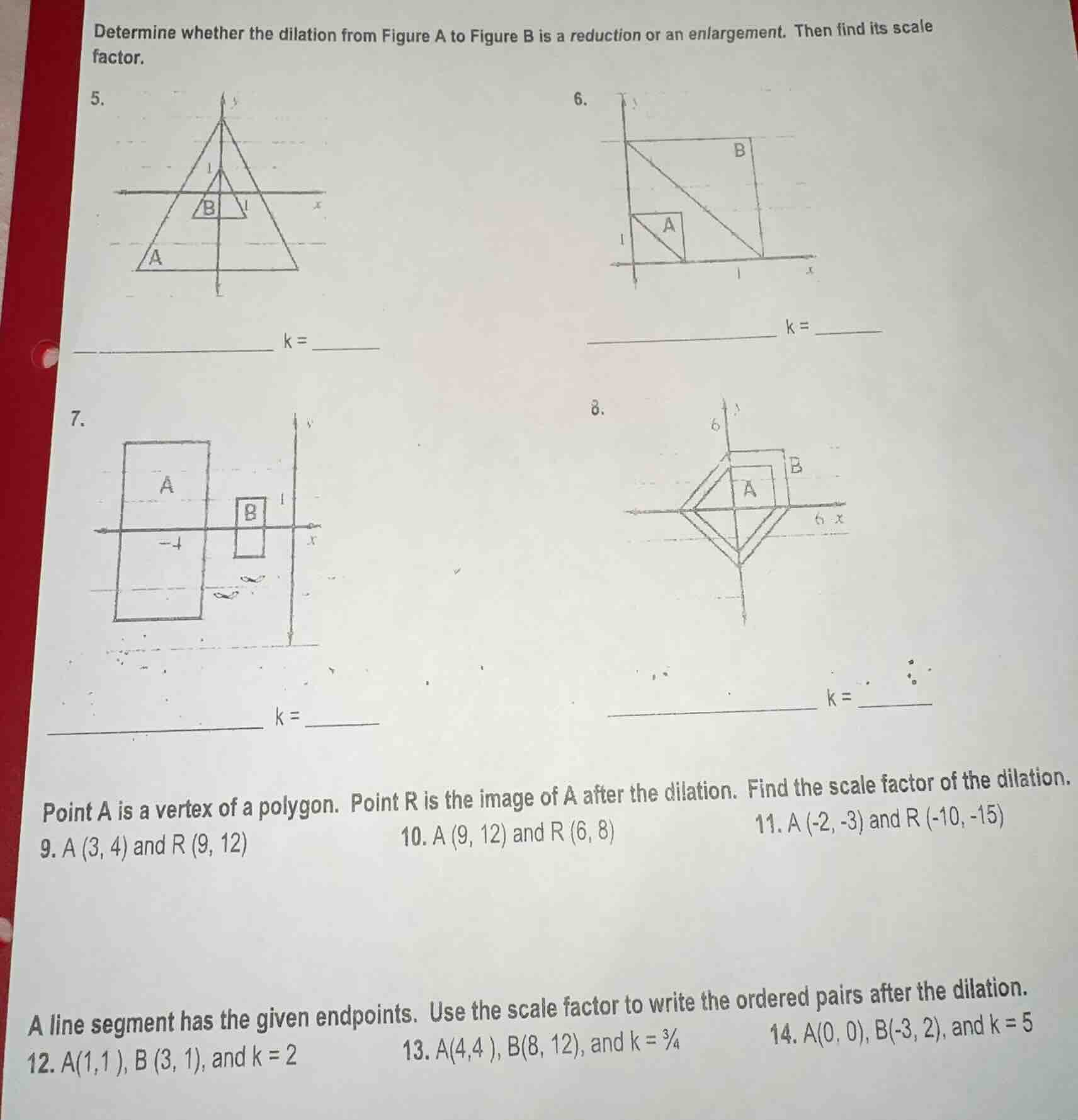
5. Step1: Identify dilation type (reduction)
Figure B is smaller than Figure A, so it is a reduction.
5. Step2: Calculate scale factor
The side length of B is 1, side length of A is 2. $k = \frac{1}{2}$
6. Step1: Identify dilation type (enlargement)
Figure B is larger than Figure A, so it is an enlargement.
6. Step2: Calculate scale factor
The side length of B is 1, side length of A is $\frac{1}{2}$. $k = \frac{1}{\frac{1}{2}} = 2$
7. Step1: Identify dilation type (reduction)
Figure B is smaller than Figure A, so it is a reduction.
7. Step2: Calculate scale factor
The horizontal length of A is 4, horizontal length of B is 1. $k = \frac{1}{4}$
8. Step1: Identify dilation type (enlargement)
Figure B is larger than Figure A, so it is an enlargement.
8. Step2: Calculate scale factor
The side length of B is 6, side length of A is 3. $k = \frac{6}{3} = 2$
9. Step1: Divide R's coords by A's
Scale factor $k = \frac{9}{3} = \frac{12}{4} = 3$
10. Step1: Divide R's coords by A's
Scale factor $k = \frac{6}{9} = \frac{8}{12} = \frac{2}{3}$
11. Step1: Divide R's coords by A's
Scale factor $k = \frac{-10}{-2} = \frac{-15}{-3} = 5$
12. Step1: Dilate A(1,1) by k=2
$A'(1\times2, 1\times2) = (2,2)$
12. Step2: Dilate B(3,1) by k=2
$B'(3\times2, 1\times2) = (6,2)$
13. Step1: Dilate A(4,4) by $k=\frac{3}{4}$
$A'(4\times\frac{3}{4}, 4\times\frac{3}{4}) = (3,3)$
13. Step2: Dilate B(8,12) by $k=\frac{3}{4}$
$B'(8\times\frac{3}{4}, 12\times\frac{3}{4}) = (6,9)$
14. Step1: Dilate A(0,0) by k=5
$A'(0\times5, 0\times5) = (0,0)$
14. Step2: Dilate B(-3,2) by k=5
$B'(-3\times5, 2\times5) = (-15,10)$

Snap & solve any problem in the app
Get step-by-step solutions on Sovi AI
Photo-based solutions with guided steps
Explore more problems and detailed explanations
- Reduction, $k=\frac{1}{2}$
- Enlargement, $k=2$
- Reduction, $k=\frac{1}{4}$
- Enlargement, $k=2$
- $k=3$
- $k=\frac{2}{3}$
- $k=5$
- $A'(2,2)$, $B'(6,2)$
- $A'(3,3)$, $B'(6,9)$
- $A'(0,0)$, $B'(-15,10)$