QUESTION IMAGE
Question
Question was provided via image upload.
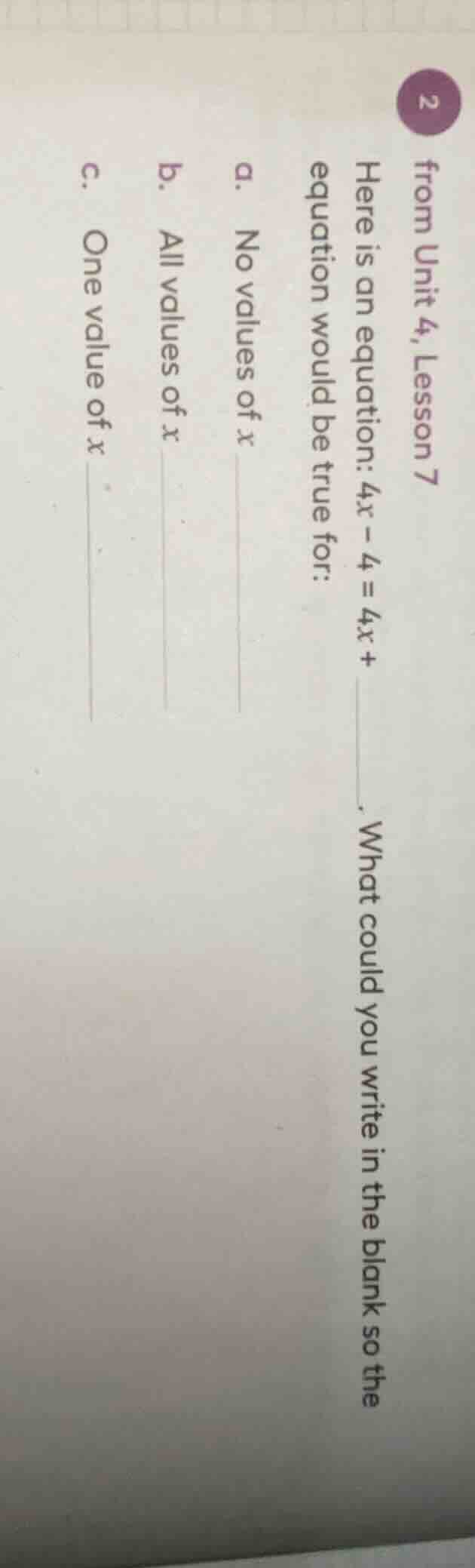
Step1: Analyze the equation structure
We have the equation \(4x - 4=4x+\text{[blank]}\). Let's denote the blank as \(c\), so the equation is \(4x - 4 = 4x + c\).
Step2: Subtract \(4x\) from both sides
Subtracting \(4x\) from both sides of the equation \(4x - 4=4x + c\), we get \((4x - 4)-4x=(4x + c)-4x\). Simplifying both sides, the left - hand side is \(4x-4 - 4x=-4\) and the right - hand side is \(4x + c-4x = c\). So we have \(-4=c\).
Step3: Determine the type of solution
If we substitute \(c = - 4\) back into the original equation, we have \(4x-4=4x - 4\). If we subtract \(4x\) from both sides, we get \(-4=-4\), which is a true statement for all values of \(x\). But the question is about what to put in the blank for each case:
- For part a (No values of \(x\) make it true): We need the equation to be a contradiction. Let's say the blank is a number \(k
eq - 4\). For example, if the blank is \(0\), the equation is \(4x-4 = 4x+0\), subtracting \(4x\) from both sides gives \(-4 = 0\), which is false for all \(x\).
- For part b (All values of \(x\) make it true): We need the equation to be an identity. As we saw earlier, if the blank is \(-4\), the equation \(4x - 4=4x-4\) is true for all \(x\) (because when we simplify, we get \(-4=-4\)).
- For part c (One value of \(x\) makes it true): We need a linear equation with a unique solution. Let's rewrite the original equation as \(4x-4=4x + k\), subtract \(4x\) from both sides: \(-4=k\) (for identity), \( - 4
eq k\) (for contradiction). To have a unique solution, the \(x\) terms must not cancel out. But in our original equation, both sides have \(4x\). So we need to change the coefficient of \(x\) on one side. Wait, the original equation is \(4x-4 = 4x+\text{[blank]}\). If we want a unique solution, we need to have a non - linear equation or change the form. But with the given form \(4x - 4=4x + k\), we can't have a unique solution (because the \(x\) terms will always cancel). But if we consider a different form, for example, if the equation was \(3x-4 = 4x + k\), then we could have a unique solution. But based on the given equation structure (\(4x\) on both sides), for part c, maybe there is a mis - type, but if we follow the given structure, we can't have a unique solution. However, if we assume a different equation structure (maybe a typo, like \(3x-4=4x + k\)), let's say we want one solution. Let's solve \(3x-4=4x + 2\), subtract \(3x\) from both sides: \(-4=x + 2\), then \(x=-6\) (one solution). But in our original equation with \(4x\) on both sides, for part c, since the \(x\) terms cancel, we can't have one solution. But maybe the problem expects us to fill in the blanks as follows:
For part a:
If we put a number other than \(-4\) in the blank, say \(0\), the equation \(4x - 4=4x+0\) simplifies to \(-4 = 0\), which is false for all \(x\). So for part a, we can put \(0\) (or any number except \(-4\)) in the blank.
For part b:
If we put \(-4\) in the blank, the equation \(4x - 4=4x-4\) is true for all \(x\) (because when we subtract \(4x\) from both sides, we get \(-4=-4\)).
For part c:
As the equation is structured with \(4x\) on both sides, we can't have a unique solution. But if we change the coefficient of \(x\) on one side, for example, if the equation was \(3x-4=4x + k\), and we want one solution, let's take \(k = 5\), then \(3x-4=4x + 5\), subtract \(3x\) from both sides: \(-4=x + 5\), \(x=-9\) (one solution). But based on the given equation \(4x-4 = 4x+\text{[blank]}\), since the \(x\) terms will always cancel, we can't have one solution. Maybe the…

Snap & solve any problem in the app
Get step-by-step solutions on Sovi AI
Photo-based solutions with guided steps
Explore more problems and detailed explanations
s:
Part a:
If we put \(0\) (or any number \(
eq - 4\)) in the blank, the equation has no solution. For example, putting \(0\) in the blank, the equation \(4x-4 = 4x + 0\) is false for all \(x\). So the blank can be filled with a number like \(0\) (or \(1,2,3,\cdots\) or \(-5,-6,\cdots\) except \(-4\)).
Part b:
If we put \(-4\) in the blank, the equation \(4x - 4=4x-4\) is true for all \(x\) (because simplifying gives \(-4=-4\)). So the blank should be \(-4\).
Part c:
As the given equation has \(4x\) on both sides, we can't have a unique solution. But if we assume a different equation structure (e.g., changing the coefficient of \(x\) on one side), for example, if the equation was \(3x-4 = 4x + k\), and we want one solution, we can put a number that makes the equation have a unique solution. But with the given \(4x\) on both sides, it's not possible. However, if we consider a mis - print and the equation was \(3x-4 = 4x + k\), and we want one solution, let's say \(k = 2\), then solving \(3x-4=4x + 2\) gives \(x=-6\) (one solution). But based on the original problem's structure, this part might have an error. But if we follow the options:
For part a (No values of \(x\)): We can fill the blank with a number that is not \(-4\) (e.g., \(0\)).
For part b (All values of \(x\)): We fill the blank with \(-4\).
For part c: Since the equation as given can't have a unique solution (because the \(x\) terms cancel), but if we ignore that and assume a different form, we can't really have a valid fill. But based on the problem's intention, maybe it's a mistake, and for part c, we can't have a valid number to put in the blank (or there is a mis - type in the problem).
But to answer as per the problem's parts:
a. To have no values of \(x\) make it true, put a number other than \(-4\) (e.g., \(0\)) in the blank.
b. To have all values of \(x\) make it true, put \(-4\) in the blank.
c. As the equation is structured, we can't have one value of \(x\) make it true (since the \(x\) terms cancel), so there is no valid number to put in the blank (or the problem has a typo).