QUESTION IMAGE
Question
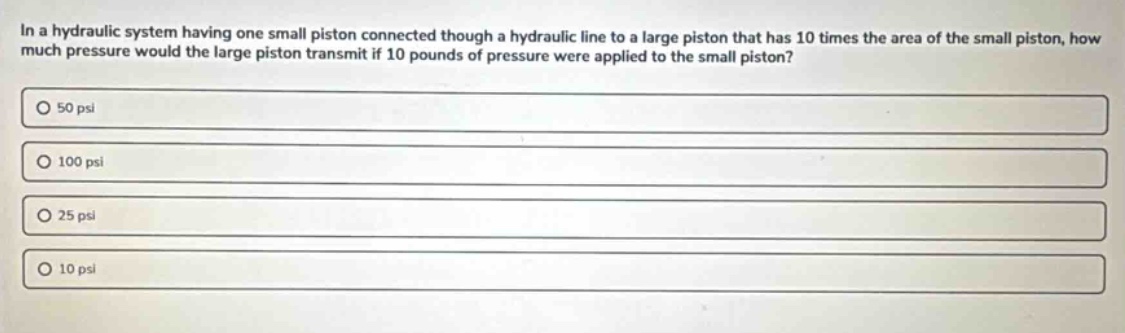
in a hydraulic system having one small piston connected though a hydraulic line to a large piston that has 10 times the area of the small piston, how much pressure would the large piston transmit if 10 pounds of pressure were applied to the small piston? 50 psi 100 psi 25 psi 10 psi
Step1: Recall Pascal's Law
Pascal's Law states that pressure in a hydraulic system is transmitted equally throughout the fluid. Pressure \( P \) is defined as \( P=\frac{F}{A} \), where \( F \) is force and \( A \) is area. For the small piston, \( P_1=\frac{F_1}{A_1} \), and for the large piston, \( P_2 = \frac{F_2}{A_2} \). By Pascal's Law, \( P_1 = P_2 \).
Step2: Apply the Law to the Problem
We are given that the pressure applied to the small piston (\( P_1 \)) is due to a force \( F_1 = 10 \) pounds (the pressure here is \( P_1=\frac{10}{A_1} \), but we don't need the actual area of the small piston). Since pressure is transmitted equally, the pressure at the large piston (\( P_2 \)) will be equal to the pressure at the small piston. So regardless of the area of the large piston (as long as the fluid is transmitting pressure), the pressure at the large piston is the same as at the small piston. The pressure applied to the small piston is 10 psi (since the force is 10 pounds, and pressure is force per unit area, but the key is Pascal's Law says pressure is transmitted equally). So the large piston will transmit 10 psi.

Snap & solve any problem in the app
Get step-by-step solutions on Sovi AI
Photo-based solutions with guided steps
Explore more problems and detailed explanations
D. 10 psi (assuming the last option is D, as the options are 50 psi, 100 psi, 25 psi, 10 psi, so the correct one is 10 psi which is the last option. If the options are labeled as A:50 psi, B:100 psi, C:25 psi, D:10 psi, then the answer is D. 10 psi)