QUESTION IMAGE
Question
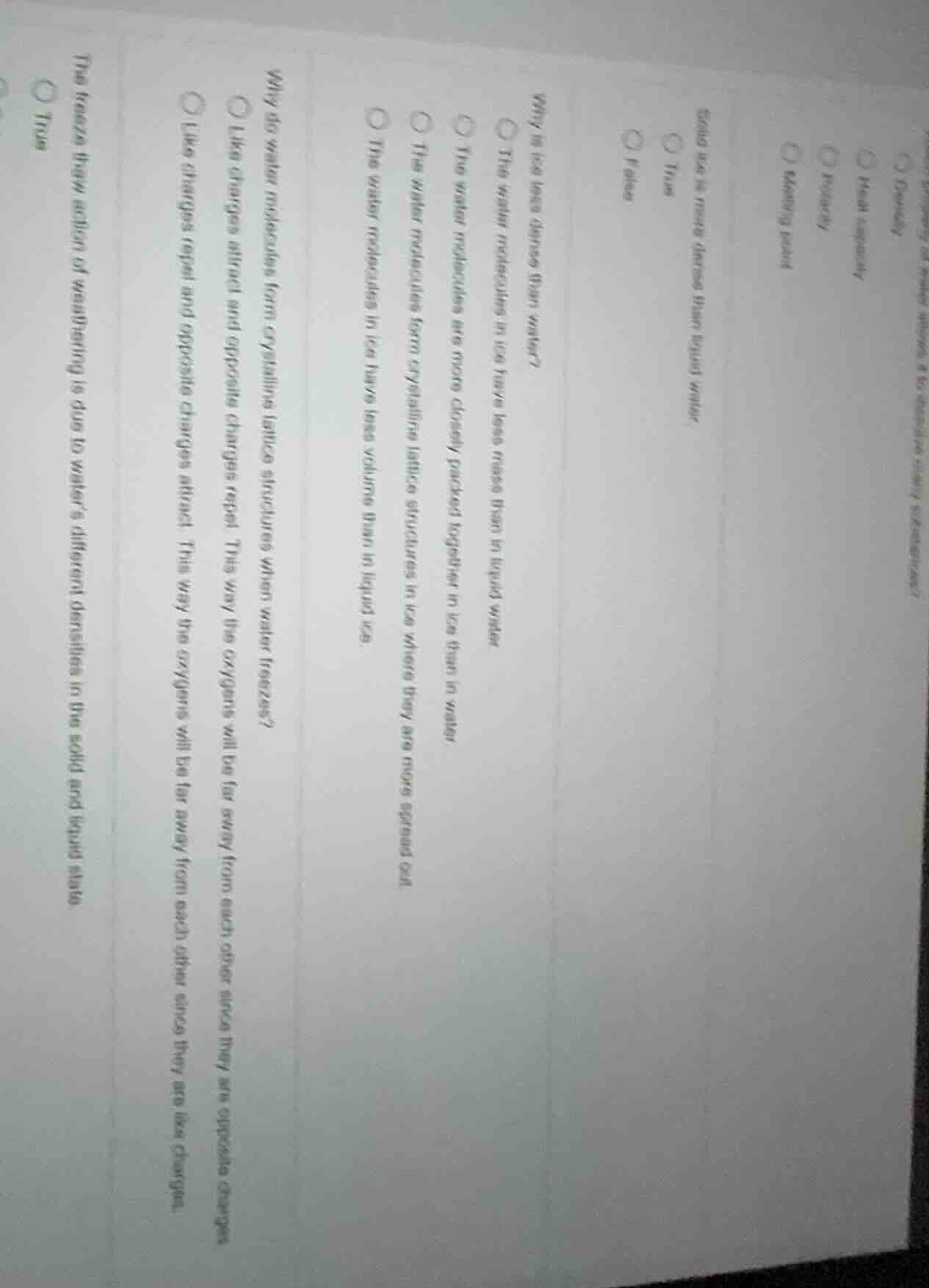
could ice is more dense than liquid water?
true
false
why is ice less dense than water?
the water molecules in ice have less mass than in liquid water
the water molecules are more closely packed together in ice than in water.
the water molecules form crystalline lattice structures in ice where they are more spread out.
the water molecules in ice have less volume than in liquid ice.
why do water molecules form crystalline lattice structures when water freezes?
like charges attract and opposite charges repel. this way the oxygens will be far away from each other since they are opposite charges
like charges repel and opposite charges attract. this way the oxygens will be far away from each other since they are like charges.
the freeze thaw action of weathering is due to water’s different densities in the solid and liquid state
true
First Question: "Could ice is more dense than liquid water." (True/False)
In reality, ice is less dense than liquid water. This is because the hydrogen bonding in ice forms a crystalline lattice structure that spaces the water molecules further apart compared to the more closely packed arrangement in liquid water. So the statement is false.
- Option 1: The mass of water molecules in ice and liquid water is the same (same number of molecules for the same amount), so this is incorrect.
- Option 2: Water molecules in ice are less closely packed (due to the lattice structure from hydrogen bonding) than in liquid water, so this is incorrect.
- Option 3: When water freezes, water molecules form a crystalline lattice structure where they are more spread out (due to hydrogen bonding angles and the lattice arrangement), making ice less dense. This is correct.
- Option 4: The volume of water molecules in ice is greater (since they are more spread out) than in liquid water, so this is incorrect.
Water molecules are polar, with oxygen having a partial negative charge and hydrogen having partial positive charges. Like charges repel and opposite charges attract. In ice, the hydrogen bonds between water molecules (due to these partial charges) lead to the formation of a crystalline lattice. The first option correctly describes the charge interactions (like charges repel, opposite attract) that lead to the lattice structure as oxygens (partial negative) are attracted to hydrogens (partial positive) of other molecules, arranging into a lattice. The second option has an incorrect description of the charge interactions (saying like charges attract and opposite repel, which is wrong).

Snap & solve any problem in the app
Get step-by-step solutions on Sovi AI
Photo-based solutions with guided steps
Explore more problems and detailed explanations
False