QUESTION IMAGE
Question
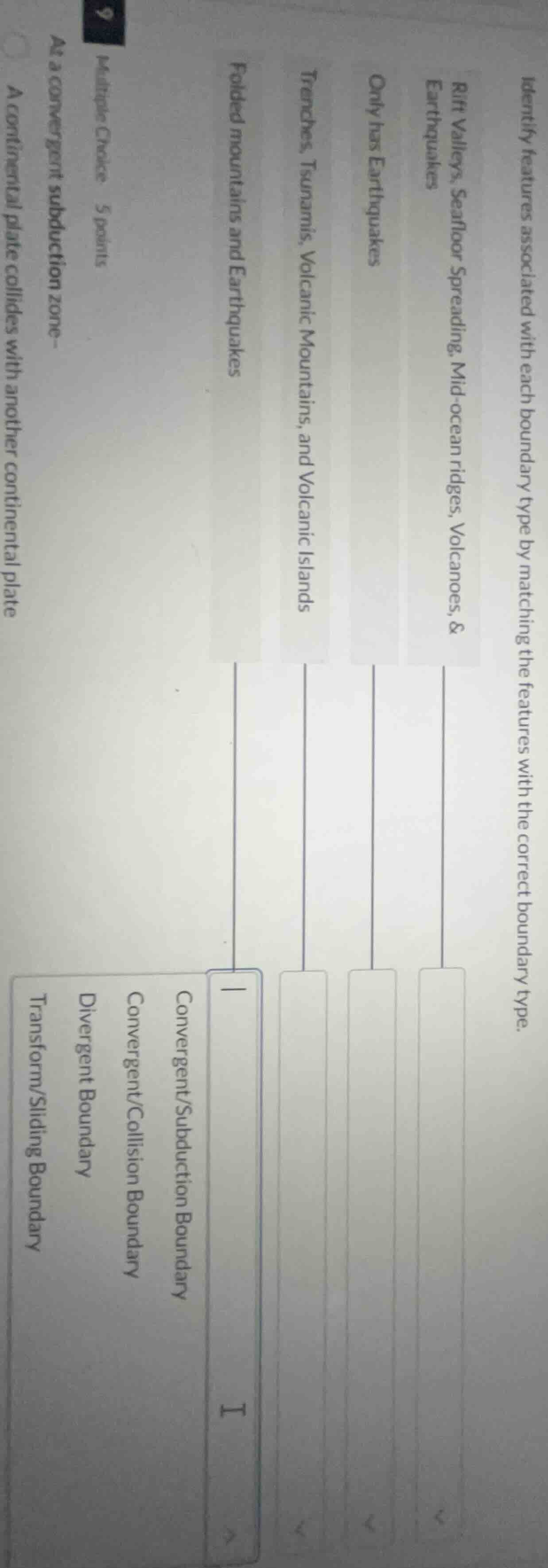
identify features associated with each boundary type by matching the features with the correct boundary type.
rift valleys, seafloor spreading, mid - ocean ridges, volcanoes, & earthquakes
only has earthquakes
trenches, tsunamis, volcanic mountains, and volcanic islands
folded mountains and earthquakes
multiple choice 5 points
a convergent subduction zone -
a continental plate collides with another continental plate
convergent/subduction boundary
convergent/collision boundary
divergent boundary
transform/sliding boundary
To solve this plate boundary - feature matching problem, we analyze each boundary type and its associated features:
1. Divergent Boundary
- Explanation: Divergent boundaries are where tectonic plates move apart. At oceanic divergent boundaries (like mid - ocean ridges), new oceanic crust is formed. Features such as rift valleys (on land), seafloor spreading, mid - ocean ridges, volcanoes (from the upwelling of magma), and earthquakes (due to the movement of plates) are associated with divergent boundaries.
- Matching Feature: "Rift Valleys, Seafloor Spreading, Mid - ocean ridges, Volcanoes, & Earthquakes"
2. Transform/Sliding Boundary
- Explanation: Transform boundaries are where plates slide past each other horizontally. The main geological activity here is the occurrence of earthquakes as the plates grind against each other, with no significant volcanic activity or mountain building (in the typical sense of other boundaries) because there is no subduction or divergence of crust material.
- Matching Feature: "Only has Earthquakes"
3. Convergent/Subduction Boundary
- Explanation: In a convergent subduction boundary, one plate (usually oceanic) is subducted beneath another (either oceanic or continental). The subduction of the oceanic plate leads to the formation of trenches (where the plate is forced down), and the melting of the subducted plate causes volcanic activity which can form volcanic mountains (on land) or volcanic islands (in the ocean). Also, tsunamis can be triggered by the sudden movement of the subducting plate, and earthquakes are common due to the intense pressure and friction at the boundary.
- Matching Feature: "Trenches, Tsunamis, Volcanic Mountains, and Volcanic Islands"
4. Convergent/Collision Boundary
- Explanation: When two continental plates collide at a convergent boundary (no subduction as continental crust is less dense and buoyant), the crust is compressed and folded. This compression leads to the formation of folded mountains (like the Himalayas), and earthquakes occur due to the large - scale movement and pressure build - up at the boundary.
- Matching Feature: "Folded mountains and Earthquakes"
Final Matches:
- Divergent Boundary - Rift Valleys, Seafloor Spreading, Mid - ocean ridges, Volcanoes, & Earthquakes
- Transform/Sliding Boundary - Only has Earthquakes
- Convergent/Subduction Boundary - Trenches, Tsunamis, Volcanic Mountains, and Volcanic Islands
- Convergent/Collision Boundary - Folded mountains and Earthquakes

Snap & solve any problem in the app
Get step-by-step solutions on Sovi AI
Photo-based solutions with guided steps
Explore more problems and detailed explanations
To solve this plate boundary - feature matching problem, we analyze each boundary type and its associated features:
1. Divergent Boundary
- Explanation: Divergent boundaries are where tectonic plates move apart. At oceanic divergent boundaries (like mid - ocean ridges), new oceanic crust is formed. Features such as rift valleys (on land), seafloor spreading, mid - ocean ridges, volcanoes (from the upwelling of magma), and earthquakes (due to the movement of plates) are associated with divergent boundaries.
- Matching Feature: "Rift Valleys, Seafloor Spreading, Mid - ocean ridges, Volcanoes, & Earthquakes"
2. Transform/Sliding Boundary
- Explanation: Transform boundaries are where plates slide past each other horizontally. The main geological activity here is the occurrence of earthquakes as the plates grind against each other, with no significant volcanic activity or mountain building (in the typical sense of other boundaries) because there is no subduction or divergence of crust material.
- Matching Feature: "Only has Earthquakes"
3. Convergent/Subduction Boundary
- Explanation: In a convergent subduction boundary, one plate (usually oceanic) is subducted beneath another (either oceanic or continental). The subduction of the oceanic plate leads to the formation of trenches (where the plate is forced down), and the melting of the subducted plate causes volcanic activity which can form volcanic mountains (on land) or volcanic islands (in the ocean). Also, tsunamis can be triggered by the sudden movement of the subducting plate, and earthquakes are common due to the intense pressure and friction at the boundary.
- Matching Feature: "Trenches, Tsunamis, Volcanic Mountains, and Volcanic Islands"
4. Convergent/Collision Boundary
- Explanation: When two continental plates collide at a convergent boundary (no subduction as continental crust is less dense and buoyant), the crust is compressed and folded. This compression leads to the formation of folded mountains (like the Himalayas), and earthquakes occur due to the large - scale movement and pressure build - up at the boundary.
- Matching Feature: "Folded mountains and Earthquakes"
Final Matches:
- Divergent Boundary - Rift Valleys, Seafloor Spreading, Mid - ocean ridges, Volcanoes, & Earthquakes
- Transform/Sliding Boundary - Only has Earthquakes
- Convergent/Subduction Boundary - Trenches, Tsunamis, Volcanic Mountains, and Volcanic Islands
- Convergent/Collision Boundary - Folded mountains and Earthquakes