QUESTION IMAGE
Question
identify the figure shown in the front, top, and side views.
Step1: Analyze Front View
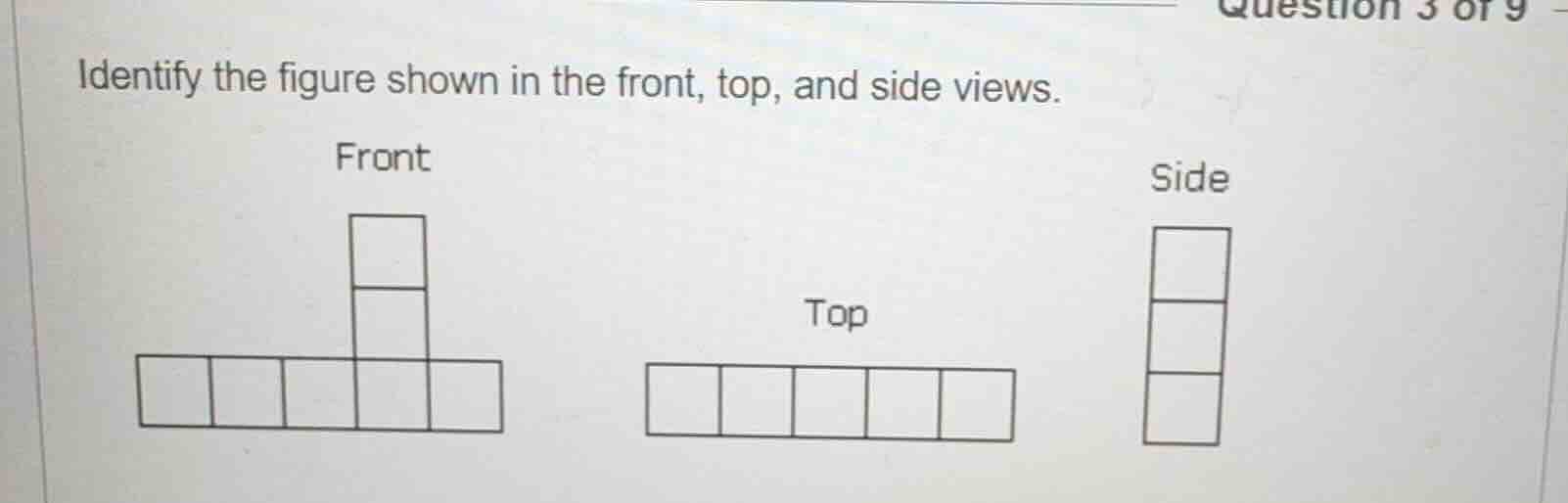
The front view has a base row of 5 squares, and on the 4th square (from left), there are 2 more squares stacked vertically, so total in front - aligned column: 3 squares, base row: 5.
Step2: Analyze Top View
Top view is a single row of 5 squares, meaning the base layer (from top perspective) is 5 squares in a row, no depth (only 1 square deep in the direction perpendicular to front - top plane).
Step3: Analyze Side View
Side view is 3 squares stacked vertically, meaning in the side (depth - height) direction, there are 3 squares stacked.
Step4: Reconstruct the Figure
From top view: 1 layer (depth) with 5 squares in a row. From front view: base row 5, and column 4 (1 - based or 0 - based? Let's say 4th from left, 1 - based) has 3 squares (base + 2 above). From side view: 3 squares in height. So the figure is a 5 - square - long (in length, front - back? No, length is left - right, depth is front - back) base (1 square deep), with a column (at the 4th left - right position) of 3 squares (height) and the rest of the base row (5 squares) have 1 square each (height 1), and depth 1 (from top view, only 1 square deep). So it's a 3 - D figure with a base of 5 unit cubes in a row (depth 1), and on the 4th cube (left - right) of the base, 2 more unit cubes are stacked, making that column have 3 unit cubes, and the other 4 base cubes have 1 unit cube each.

Snap & solve any problem in the app
Get step-by-step solutions on Sovi AI
Photo-based solutions with guided steps
Explore more problems and detailed explanations
The figure is a composite of unit cubes: a base row of 5 unit cubes (arranged in a line, depth = 1), and on the 4th unit cube (from the left) of this base row, 2 more unit cubes are stacked vertically, resulting in a column of 3 unit cubes at that position, while the other 4 base - row unit cubes have a height of 1 unit cube. In terms of a named figure, it's a 5 - cube - long (in the horizontal axis) rectangular prism - like base with a 3 - cube - tall column (at the 4th horizontal position) and the rest of the base having height 1, and depth 1. If we count the number of cubes: base row 5 (1 each) + 2 (on the 4th cube) = 5+2 = 7? Wait, no: base row 5 (each 1 cube) and the 4th cube has 2 more, so total cubes: 5 (base) + 2 (stacked) = 7? Wait, no: 5 (base) + 2 (since 3 - 1 = 2 stacked on base) = 7. But the key is the structure: a 5 - square base (1 deep), with a 3 - square - tall column at the 4th (left - right) position of the base.