QUESTION IMAGE
Question
identify the graph for the equation.
y = 9(3)^x
Step1: Analyze the function type
The equation \( y = 9(3)^x \) is an exponential function of the form \( y = ab^x \), where \( a = 9 \) and \( b = 3>1 \). So it should be an exponential growth function.
Step2: Check the y - intercept
To find the y - intercept, set \( x = 0 \). Then \( y=9\times(3)^0=9\times1 = 9 \)? Wait, no, wait. Wait, when \( x = 0 \), \( y=9\times3^0=9\times1 = 9 \)? Wait, but let's re - calculate. Wait, \( 3^0=1 \), so \( y = 9\times1=9 \)? Wait, but looking at the graphs, when \( x = 0 \), let's check the value. Wait, maybe I made a mistake. Wait, the function is \( y = 9(3)^x \). When \( x = 0 \), \( y=9\times3^{0}=9\times1 = 9 \). When \( x = 1 \), \( y=9\times3^{1}=27 \). When \( x = 2 \), \( y=9\times3^{2}=9\times9 = 81 \).
Now let's analyze the three graphs:
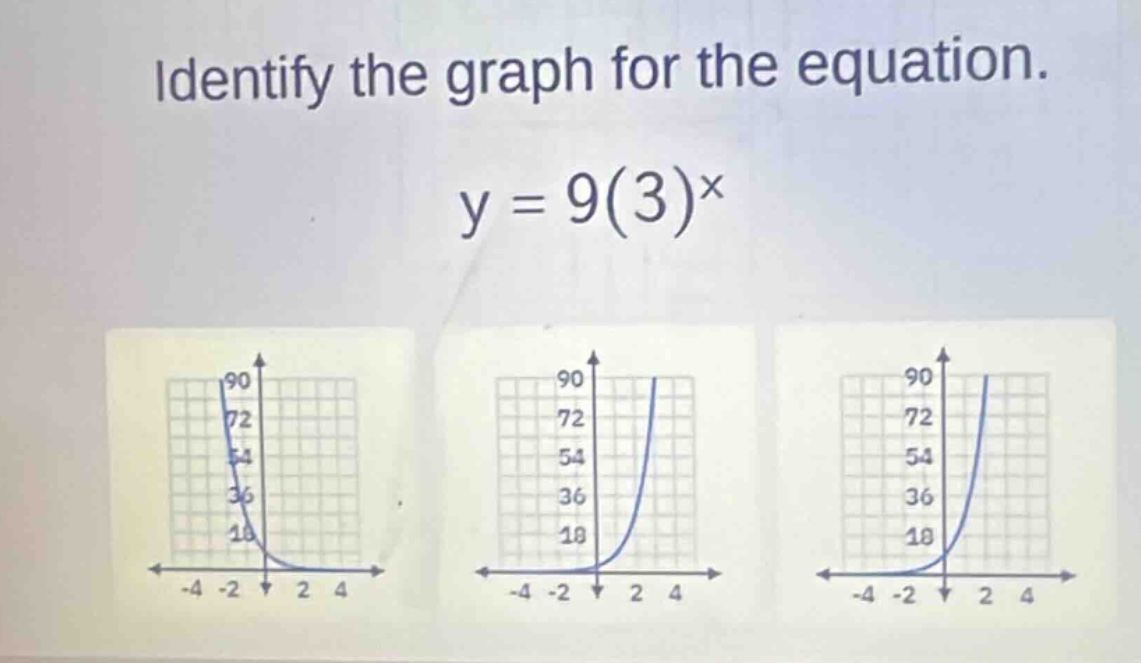
- The first graph is a decreasing exponential (decay) since it is decreasing as \( x \) increases, so it's for \( 0 < b<1 \), so we can eliminate the first graph.
- The second graph: Let's check the y - intercept. When \( x = 0 \), if the graph passes through \( (0,0) \), but our function at \( x = 0 \) is \( y = 9 \), so the second graph (which seems to pass through \( (0,0) \)) is incorrect.
- The third graph: Let's check the values. When \( x = 0 \), \( y = 9 \) (close to 10 on the graph, maybe due to scaling), when \( x = 1 \), \( y = 27 \), when \( x = 2 \), \( y = 81 \). The graph is increasing (exponential growth) and the y - intercept is around 9 - 10, which matches our calculation. Also, as \( x \) increases, the function grows rapidly, which is consistent with \( b = 3>1 \).

Snap & solve any problem in the app
Get step-by-step solutions on Sovi AI
Photo-based solutions with guided steps
Explore more problems and detailed explanations
The third graph (the right - most graph among the three given graphs) is the graph of \( y = 9(3)^x \)