QUESTION IMAGE
Question
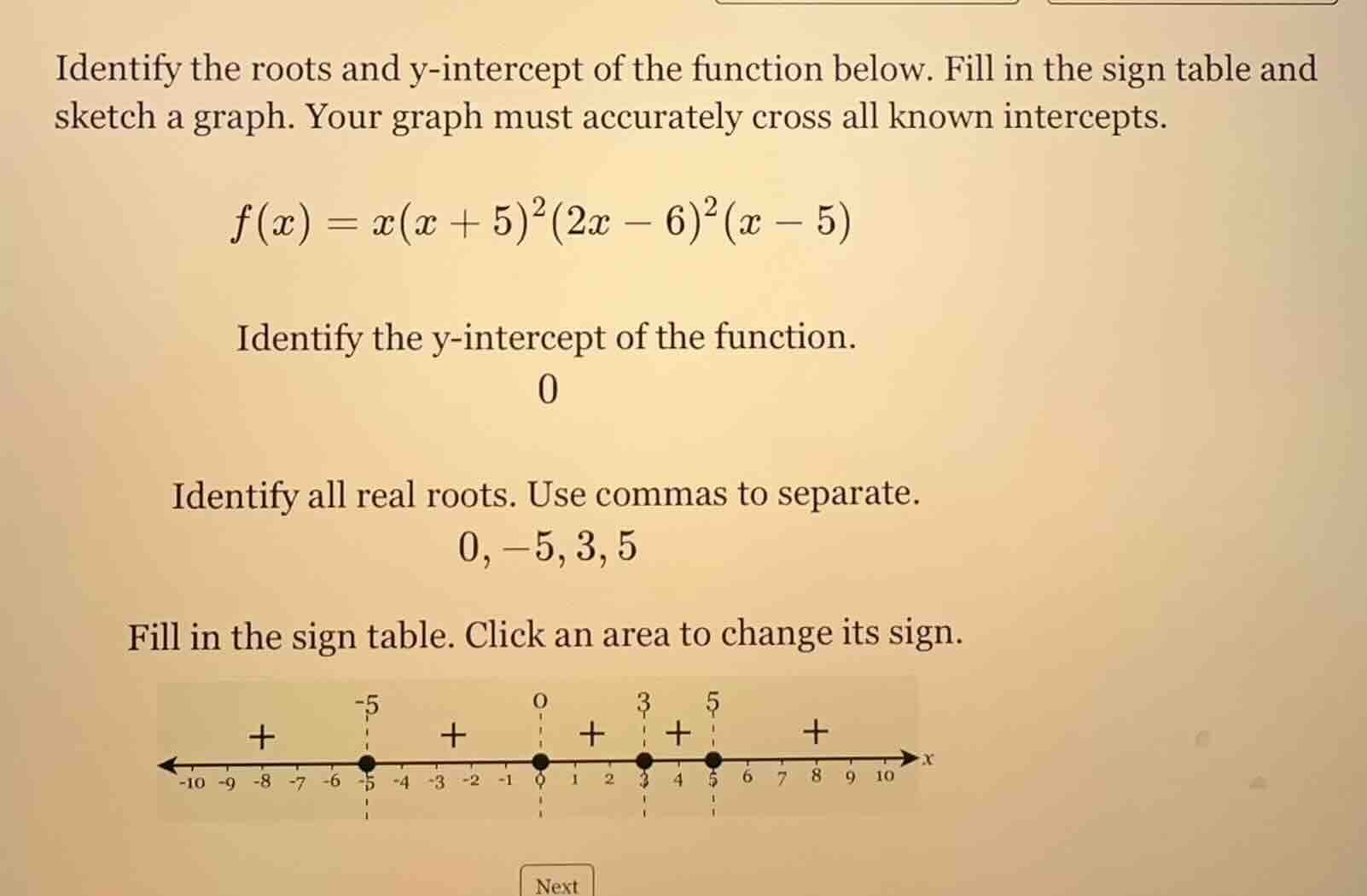
identify the roots and y-intercept of the function below. fill in the sign table and sketch a graph. your graph must accurately cross all known intercepts.
$f(x) = x(x + 5)^2(2x - 6)^2(x - 5)$
identify the y-intercept of the function.
0
identify all real roots. use commas to separate.
0, -5, 3, 5
fill in the sign table. click an area to change its sign.
-5
o
3
5
+
+
+
+
+
x
-10 -9 -8 -7 -6 -5 -4 -3 -2 -1 0 1 2 3 4 5 6 7 8 9 10
next
For y - intercept:
Step 1: Recall y - intercept definition
The y - intercept of a function \(y = f(x)\) is the value of \(y\) when \(x = 0\). So we substitute \(x = 0\) into the function \(f(x)=x(x + 5)^{2}(2x-6)^{2}(x - 5)\).
Step 2: Substitute \(x = 0\)
\(f(0)=0\times(0 + 5)^{2}(2\times0-6)^{2}(0 - 5)=0\)
Step 1: Recall root definition
A root of a function \(f(x)\) is a value of \(x\) for which \(f(x)=0\). We set \(f(x)=x(x + 5)^{2}(2x-6)^{2}(x - 5)=0\).
Step 2: Solve for \(x\)
Using the zero - product property, if \(ab = 0\), then either \(a = 0\) or \(b = 0\).
- For \(x=0\), the factor \(x = 0\) gives a root.
- For \((x + 5)^{2}=0\), we have \(x=-5\) (with multiplicity 2).
- For \((2x - 6)^{2}=0\), we solve \(2x-6 = 0\Rightarrow x = 3\) (with multiplicity 2).
- For \((x - 5)=0\), we have \(x = 5\).
Step 1: Analyze the factors
The function is \(f(x)=x(x + 5)^{2}(2x-6)^{2}(x - 5)\). Let's rewrite \(2x-6\) as \(2(x - 3)\), so \(f(x)=x(x + 5)^{2}\times4(x - 3)^{2}(x - 5)=4x(x + 5)^{2}(x - 3)^{2}(x - 5)\). The factors \((x + 5)^{2}\) and \((x - 3)^{2}\) are always non - negative (since square of a real number is non - negative) for all real \(x\) (they are zero when \(x=-5\) and \(x = 3\) respectively). The sign of \(f(x)\) is determined by the product of the remaining factors \(x\) and \((x - 5)\) (and the positive constant factor 4 which does not change the sign).
Step 2: Test intervals
- Interval \(x\lt - 5\): Let's take \(x=-6\). Then \(x=-6\lt0\), \(x - 5=-11\lt0\). The product \(x(x - 5)=(-6)\times(-11)=66\gt0\). Since \((x + 5)^{2}\gt0\) and \((x - 3)^{2}\gt0\) for \(x=-6\), \(f(x)\gt0\).
- Interval \(-5\lt x\lt0\): Let's take \(x=-1\). Then \(x=-1\lt0\), \(x - 5=-6\lt0\). The product \(x(x - 5)=(-1)\times(-6)=6\gt0\). Since \((x + 5)^{2}\gt0\) and \((x - 3)^{2}\gt0\) for \(x=-1\), \(f(x)\gt0\).
- Interval \(0\lt x\lt3\): Let's take \(x = 1\). Then \(x=1\gt0\), \(x - 5=-4\lt0\). The product \(x(x - 5)=(1)\times(-4)=-4\lt0\). But we have to consider the square factors. Wait, no, the square factors \((x + 5)^{2}\) and \((x - 3)^{2}\) are positive. So \(f(x)=4\times x\times(positive)\times(positive)\times(x - 5)\). For \(x = 1\), \(x\gt0\), \(x - 5\lt0\), so \(f(x)\lt0\)? Wait, no, earlier mistake. Wait, \((x + 5)^{2}\) and \((x - 3)^{2}\) are non - negative. So the sign of \(f(x)\) is:
- For \(x\lt - 5\): \(x\lt0\), \(x - 5\lt0\), \((x + 5)^{2}\gt0\), \((x - 3)^{2}\gt0\). So \(x(x - 5)\gt0\) (negative times negative), and with positive square factors and positive 4, \(f(x)\gt0\).
- For \(-5\lt x\lt0\): \(x\lt0\), \(x - 5\lt0\), \((x + 5)^{2}\gt0\), \((x - 3)^{2}\gt0\). \(x(x - 5)\gt0\) (negative times negative), so \(f(x)\gt0\).
- For \(0\lt x\lt3\): \(x\gt0\), \(x - 5\lt0\), \((x + 5)^{2}\gt0\), \((x - 3)^{2}\gt0\). \(x(x - 5)\lt0\) (positive times negative), so \(f(x)\lt0\)? Wait, no, the function is \(f(x)=4x(x + 5)^{2}(x - 3)^{2}(x - 5)\). The factor \((x + 5)^{2}\) and \((x - 3)^{2}\) are non - negative. So when \(0\lt x\lt3\): \(x\gt0\), \(x - 5\lt0\), so \(x(x - 5)\lt0\), and \((x + 5)^{2}\gt0\), \((x - 3)^{2}\gt0\), so \(f(x)=4\times(positive)\times(positive)\times(positive)\times(negative)=negative\). But in the given sign table, the intervals are marked as positive. Wait, maybe there is a miscalculation. Wait, the original function is \(f(x)=x(x + 5)^{2}(2x - 6)^{2}(x - 5)\). Let's re - express \(2x-6=2(x - 3)\), so \((2x - 6)^{2}=4(x - 3)^{2}\). So \(f(x)=4x(x + 5)^{2}(x - 3)^{2}(x - 5)\). The degree of the function: the degree is \(1 + 2+2 + 1=6\) (even degree). The leading coefficient is \(4\times1\times1\times1 = 4\) (positive).
- As \(x
ightarrow\pm\infty\), \(f(x)
ightarrow+\infty\) (since the leading term is of even degree with positive coefficient).
- Let's test \(x=-6\) (in \(x\lt - 5\)): \(f(-6)=-6\times(-6 + 5)^{2}\times(2\times(-6)-6)^{2}\times(-6 - 5)=-6\times(-1)^{2}\times(-18)^{2}\times(-11)=-6\times1\times324\times(-11)=6\times324\times11\gt0\)
- \(x=-1\) (in \(-5\lt x\lt0\)): \(f(-1)=-1\times(-1 + 5)^{2}\times(2\times(-1)-6)^{2}\times(-1 - 5)=-1\times16\times(-8)^{2}\times(-6)=-1\times16\times64\times(-6)=16\times64\times6\gt0\)
- \(x = 1\) (in \(0\lt x\lt3\)): \(f(1)=1\times(1 + 5)^{2}\times(2\times1-6)^{2}\times(1 - 5)=1\times36\times(-4)^{2}\times(-4)=1\times36\times16\times(-4)=-36\times64\lt0\)
- \(x = 4\) (in \(3\lt x\lt5\)): \(f(4)=4\times(4 + 5)^{2}\times(…

Snap & solve any problem in the app
Get step-by-step solutions on Sovi AI
Photo-based solutions with guided steps
Explore more problems and detailed explanations
The y - intercept is \(0\)