QUESTION IMAGE
Question
identifying characteristics of a function and its inverse
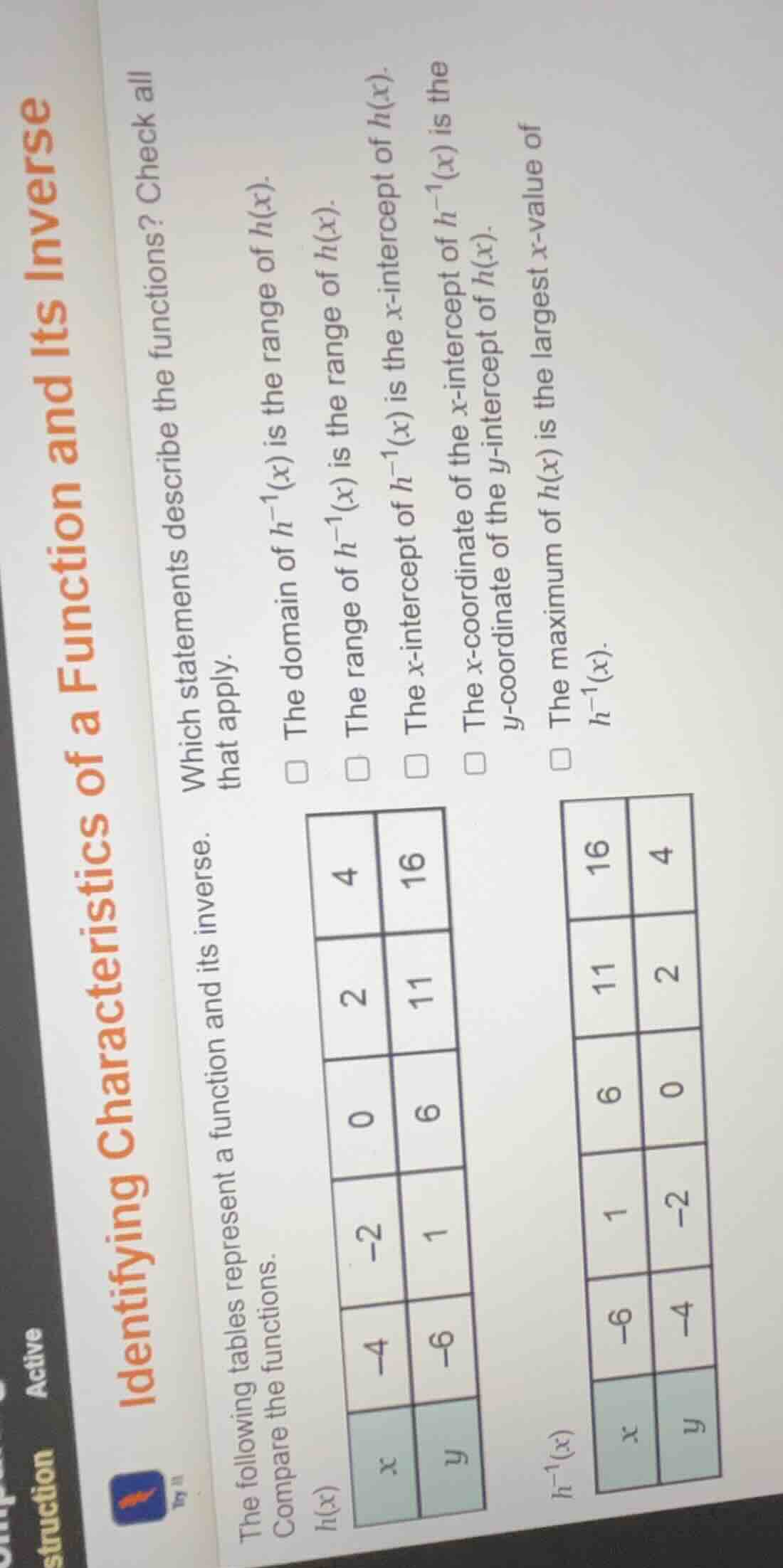
the following tables represent a function and its inverse. compare the functions.
which statements describe the functions? check all that apply.
□ the domain of ( h^{-1}(x) ) is the range of ( h(x) ).
□ the range of ( h^{-1}(x) ) is the range of ( h(x) ).
□ the ( x )-intercept of ( h^{-1}(x) ) is the ( x )-intercept of ( h(x) ).
□ the ( x )-coordinate of the ( x )-intercept of ( h^{-1}(x) ) is the ( y )-coordinate of the ( y )-intercept of ( h(x) ).
□ the maximum of ( h(x) ) is the largest ( x )-value of ( h^{-1}(x) ).
( h(x) )
| ( x ) | ( y ) |
|---|---|
| ( -2 ) | ( 1 ) |
| ( 0 ) | ( 6 ) |
| ( 2 ) | ( 11 ) |
| ( 4 ) | ( 16 ) |
( h^{-1}(x) )
| ( x ) | ( y ) |
|---|---|
| ( 1 ) | ( -2 ) |
| ( 6 ) | ( 0 ) |
| ( 11 ) | ( 2 ) |
| ( 16 ) | ( 4 ) |
To solve this, we analyze the properties of a function and its inverse:
Step 1: Recall Inverse Function Properties
For a function \( h(x) \) and its inverse \( h^{-1}(x) \):
- The domain of \( h^{-1}(x) \) is the range of \( h(x) \).
- The range of \( h^{-1}(x) \) is the domain of \( h(x) \).
- The \( x \)-intercept of \( h^{-1}(x) \) corresponds to the \( y \)-intercept of \( h(x) \) (since \( (a,0) \) on \( h^{-1}(x) \) implies \( (0,a) \) on \( h(x) \)).
- The \( x \)-coordinate of the \( x \)-intercept of \( h^{-1}(x) \) is the \( y \)-coordinate of the \( y \)-intercept of \( h(x) \).
Step 2: Analyze Each Statement
- "The domain of \( h^{-1}(x) \) is the range of \( h(x) \)."
From inverse function properties, this is true. The domain of \( h^{-1} \) (input values) is the range of \( h \) (output values of \( h \)).
- "The range of \( h^{-1}(x) \) is the range of \( h(x) \)."
The range of \( h^{-1} \) is the domain of \( h \), not the range of \( h \). Thus, this is false.
- "The \( x \)-intercept of \( h^{-1}(x) \) is the \( x \)-intercept of \( h(x) \)."
The \( x \)-intercept of \( h^{-1}(x) \) (where \( y=0 \)) corresponds to the \( y \)-intercept of \( h(x) \) (where \( x=0 \)), not the \( x \)-intercept of \( h(x) \). Thus, this is false.
- "The \( x \)-coordinate of the \( x \)-intercept of \( h^{-1}(x) \) is the \( y \)-coordinate of the \( y \)-intercept of \( h(x) \)."
For \( h(x) \), the \( y \)-intercept occurs at \( x=0 \). From the table of \( h(x) \), when \( x=0 \), \( y=6 \) (so \( (0,6) \) is the \( y \)-intercept of \( h(x) \)). For \( h^{-1}(x) \), the \( x \)-intercept occurs at \( y=0 \) (i.e., \( (a,0) \) on \( h^{-1}(x) \)), which implies \( (0,a) \) on \( h(x) \). Here, \( a=6 \), so the \( x \)-intercept of \( h^{-1}(x) \) is \( (6,0) \), and its \( x \)-coordinate (6) matches the \( y \)-coordinate of \( h(x) \)’s \( y \)-intercept (6). Thus, this is true.
- "The maximum of \( h(x) \) is the largest \( x \)-value of \( h^{-1}(x) \)."
The maximum of \( h(x) \) (largest \( y \)-value) is the largest \( x \)-value of \( h^{-1}(x) \) (since the range of \( h \) is the domain of \( h^{-1} \)). From \( h(x) \)’s table, the largest \( y \)-value is \( 16 \) (when \( x=4 \)). From \( h^{-1}(x) \)’s table, the largest \( x \)-value is \( 16 \) (when \( y=4 \)). Thus, this is true.

Snap & solve any problem in the app
Get step-by-step solutions on Sovi AI
Photo-based solutions with guided steps
Explore more problems and detailed explanations
The true statements are:
- The domain of \( h^{-1}(x) \) is the range of \( h(x) \).
- The \( x \)-coordinate of the \( x \)-intercept of \( h^{-1}(x) \) is the \( y \)-coordinate of the \( y \)-intercept of \( h(x) \).
- The maximum of \( h(x) \) is the largest \( x \)-value of \( h^{-1}(x) \).
(In checkbox form, these correspond to the first, fourth, and fifth statements.)