QUESTION IMAGE
Question
identifying the domain and range of an exponential function
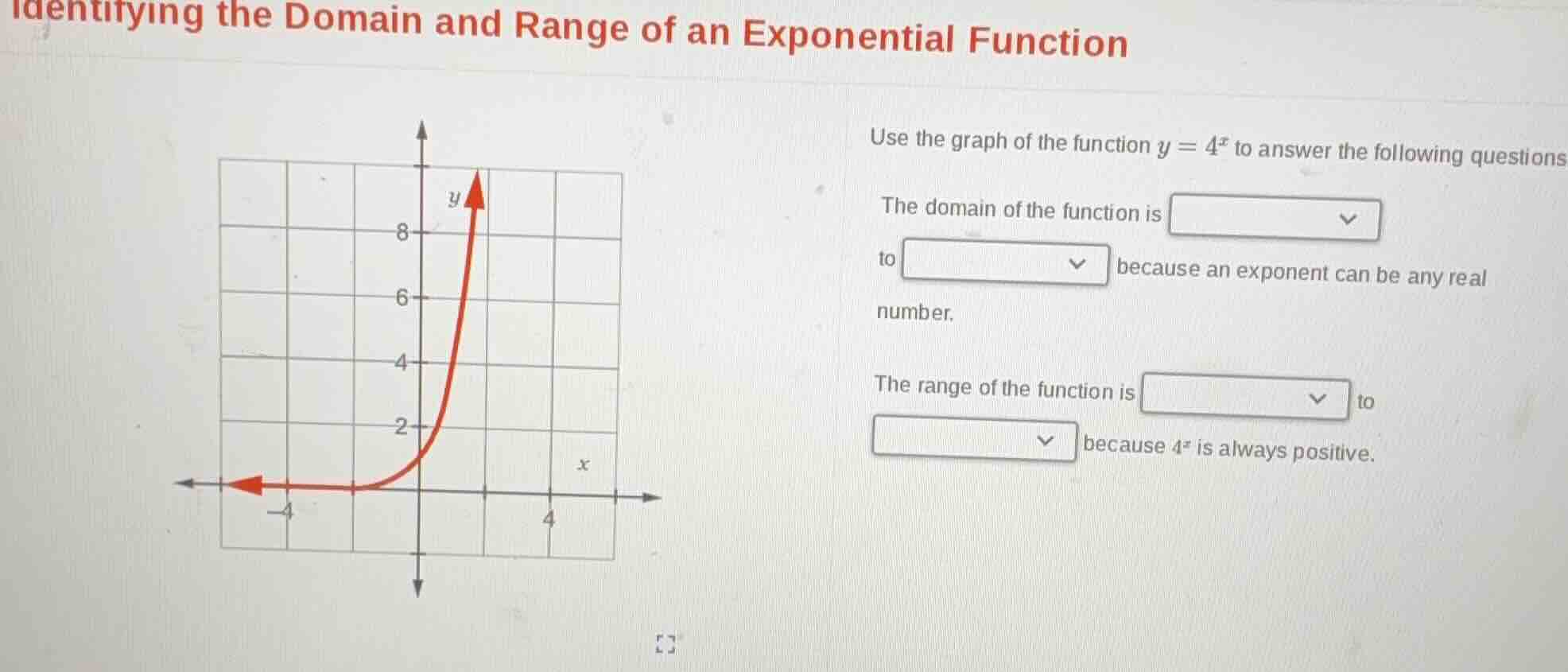
use the graph of the function $y = 4^x$ to answer the following questions
the domain of the function is
to
because an exponent can be any real number.
the range of the function is
to
because $4^x$ is always positive.
Step1: Determine the domain of \( y = 4^x \)
The domain of a function is the set of all possible input values (x - values). For an exponential function of the form \( y = a^x \) (where \( a>0, a
eq1 \)), the exponent \( x \) can be any real number. So, the domain of \( y = 4^x \) is all real numbers, which means from \( -\infty \) to \( \infty \).
Step2: Determine the range of \( y = 4^x \)
The range of a function is the set of all possible output values (y - values). For the exponential function \( y = 4^x \), we know that any positive number raised to a real power is positive. As \( x \to -\infty \), \( 4^x=\frac{1}{4^{|x|}}\to0 \), and as \( x \to \infty \), \( 4^x\to\infty \). So, the range of \( y = 4^x \) is from \( 0 \) (not including \( 0 \), but in terms of the interval, we write it as starting from \( 0 \)) to \( \infty \).

Snap & solve any problem in the app
Get step-by-step solutions on Sovi AI
Photo-based solutions with guided steps
Explore more problems and detailed explanations
- The domain of the function is \( -\infty \) to \( \infty \) because an exponent can be any real number.
- The range of the function is \( 0 \) to \( \infty \) because \( 4^x \) is always positive.