QUESTION IMAGE
Question
identifying tables
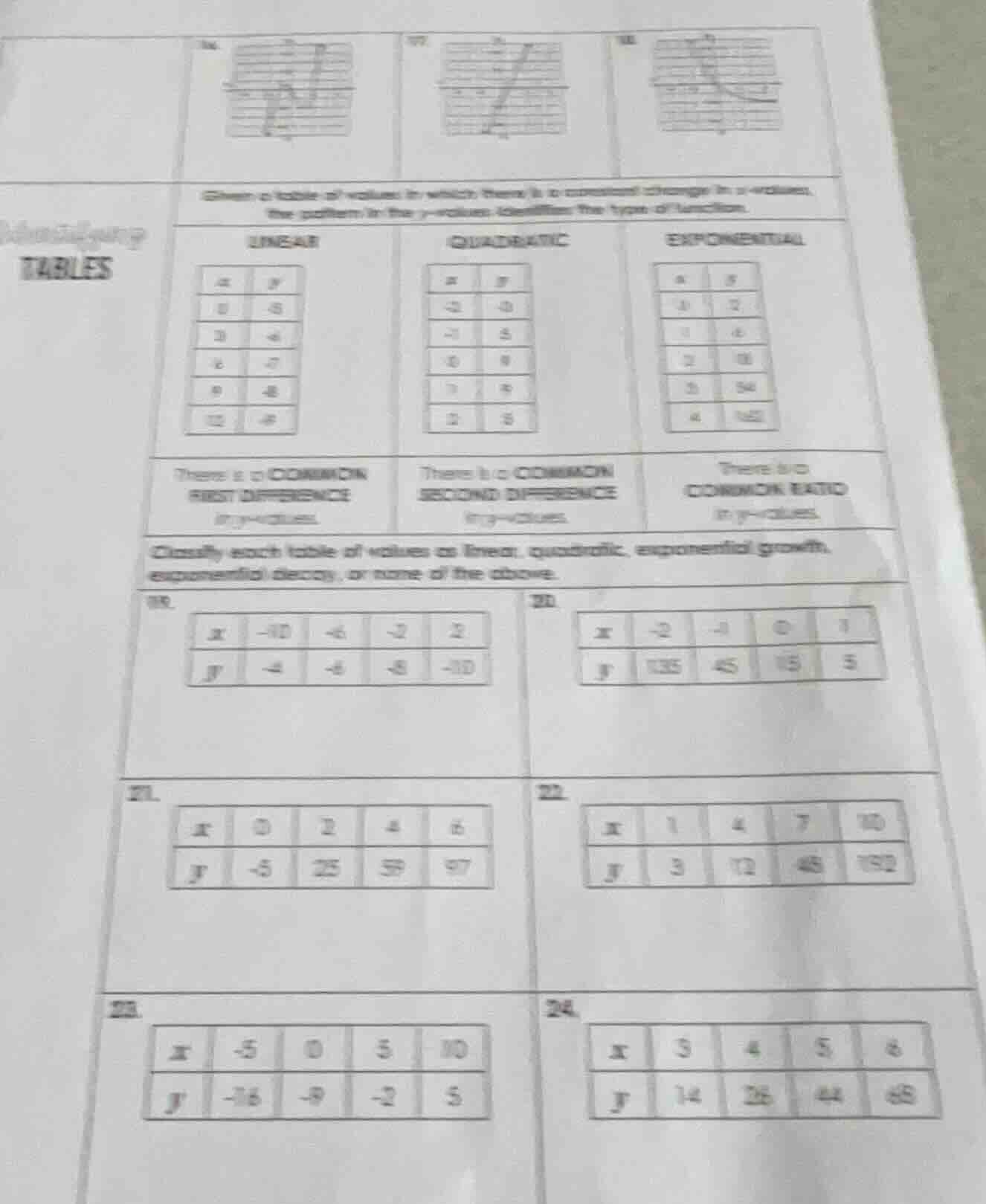
given a table of values in which there is a constant change in x-values, the pattern in the y-values identifies the type of function.
linear
| x | y |
| 0 | -8 |
| 3 | -6 |
| 6 | -7 |
| 9 | -8 |
| 12 | -8 |
there is a common first difference in y-values.
quadratic
| x | y |
| -2 | -0 |
| -1 | 5 |
| 0 | 9 |
| 1 | 9 |
| 2 | 5 |
there is a common second difference in y-values.
exponential
| x | y |
| 1 | 2 |
| 1 | 6 |
| 2 | 18 |
| 3 | 54 |
| 4 | 162 |
there is a common ratio in y-values.
classify each table of values as linear, quadratic, exponential growth, exponential decay, or none of the above.
19.
| x | -10 | -6 | -2 | 2 |
| y | -4 | -6 | -8 | -10 |
20.
| x | -2 | -1 | 0 | 1 |
| y | 135 | 45 | 15 | 5 |
21.
| x | 0 | 2 | 4 | 6 |
| y | -5 | 25 | 59 | 97 |
22.
| x | 1 | 4 | 7 | 10 |
| y | 3 | 12 | 48 | 192 |
23.
| x | -5 | 0 | 5 | 10 |
| y | -16 | -9 | -2 | 5 |
24.
| x | 3 | 4 | 5 | 6 |
| y | 14 | 26 | 44 | 68 |
---
Table 19
Step1: Check x-value increment
$(-6)-(-10)=4$, $(-2)-(-6)=4$, $2-(-2)=4$ (common increment of 4)
Step2: Check 1st y-differences
$(-6)-(-4)=-2$, $(-8)-(-6)=-2$, $(-10)-(-8)=-2$ (common first difference)
---
Table 20
Step1: Check x-value increment
$(-1)-(-2)=1$, $0-(-1)=1$, $1-0=1$ (common increment of 1)
Step2: Check y-value ratios
$\frac{45}{135}=\frac{1}{3}$, $\frac{15}{45}=\frac{1}{3}$, $\frac{5}{15}=\frac{1}{3}$ (common ratio <1)
---
Table 21
Step1: Check x-value increment
$2-0=2$, $4-2=2$, $6-4=2$ (common increment of 2)
Step2: Check 1st y-differences
$25-(-5)=30$, $59-25=34$, $97-59=38$ (no common 1st difference)
Step3: Check 2nd y-differences
$34-30=4$, $38-34=4$ (common second difference)
---
Table 22
Step1: Check x-value increment
$4-1=3$, $7-4=3$, $10-7=3$ (common increment of 3)
Step2: Check y-value ratios
$\frac{12}{3}=4$, $\frac{48}{12}=4$, $\frac{192}{48}=4$ (common ratio >1)
---
Table 23
Step1: Check x-value increment
$0-(-5)=5$, $5-0=5$, $10-5=5$ (common increment of 5)
Step2: Check 1st y-differences
$(-9)-(-16)=7$, $(-2)-(-9)=7$, $5-(-2)=7$ (common first difference)
---
Table 24
Step1: Check x-value increment
$4-3=1$, $5-4=1$, $6-5=1$ (common increment of 1)
Step2: Check 1st y-differences
$26-14=12$, $44-26=18$, $68-44=24$ (no common 1st difference)
Step3: Check 2nd y-differences
$18-12=6$, $24-18=6$ (common second difference)
---

Snap & solve any problem in the app
Get step-by-step solutions on Sovi AI
Photo-based solutions with guided steps
Explore more problems and detailed explanations
- Linear
- Exponential decay
- Quadratic
- Exponential growth
- Linear
- Quadratic