QUESTION IMAGE
Question
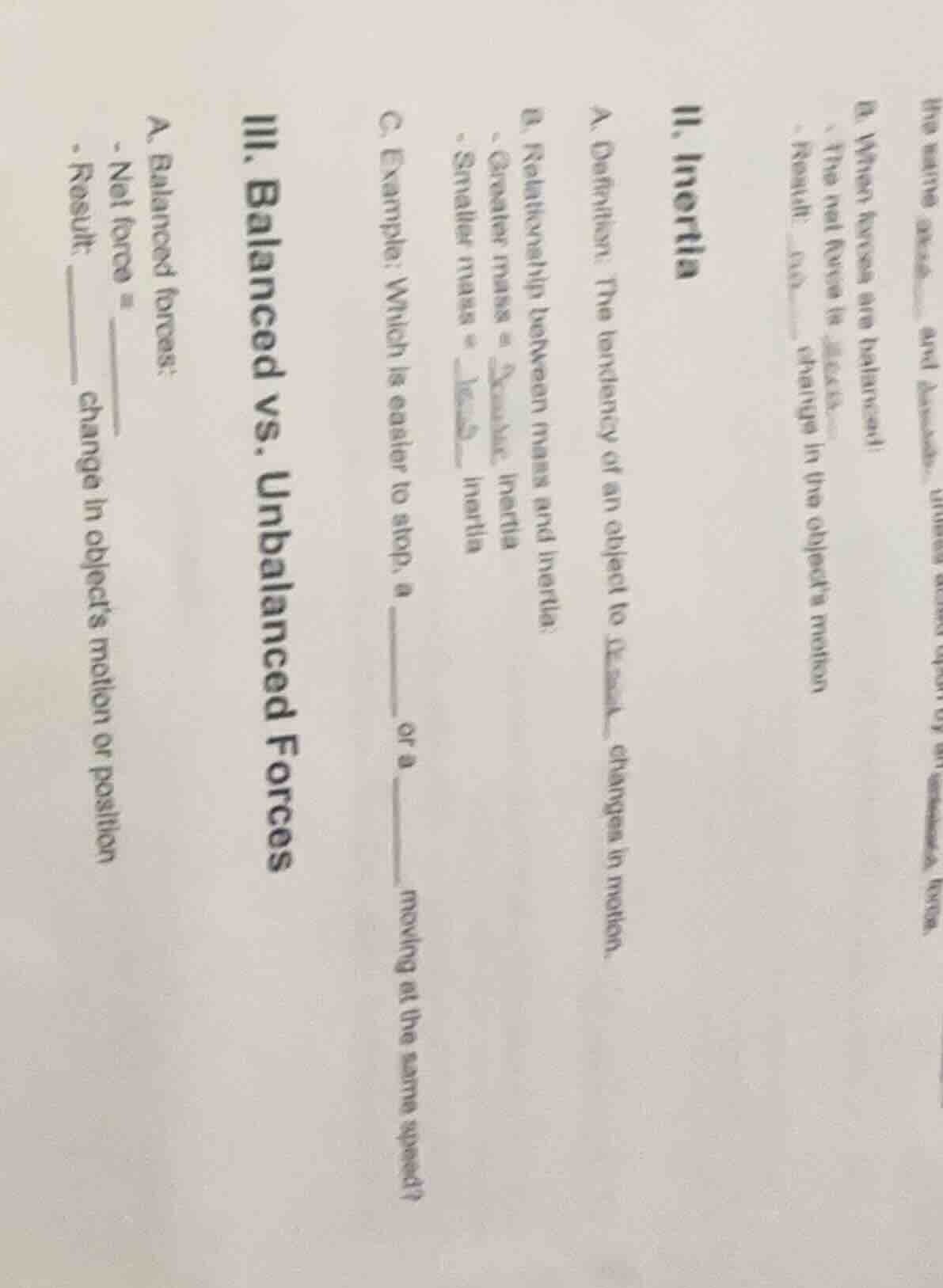
ii. inertia
a. definition: the tendency of an object to _____ changes in motion.
b. relationship between mass and inertia:
- greater mass = _____ inertia
- smaller mass = _____ inertia
c. example: which is easier to stop, a ___ or a ___ moving at the same speed?
iii. balanced vs. unbalanced forces
a. balanced forces:
- net force = _____
- result: _____ change in object’s motion or position
These are fill-in-the-blank questions based on basic physics concepts (Newton's laws, inertia, and balanced/unbalanced forces).
- For Section II (Inertia):
- Inertia is the resistance of any physical object to any change in its velocity.
- Inertia is directly proportional to an object's mass: more mass means more inertia, less mass means less inertia.
- An object with less inertia (smaller mass) is easier to stop at the same speed.
- For Section III (Balanced vs. Unbalanced Forces):
- Balanced forces are equal in magnitude and opposite in direction, so their net force is zero, and they do not change an object's motion.

Snap & solve any problem in the app
Get step-by-step solutions on Sovi AI
Photo-based solutions with guided steps
Explore more problems and detailed explanations
II. Inertia
A. Definition: The tendency of an object to resist changes in motion.
B. Relationship between mass and inertia:
- Greater mass = greater inertia
- Smaller mass = less inertia
C. Example: Which is easier to stop, a small car or a large truck moving at the same speed? (Note: Any pair of objects where the first has smaller mass than the second is acceptable; small car/large truck is a common example)
III. Balanced vs. Unbalanced Forces
A. Balanced forces:
- Net force = $0$
- Result: no change in the object's motion or position