QUESTION IMAGE
Question
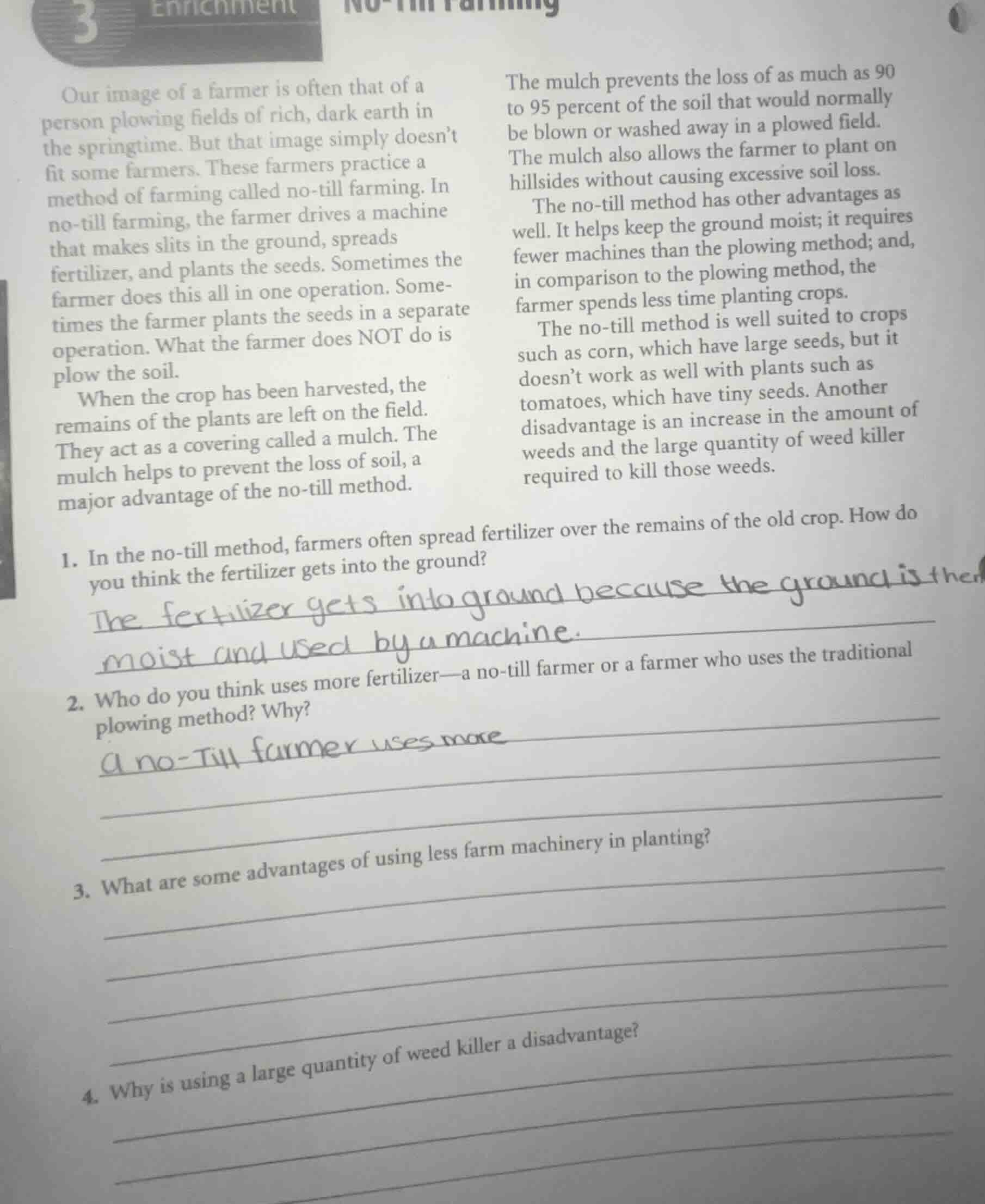
our image of a farmer is often that of a person plowing fields of rich, dark earth in the springtime. but that image simply doesn’t fit some farmers. these farmers practice a method of farming called no - till farming. in no - till farming, the farmer drives a machine that makes slits in the ground, spreads fertilizer, and plants the seeds. sometimes the farmer does this all in one operation. sometimes the farmer plants the seeds in a separate operation. what the farmer does not do is plow the soil.
when the crop has been harvested, the remains of the plants are left on the field. they act as a covering called a mulch. the mulch helps to prevent the loss of soil, a major advantage of the no - till method. the mulch prevents the loss of as much as 90 to 95 percent of the soil that would normally be blown or washed away in a plowed field. the mulch also allows the farmer to plant on hillsides without causing excessive soil loss.
the no - till method has other advantages as well. it helps keep the ground moist; it requires fewer machines than the plowing method; and, in comparison to the plowing method, the farmer spends less time planting crops.
the no - till method is well suited to crops such as corn, which have large seeds, but it doesn’t work as well with plants such as tomatoes, which have tiny seeds. another disadvantage is an increase in the amount of weeds and the large quantity of weed killer required to kill those weeds.
- in the no - till method, farmers often spread fertilizer over the remains of the old crop. how do you think the fertilizer gets into the ground?
- who do you think uses more fertilizer—a no - till farmer or a farmer who uses the traditional plowing method? why?
- what are some advantages of using less farm machinery in planting?
- why is using a large quantity of weed killer a disadvantage?
Question 1
In no - till farming, the ground has slits made by the machine, and the mulch keeps the ground moist. Moisture can help the fertilizer seep into the ground through these slits, and also, natural processes like rain or irrigation (implied by the moist ground) can carry the fertilizer into the soil. Also, the roots of the new plants can take up the fertilizer, and the decomposition of the old crop remains (mulch) can interact with the fertilizer to help it integrate into the soil.
A farmer using the traditional plowing method likely uses more fertilizer. In traditional plowing, when the soil is plowed, it is more exposed. Fertilizer spread on plowed soil is more likely to be lost through processes like evaporation, wind, or water runoff. In no - till farming, the mulch (old crop remains) helps to retain the fertilizer, and the slits in the ground help the fertilizer to be in contact with the soil where plants can access it, reducing the amount of fertilizer needed as less is lost.
Using less farm machinery in planting (as in no - till farming) has several advantages. Financially, it reduces the cost of buying, maintaining, and fueling the machinery. Environmentally, it reduces the amount of fossil fuel consumption, which in turn reduces air pollution. Also, it saves time as there are fewer machines to operate and coordinate, and it reduces soil compaction that can be caused by heavy machinery, which is beneficial for soil health and plant growth.

Snap & solve any problem in the app
Get step-by-step solutions on Sovi AI
Photo-based solutions with guided steps
Explore more problems and detailed explanations
The fertilizer can get into the ground in several ways. The machine used in no - till farming makes slits in the ground, allowing the fertilizer to enter these slits. Also, the mulch (old crop remains) keeps the ground moist, and water (from rain or irrigation) can dissolve the fertilizer and carry it into the soil. Additionally, the roots of the newly planted seeds can absorb the fertilizer, and the decomposition of the mulch can help the fertilizer mix with the soil.