QUESTION IMAGE
Question
imperialism and the punic wars
imperialism is the conquest or domination of one country by another. the romans conquered the entire italian peninsula by 256 bce, including etruscan and greek areas. many greeks made slaves, often became tutors to wealthy children. soon rome expanded into north of sicily, coming into contact with the carthaginians. phoenicians who had established colonies in north africa, southern iberia (spain), and sicily. in the first half of the 3rd century bce, carthage held many territories, making it easy for them to control and dominate the western mediterranean sea region.
first punic war
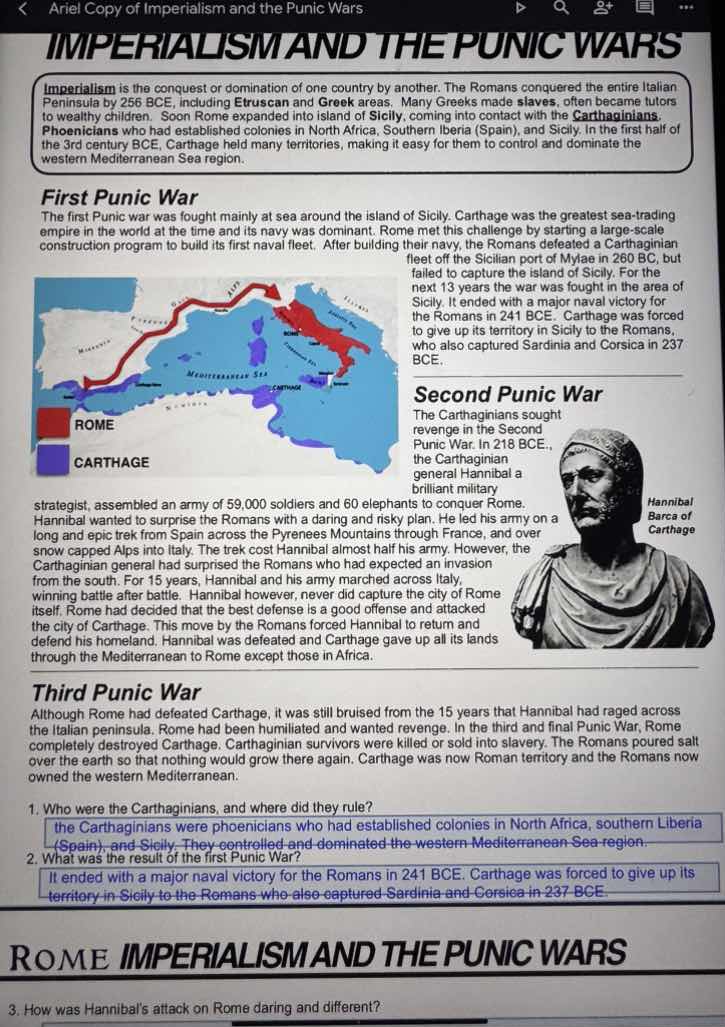
the first punic war was fought mainly at sea around the island of sicily. carthage was the greatest sea - trading empire in the world at the time and its navy was dominant. rome met this challenge by starting a large - scale construction program to build its first naval fleet. after building their navy, the romans defeated a carthaginian fleet off the sicilian port of myae in 260 bc, but failed to capture the island of sicily. for the next 13 years the war was fought in the area of sicily. it ended with a major naval victory for the romans in 241 bce. carthage was forced to give up its territory in sicily to the romans, who also captured sardinia and corsica in 237 bce.
second punic war
the carthaginians sought revenge in the second punic war. in 218 bce, the carthaginian general hannibal a brilliant military strategist, assembled an army of 59,000 soldiers and 60 elephants to conquer rome. hannibal wanted to surprise the romans with a daring and risky plan. he led his army on a long and epic trek from spain across the pyrenees mountains through france, and over snow capped alps into italy. the trek cost hannibal almost half his army. however, the carthaginian general had surprised the romans who had expected an invasion from the south. for 15 years, hannibal and his army marched across italy, winning battle after battle. hannibal however, never did capture the city of rome itself. rome had decided that the best defense is a good offense and attacked the city of carthage. this move by the romans forced hannibal to return and defend his homeland. hannibal was defeated and carthage gave up all its lands through the mediterranean to rome except those in africa.
third punic war
although rome had defeated carthage, it was still bruised from the 15 years that hannibal had raged across the italian peninsula. rome had been humiliated and wanted revenge. in the third and final punic war, rome completely destroyed carthage. carthaginian survivors were killed or sold into slavery. the romans poured salt over the earth so that nothing would grow there again. carthage was now roman territory and the romans now owned the western mediterranean.
- who were the carthaginians, and where did they rule?
- what was the result of the first punic war?
- how was hannibal’s attack on rome daring and different?
To determine how Hannibal’s attack was daring and different, we analyze the text: He led his army on a long, epic trek from Spain across the Pyrenees Mountains, through France, and over snow - capped Alps into Italy. This route was unexpected (Romans expected invasion from the south), and the trek cost almost half his army, showing the risk. Also, he surprised Romans by invading from the north (Alps route) instead of the expected southern approach, and fought for 15 years in Italy without capturing Rome but winning many battles.

Snap & solve any problem in the app
Get step-by-step solutions on Sovi AI
Photo-based solutions with guided steps
Explore more problems and detailed explanations
Hannibal led his army on a long and risky trek from Spain across the Pyrenees Mountains, through France, and over snow - capped Alps into Italy (a route the Romans didn't expect, as they anticipated an invasion from the south). This trek cost almost half his army. He then surprised the Romans by invading from the north (via the Alps) and, for 15 years, his army marched across Italy, winning battle after battle, though he never captured Rome. This approach was daring as it involved a perilous mountain crossing and a surprise invasion route, and different as it deviated from the Romans' expected southern invasion.