QUESTION IMAGE
Question
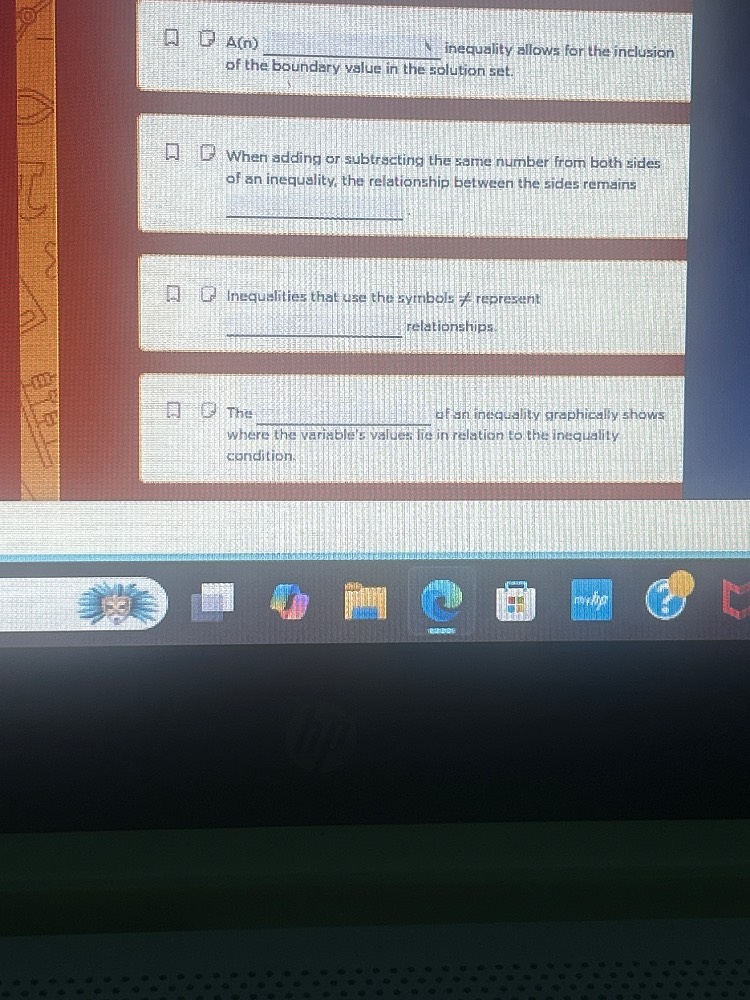
a(n) _______ inequality allows for the inclusion of the boundary value in the solution set.
when adding or subtracting the same number from both sides of an inequality, the relationship between the sides remains _______.
inequalities that use the symbols ≠ represent _______ relationships.
the _______ of an inequality graphically shows where the variables values lie in relation to the inequality condition.
Brief Explanations
- Inequalities with "or equal to" (≤, ≥) include boundary values.
- Adding/subtracting the same number to both sides of an inequality does not change the inequality direction.
- The ≠ symbol denotes values that are not equal, a non-equivalent relationship.
- A graph of an inequality visually represents the valid range of variable values.

Snap & solve any problem in the app
Get step-by-step solutions on Sovi AI
Photo-based solutions with guided steps
Explore more problems and detailed explanations
- A(n) non-strict inequality allows for the inclusion of the boundary value in the solution set.
- When adding or subtracting the same number from both sides of an inequality, the relationship between the sides remains unchanged.
- Inequalities that use the symbols ≠ represent non-equivalent relationships.
- The graph of an inequality graphically shows where the variable's values lie in relation to the inequality condition.