QUESTION IMAGE
Question
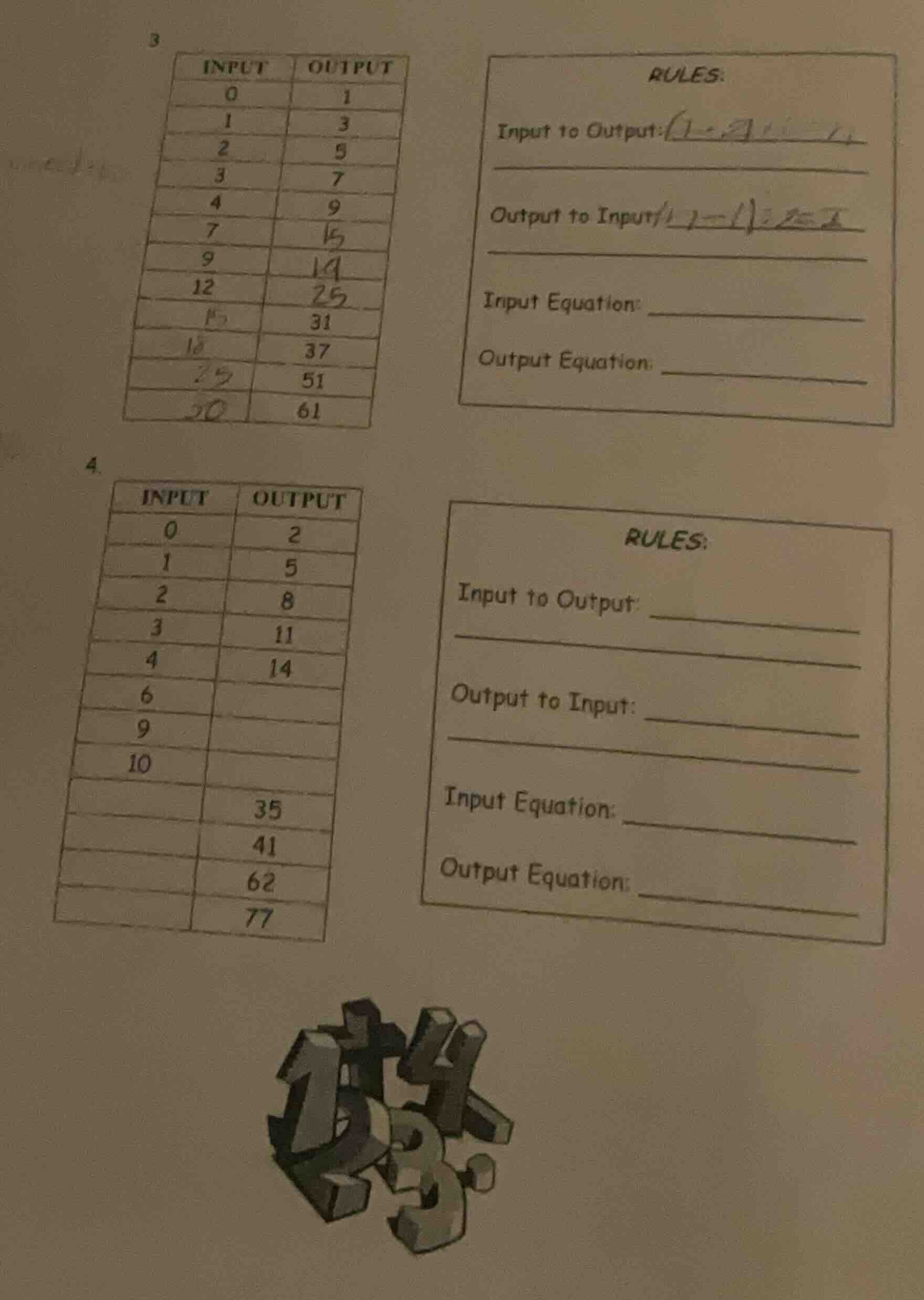
3
input\toutput
0\t1
1\t3
2\t5
3\t7
4\t9
7\t15
9\t19
12\t25
15\t31
18\t37
25\t51
30\t61
rules:
input to output:
output to input:
input equation:
output equation:
4.
input\toutput
0\t2
1\t5
2\t8
3\t11
4\t14
6\t
9\t
10\t
\t35
\t41
\t62
\t77
rules:
input to output:
output to input:
input equation:
output equation:
Problem 3
Step1: Identify the pattern
Looking at the input (let's call it \( x \)) and output (let's call it \( y \)) values:
- When \( x = 0 \), \( y = 1 \)
- When \( x = 1 \), \( y = 3 \)
- When \( x = 2 \), \( y = 5 \)
- The difference between consecutive outputs is \( 2 \), so it's a linear pattern. The slope \( m \) is \( 2 \) (since \( 3 - 1 = 2 \), \( 5 - 3 = 2 \), etc.). Using the point - slope form \( y - y_1=m(x - x_1) \), with \( (x_1,y_1)=(0,1) \), we get \( y=2x + 1 \).
Step2: Input to Output rule
To get the output from the input, we multiply the input by \( 2 \) and add \( 1 \). So the rule is: Output = \( 2\times \text{Input}+1 \)
Step3: Output to Input rule
Starting from \( y = 2x+1 \), we solve for \( x \). Subtract \( 1 \) from both sides: \( y - 1=2x \), then divide by \( 2 \): \( x=\frac{y - 1}{2} \). So the rule is: Input=\( \frac{\text{Output}-1}{2} \)
Step4: Input and Output Equations
The input - output relationship is linear. The output equation (relating input \( x \) to output \( y \)) is \( y = 2x+1 \). The input equation (if we consider output \( y \) as the independent variable) is \( x=\frac{y - 1}{2} \) or \( x=\frac{y}{2}-\frac{1}{2} \)
Problem 4
Step1: Identify the pattern
Looking at the input ( \( x \)) and output ( \( y \)) values:
- When \( x = 0 \), \( y = 2 \)
- When \( x = 1 \), \( y = 5 \)
- When \( x = 2 \), \( y = 8 \)
- The difference between consecutive outputs is \( 3 \), so the slope \( m = 3 \). Using the point - slope form \( y - y_1=m(x - x_1) \) with \( (x_1,y_1)=(0,2) \), we get \( y=3x + 2 \)
Step2: Input to Output rule
To get the output from the input, we multiply the input by \( 3 \) and add \( 2 \). So the rule is: Output=\( 3\times \text{Input}+2 \)
Step3: Output to Input rule
Starting from \( y = 3x + 2 \), we solve for \( x \). Subtract \( 2 \) from both sides: \( y - 2=3x \), then divide by \( 3 \): \( x=\frac{y - 2}{3} \). So the rule is: Input=\( \frac{\text{Output}-2}{3} \)
Step4: Input and Output Equations
The output equation (relating input \( x \) to output \( y \)) is \( y = 3x+2 \). The input equation (if we consider output \( y \) as the independent variable) is \( x=\frac{y - 2}{3} \) or \( x=\frac{y}{3}-\frac{2}{3} \)
Step5: Fill in the missing values
- For \( x = 6 \): \( y=3\times6 + 2=20 \)
- For \( x = 9 \): \( y=3\times9+2 = 29 \)
- For \( x = 10 \): \( y=3\times10 + 2=32 \)
- For \( y = 35 \): \( x=\frac{35 - 2}{3}=\frac{33}{3}=11 \)
- For \( y = 41 \): \( x=\frac{41 - 2}{3}=\frac{39}{3}=13 \)
- For \( y = 62 \): \( x=\frac{62 - 2}{3}=\frac{60}{3}=20 \)
- For \( y = 77 \): \( x=\frac{77 - 2}{3}=\frac{75}{3}=25 \)

Snap & solve any problem in the app
Get step-by-step solutions on Sovi AI
Photo-based solutions with guided steps
Explore more problems and detailed explanations
s:
Problem 3
- Input to Output: Output = \( 2\times \text{Input}+1 \)
- Output to Input: Input=\( \frac{\text{Output}-1}{2} \)
- Input Equation: \( x=\frac{y - 1}{2} \) (where \( y \) is output, \( x \) is input)
- Output Equation: \( y = 2x+1 \) (where \( x \) is input, \( y \) is output)
Problem 4
- Input to Output: Output=\( 3\times \text{Input}+2 \)
- Output to Input: Input=\( \frac{\text{Output}-2}{3} \)
- Input Equation: \( x=\frac{y - 2}{3} \) (where \( y \) is output, \( x \) is input)
- Output Equation: \( y = 3x+2 \) (where \( x \) is input, \( y \) is output)
- Missing values:
- For \( x = 6 \), Output = \( 20 \)
- For \( x = 9 \), Output = \( 29 \)
- For \( x = 10 \), Output = \( 32 \)
- For \( y = 35 \), Input = \( 11 \)
- For \( y = 41 \), Input = \( 13 \)
- For \( y = 62 \), Input = \( 20 \)
- For \( y = 77 \), Input = \( 25 \)