QUESTION IMAGE
Question
instructions
choose the answer that best fits each statement below.
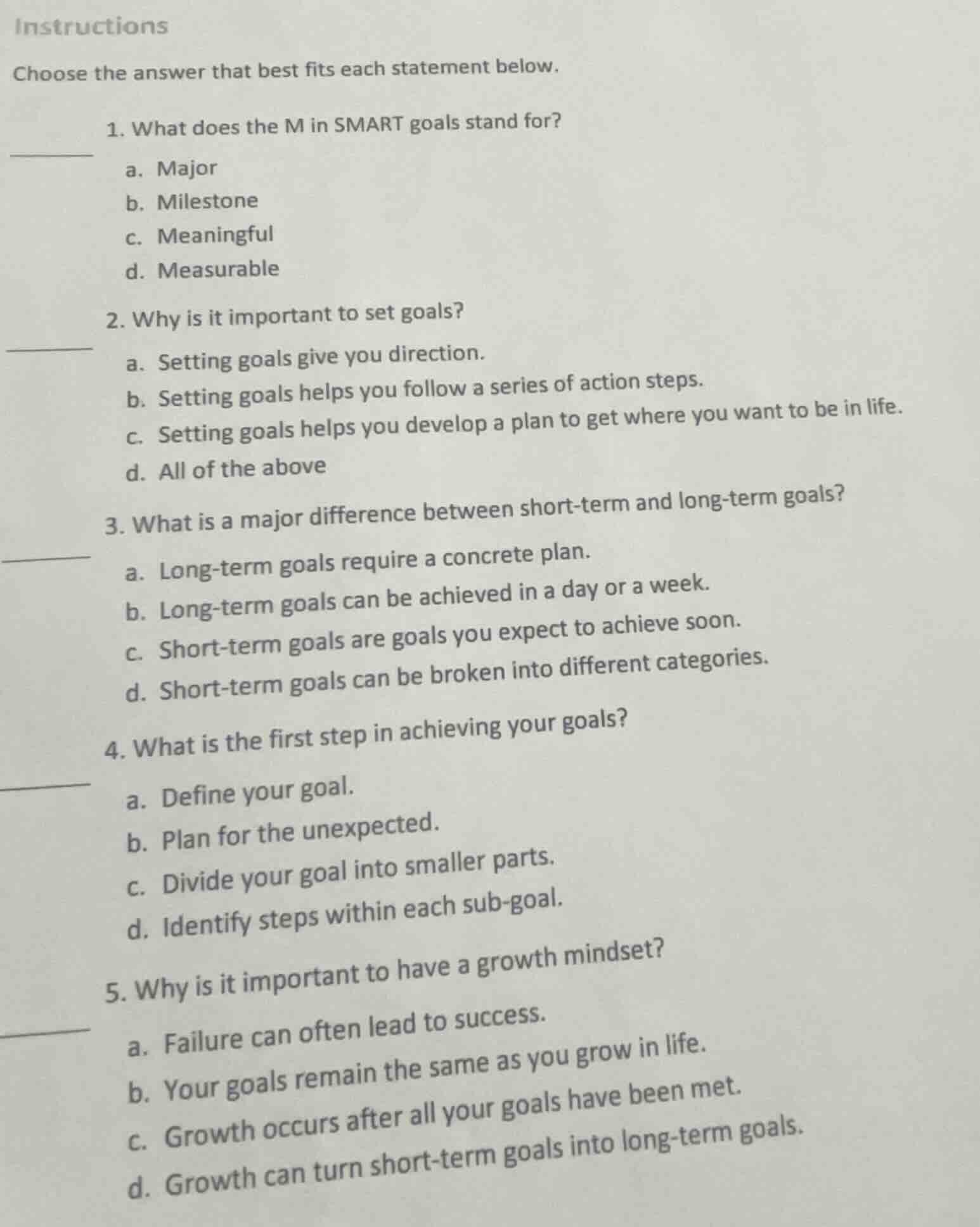
- what does the m in smart goals stand for?
a. major
b. milestone
c. meaningful
d. measurable
- why is it important to set goals?
a. setting goals give you direction.
b. setting goals helps you follow a series of action steps.
c. setting goals helps you develop a plan to get where you want to be in life.
d. all of the above
- what is a major difference between short - term and long - term goals?
a. long - term goals require a concrete plan.
b. long - term goals can be achieved in a day or a week.
c. short - term goals are goals you expect to achieve soon.
d. short - term goals can be broken into different categories.
- what is the first step in achieving your goals?
a. define your goal.
b. plan for the unexpected.
c. divide your goal into smaller parts.
d. identify steps within each sub - goal.
- why is it important to have a growth mindset?
a. failure can often lead to success.
b. your goals remain the same as you grow in life.
c. growth occurs after all your goals have been met.
d. growth can turn short - term goals into long - term goals.
- SMART goals are defined as Specific, Measurable, Achievable, Relevant, Time-bound, so M stands for Measurable.
- Setting goals provides direction, guides action steps, and helps create life plans, so all options are correct.
- Short-term goals are intended for near-future achievement, while long-term goals take longer; this is the core difference.
- Before any planning or breaking down goals, you must first clearly define the goal you want to achieve.
- A growth mindset frames failure as a learning opportunity that can lead to future success, which is its key benefit.

Snap & solve any problem in the app
Get step-by-step solutions on Sovi AI
Photo-based solutions with guided steps
Explore more problems and detailed explanations
- d. Measurable
- d. All of the above
- c. Short-term goals are goals you expect to achieve soon.
- a. Define your goal.
- a. Failure can often lead to success.