QUESTION IMAGE
Question
instructions
read the question carefully and select the best answer.
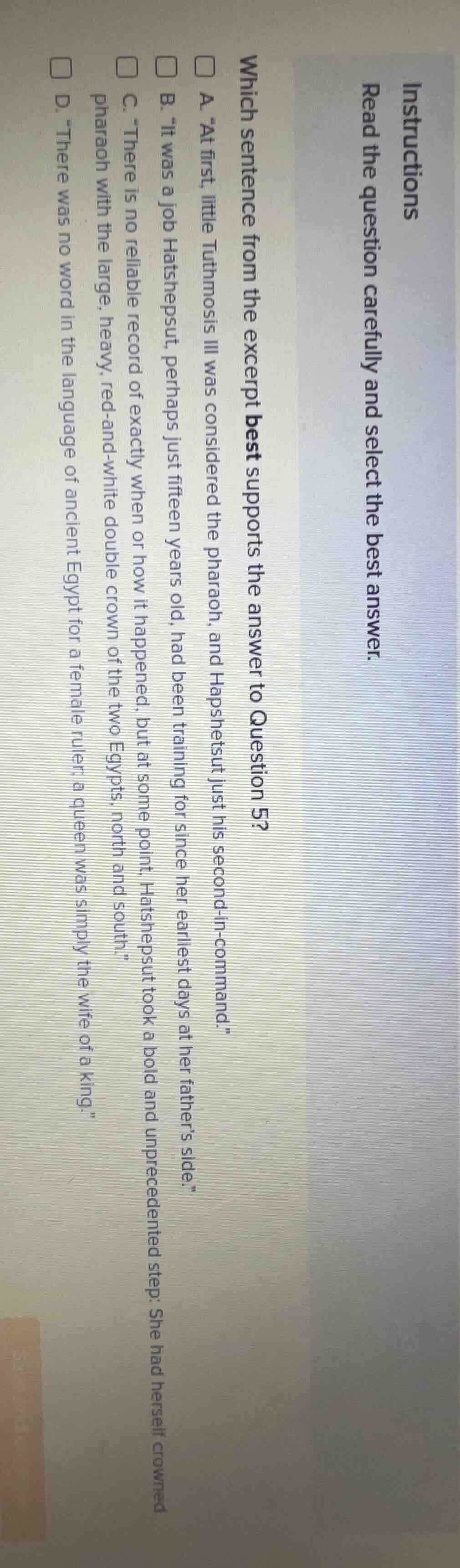
which sentence from the excerpt best supports the answer to question 5?
a. “at first, little tuthmosis iii was considered the pharaoh, and hapshetsut just his second - in - command.”
b. “it was a job hatshepsut, perhaps just fifteen years old, had been training for since her earliest days at her father’s side.”
c. “there is no reliable record of exactly when or how it happened, but at some point, hatshepsut took a bold and unprecedented step: she had herself crowned pharaoh with the large, heavy, red - and - white double crown of the two egypts, north and south.”
d. “there was no word in the language of ancient egypt for a female ruler: a queen was simply the wife of a king.”
To solve this, we need to analyze each option to see which one best supports the answer to Question 5 (though Question 5's prompt isn't shown, we can infer the context is about female rulers in ancient Egypt or Hatshepsut's role).
- Option A talks about Tuthmosis III and Hapshetsut's initial roles, not directly about female rule or a key supporting detail for a question likely about Hatshepsut as a female ruler.
- Option B focuses on Hatshepsut's training, not on the unique aspect of her rule or the lack of a female ruler term.
- Option C describes her crowning with the pharaoh's crown, showing her taking on the pharaoh's role, but if the question is about the absence of a term for female ruler, this is less relevant.
- Option D states there was no word for a female ruler in ancient Egyptian language ("a queen was simply the wife of a king"), which would directly support a question about the challenges or uniqueness of Hatshepsut's rule as a female (since there was no term for a female ruler, her taking the pharaoh's role was unprecedented).
Option D explains that ancient Egyptian language had no term for a female ruler (a queen was just a king’s wife), which likely supports a question about Hatshepsut’s unique role as a female ruler. Other options focus on roles/training (A, B) or her crowning (C), not the linguistic absence of a female ruler term.

Snap & solve any problem in the app
Get step-by-step solutions on Sovi AI
Photo-based solutions with guided steps
Explore more problems and detailed explanations
D. "There was no word in the language of ancient Egypt for a female ruler: a queen was simply the wife of a king."