QUESTION IMAGE
Question
instructions
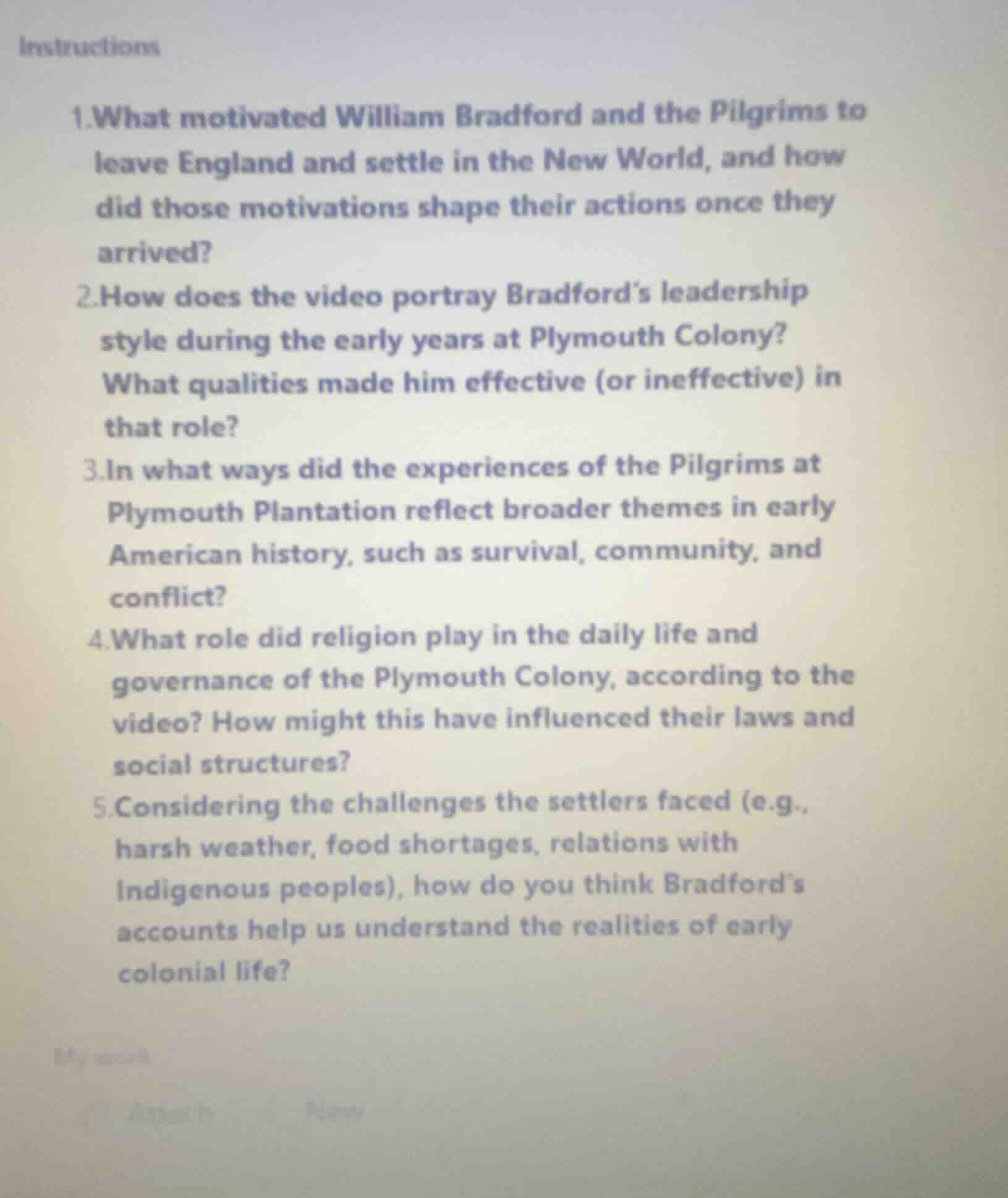
- what motivated william bradford and the pilgrims to leave england and settle in the new world, and how did those motivations shape their actions once they arrived?
- how does the video portray bradford’s leadership style during the early years at plymouth colony? what qualities made him effective (or ineffective) in that role?
- in what ways did the experiences of the pilgrims at plymouth plantation reflect broader themes in early american history, such as survival, community, and conflict?
- what role did religion play in the daily life and governance of the plymouth colony, according to the video? how might this have influenced their laws and social structures?
- considering the challenges the settlers faced (e.g., harsh weather, food shortages, relations with indigenous peoples), how do you think bradford’s accounts help us understand the realities of early colonial life?
Brief Explanations
- For question 1: The Pilgrims, including William Bradford, faced religious persecution in England as Separatists barred from practicing their faith freely. Economic struggles also pushed them to seek opportunity. Once in the New World, their religious motivation led them to build a community centered on their beliefs, while their drive for survival made them adapt to the land and form alliances with Indigenous groups.
- For question 2: Most portrayals frame Bradford as a pragmatic, empathetic, and steady leader. His effective qualities include resilience during crises, willingness to collaborate (like with Squanto), and commitment to the colony's collective survival, which helped stabilize Plymouth through harsh early years.
- For question 3: Their struggle for survival mirrors the broader early colonial experience of adapting to unfamiliar, harsh environments. Their tight-knit community built around shared faith and mutual aid reflects the communal bonds many early colonies relied on. Conflicts with some Indigenous groups and tensions over resources also echo the broader pattern of colonial-Indigenous friction in early American history.
- For question 4: Religion was the foundation of daily life and governance; laws were tied to Puritan religious principles, and social structures were organized around church membership. This meant moral and religious adherence was enforced, shaping a homogeneous, community-focused society where religious leaders held significant influence.
- For question 5: Bradford's first-hand accounts offer a detailed, personal view of the extreme hardships (starvation, cold, disease) and the complex dynamics with Indigenous peoples. They provide insight into the decision-making of colonial leaders and the psychological and practical realities of building a colony from scratch, filling gaps in our understanding of early colonial life.

Snap & solve any problem in the app
Get step-by-step solutions on Sovi AI
Photo-based solutions with guided steps
Explore more problems and detailed explanations
- The Pilgrims left England to escape religious persecution and seek economic opportunity. These motivations led them to build a faith-centered community and adapt to the New World via Indigenous alliances for survival.
- Bradford is portrayed as a steady, pragmatic leader. His empathy, resilience, and collaborative spirit made him effective at stabilizing Plymouth.
- Their survival struggles, communal bonds, and colonial-Indigenous conflicts mirror core early American historical themes.
- Religion was the core of daily life and governance, shaping laws around Puritan principles and creating a faith-based social hierarchy.
- Bradford's accounts offer first-hand, detailed insight into the extreme hardships, Indigenous relations, and leadership decisions that defined early colonial life.