QUESTION IMAGE
Question
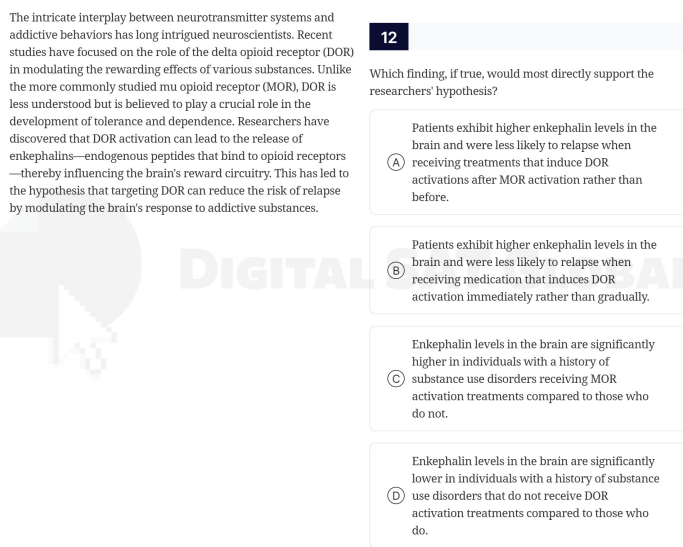
the intricate interplay between neurotransmitter systems and addictive behaviors has long intrigued neuroscientists. recent studies have focused on the role of the delta opioid receptor (dor) in modulating the rewarding effects of various substances. unlike the more commonly studied mu opioid receptor (mor), dor is less understood but is believed to play a crucial role in the development of tolerance and dependence. researchers have discovered that dor activation can lead to the release of enkephalins—endogenous peptides that bind to opioid receptors —thereby influencing the brain’s reward circuitry. this has led to the hypothesis that targeting dor can reduce the risk of relapse by modulating the brain’s response to addictive substances. 12 which finding, if true, would most directly support the researchers’ hypothesis? a patients exhibit higher enkephalin levels in the brain and were less likely to relapse when receiving treatments that induce dor activations after mor activation rather than before. b patients exhibit higher enkephalin levels in the brain and were less likely to relapse when receiving medication that induces dor activation immediately rather than gradually. c enkephalin levels in the brain are significantly higher in individuals with a history of substance use disorders receiving mor activation treatments compared to those who do not. d enkephalin levels in the brain are significantly lower in individuals with a history of substance use disorders that do not receive dor activation treatments compared to those who do.
The researchers' hypothesis is that targeting DOR reduces relapse risk by modulating the brain's response to addictive substances, with DOR activation leading to enkephalin release. Option A directly links DOR activation (treatment) to higher enkephalin levels and reduced relapse, which supports the causal chain of the hypothesis. Other options either compare unrelated groups (C, D) or focus on treatment timing (B) rather than the core link between DOR activation, enkephalins, and relapse.

Snap & solve any problem in the app
Get step-by-step solutions on Sovi AI
Photo-based solutions with guided steps
Explore more problems and detailed explanations
A. Patients exhibit higher enkephalin levels in the brain and were less likely to relapse when receiving treatments that induce DOR activation rather than before.